
Google Ads can be one of the most effective ways to generate leads and sales because it reaches people while they are actively searching, comparing options or preparing to buy. However, it can also waste money remarkably quickly when the account is built around the wrong objective.
The most expensive Google Ads mistakes are no longer limited to choosing the wrong keyword or writing a weak advert. Modern Google Ads uses automation across targeting, bidding, creative selection and campaign delivery. If the data and strategic inputs are poor, automation can scale the wrong traffic and the wrong conversions faster than a person could.
The platform can predict which auctions are more likely to produce the outcome it has been given. It cannot independently determine whether a lead was genuine, whether the sales team could close it, whether the sale was profitable or whether the customer was right for the business.
This means successful Google Ads management depends on three connected foundations:
Targeting and control: reaching suitable demand while excluding traffic the business does not want.
The advert, offer and landing page: persuading the right person to take the next step.
Measurement and AI optimisation: giving Google reliable signals that reflect valuable business outcomes.
The mistakes below damage one or more of these foundations. Some create obvious wasted spend. Others make the account look successful while quietly reducing lead quality, revenue or profit.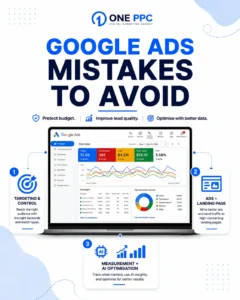
1. Starting Without a Clear Commercial Objective
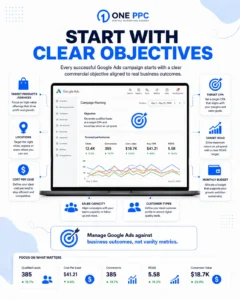
A campaign objective such as “get more leads” is too vague. Google Ads needs to operate within commercial constraints that the business understands.
Before launching or restructuring an account, define:
The products, services, locations and customer types to prioritise.
The acceptable cost per initial lead, Qualified Lead, customer or sale.
The target return on advertising spend where revenue is measured.
Average order value, gross margin, sales conversion rate and customer lifetime value.
The monthly budget and the operational capacity to fulfil additional demand.
Suppose an initial enquiry costs £40. That figure means little in isolation. If one campaign converts 30% of its leads into customers while another converts 5%, their true customer-acquisition costs are very different.
Google Ads should therefore be managed against the business outcome—not simply the metric that is easiest to see in the platform.
2. Launching Before Conversion Tracking Is Reliable
Inaccurate conversion tracking is usually the most damaging Google Ads mistake because it corrupts both reporting and automated bidding.
Common problems include:
Forms that are not tracked.
Conversions firing when a page loads rather than after a genuine submission.
The same enquiry being counted by several tags.
Purchase values, currencies or transaction IDs being incorrect.
Telephone calls being missed or double-counted.
Third-party booking forms and embedded tools not being measured.
Consent or tag configuration preventing events from recording as intended.
Imported CRM conversions failing without anyone noticing.
Test every important conversion from the advert interaction through to the final system of record. For lead generation, compare Google Ads with the CRM or enquiry database. For ecommerce, reconcile orders and revenue with the shopping platform.
Our complete Google Ads conversion-tracking guide explains the main implementation routes for website, telephone, purchase and imported conversions.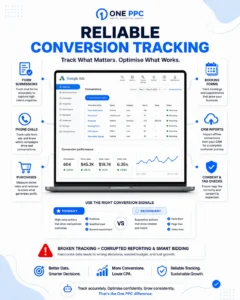
3. Using the Wrong Conversions for Bidding
Tracking an event does not automatically mean Google should optimise towards it.
Advertisers often treat low-value actions as if they were commercially equivalent to a lead or sale. Examples include:
Page views.
Scroll depth.
Time on site.
Telephone-button clicks.
Newsletter registrations.
Brochure downloads.
Live-chat openings rather than completed conversations.
Google Ads distinguishes between primary and secondary conversion actions. Primary actions can be used for bidding and included in the main Conversions column when the campaign is using the associated goal. Secondary actions normally remain observational within All conversions. Custom goals add an important qualification because they can use actions that would otherwise be secondary.
The correct setup is therefore not simply “make sales primary and everything else secondary”. Check:
Which conversion actions are being recorded.
Whether each action is primary or secondary.
Which account-default or campaign-specific goals each campaign actually uses.
Whether any custom goals override the expected behaviour.
Micro-conversions can still help diagnose the customer journey, but they should not casually compete with Qualified Leads, purchases or revenue for bidding influence. See our guide to primary and secondary Google Ads conversions and Google’s current explanation of primary and secondary conversion actions.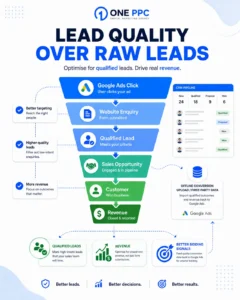
4. Optimising Lead Generation Towards Every Form Submission
A website form confirms that somebody submitted data. It does not confirm that the person was genuine, contactable, eligible, within the service area or likely to buy.
When Google receives only initial lead data, Smart Bidding learns which users are likely to complete the form. This can increase apparent conversion volume while attracting spam, job seekers, existing customers, unserviceable locations or enquiries for work the company does not provide.
A stronger lead-generation measurement sequence is:
Google Ads interaction → Website enquiry → Qualified Lead → Sales Opportunity → Customer → Revenue
These downstream events are usually recorded in a CRM. Sending selected outcomes back to Google Ads allows reporting to move beyond cost per lead towards:
Cost per Qualified Lead.
Cost per Sales Opportunity.
Customer-acquisition cost.
Revenue.
Return on advertising spend.
Offline conversion tracking for Google Ads does not replace website tracking. It completes the measurement journey by showing what happened after the enquiry entered the sales process.
Where suitable, Enhanced Conversions for Leads can use consented first-party customer information and available click identifiers to improve the matching of imported outcomes. If the business uses a sales pipeline, integrating Google Ads with the CRM is one of the most valuable improvements it can make.
5. Measuring Revenue but Ignoring Profit
This mistake is particularly common in ecommerce. A campaign can produce an attractive ROAS while prioritising products with weak margins, high return rates or expensive fulfilment.
Revenue is not profit. Review:
Product margin.
Delivery and fulfilment costs.
Returns, cancellations and refunds.
New-customer acquisition versus existing-customer revenue.
Repeat purchase rate and customer lifetime value.
Differences between the values reported by Google Ads and the commerce platform.
For lead generation, the same principle applies. A service may generate higher revenue but consume substantially more labour or have a lower close rate. Where conversion values reflect meaningful differences in customer or product value, value-based bidding can be more useful than treating every conversion as equal.
6. Treating Google Ads AI as Fully Autonomous
Google’s machine learning can evaluate far more auction-time signals than a person could process manually. It can adjust bids, predict conversion probability, interpret wider search intent, assemble Responsive Search Ad combinations and distribute activity across Google inventory.
However, it still needs human direction.
Google does not know:
Which services have the best margin.
Which leads the sales team rejects.
Whether a sudden conversion increase is spam.
Whether the company has capacity in a particular location.
Whether a low-cost customer creates excessive support work.
Whether brand visibility, legal wording or market positioning must be protected.
The mistake is not using automation. The mistake is giving it broad freedom before measurement, exclusions, goals and commercial constraints are ready.
The strongest approach combines AI’s ability to optimise auctions with human control over strategy, data quality, market context and acceptable risk. Our guide to training Google Ads AI explains this relationship in more detail.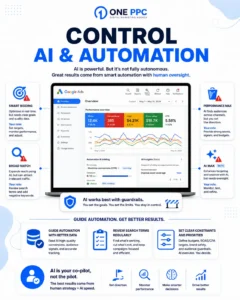
7. Using Broad Match Before the Account Is Ready
Broad Match can discover valuable demand that tighter match types miss. It can also expose a limited budget to a very wide interpretation of relevance.
Broad Match becomes more defensible when the account has:
Accurate conversion tracking.
Meaningful conversion volume.
A suitable Smart Bidding strategy.
Strong negative-keyword control.
Enough budget to test and learn.
Qualified-lead, customer or revenue feedback where possible.
For a new or modest-budget lead-generation campaign, Exact and Phrase Match usually provide a more controlled starting point. Broad Match can then be tested against that foundation and judged on qualified outcomes—not merely clicks or additional form submissions.
Modern match types are degrees of interpretation rather than literal rules. Exact Match is not always word-for-word exact, while Phrase Match can reach searches with the same meaning. Our Google Ads keyword match-type guide and Broad Match guide for service companies explain when each approach is appropriate.
8. Neglecting the Search Terms Report
Keywords are targeting instructions. Search terms are the queries people actually entered.
Failing to review search terms means the advertiser cannot see whether Google’s interpretation of relevance matches the business. This is increasingly important as match types, AI Max, Shopping and Performance Max use broader semantic and automated targeting.
The Google Ads Search Terms Report can reveal:
Irrelevant searches that require negative keywords.
Valuable queries worth targeting more deliberately.
Employment, training, support or research traffic.
Locations the business does not serve.
Brand traffic appearing in non-brand campaigns.
Search intent that requires a different advert or landing page.
Product-feed weaknesses affecting Shopping traffic.
Google does not show every individual query in the standard report. Search Terms Insights can provide aggregated themes and additional context. Use both views, then compare the apparent conversions with lead quality or revenue.
9. Building Negative Keywords Carelessly
Negative keywords are essential, but an over-aggressive exclusion can block valuable demand as easily as a missing negative can waste money.
Common errors include:
Adding one broad negative without checking the valuable searches it may contain.
Assuming negative keywords cover close variants exactly like positive keywords.
Failing to include relevant singulars, plurals, synonyms or spelling variants.
Applying an exclusion at account level when it belongs in one campaign.
Blocking research terms that play a legitimate role in a longer buying journey.
Maintaining huge inherited lists that nobody has recently reviewed.
Use the narrowest safe match type and apply the exclusion at the correct level: ad group, campaign, shared list or account. The purpose is to remove commercially unsuitable intent, not to force every useful search into an exact keyword. See our negative-keyword guide for a structured approach.
10. Structuring the Account Too Tightly—or Too Loosely
Excessive fragmentation divides budgets and conversion data across too many campaigns and ad groups. Excessive consolidation combines unrelated services, locations, margins and intentions until performance becomes difficult to interpret.
An ad group should normally contain keywords that can be answered convincingly by the same advert and landing page. A campaign boundary is justified when an area requires a different:
Budget.
Bidding strategy or target.
Location or schedule.
Conversion goal.
Campaign type.
Commercial priority.
Reporting or governance treatment.
There is no correct universal number of keywords per ad group. Avoid excessive single-keyword ad groups when several closely related terms share the same intention and message. Equally, do not place every service in one generic group simply to consolidate data.
The objective is a structure that supports both learning and meaningful control. Read our guide to building an effective Google Ads account structure.
11. Accepting Default Campaign Settings Without Review
Several campaign settings can materially change who sees the adverts and where they appear.
Check at least the following:
Locations: Decide whether to target people physically in the selected locations or also people who have shown an interest in them. For many local lead-generation campaigns, presence-based targeting provides tighter initial control.
Networks: Evaluate Google Search Partners separately. They can add useful volume, but traffic quality and reporting can differ from Google Search. Retain them when they produce suitable leads or profitable sales, not merely because they were enabled by default.
Display expansion: Do not allow a Search campaign to become an undefined mixture of high-intent Search and wider Display traffic.
Languages: Ensure the selected languages align with the audience and landing-page experience.
Schedules: Confirm that ads, call assets and lead handling operate when the business can respond effectively.
Final URLs: Check that the destination is correct, live, mobile-friendly and able to preserve tracking parameters.
The right setting depends on the business. The mistake is allowing setup defaults to make strategic decisions silently.
12. Choosing a Bid Strategy That Does Not Match the Evidence
Automated bidding is powerful, but every strategy needs the right objective and sufficient reliable feedback.
Common bidding mistakes include:
Moving to Target CPA or Target ROAS before the campaign has enough stable conversion evidence.
Using Maximise Conversions without understanding that it will try to spend the available budget to maximise conversion volume.
Setting an unrealistically restrictive CPA or ROAS target that suppresses delivery.
Changing targets repeatedly before conversion lag has passed.
Using automated bidding to compensate for poor search targeting or weak conversion tracking.
Treating every lead or product as equally valuable.
As a practical planning guideline for lead generation, around 15 conversions per campaign per month may be a minimum starting point for target-based bidding, while 30–50 or more provides a stronger learning signal. These are not guarantees or universal platform rules; required volume varies with market complexity, data consistency, conversion delay and campaign design.
For value-based strategies and Performance Max, more volume is normally preferable—particularly where conversion values vary widely. Review our full guide to Google Ads bidding strategies before changing the optimisation method.
13. Changing Bids, Budgets and Structure Too Frequently
Some accounts are “optimised” so often that no decision is given enough time to produce reliable evidence.
Frequent changes can create several problems:
Conversion lag makes recent performance look worse than it will eventually be.
Several simultaneous changes make cause and effect impossible to separate.
Large budget or target changes can destabilise delivery.
Short-term volatility is mistaken for a lasting trend.
Low-volume campaigns are judged from one or two conversions.
Review accounts frequently enough to catch tracking failures, overspend, disapprovals and obviously irrelevant traffic. However, make strategic changes only when the evidence justifies them.
Record the hypothesis, date, expected effect and review point for every material change. Where traffic allows, Google Ads campaign experiments provide a cleaner way to compare bidding, match-type, creative or landing-page approaches.
14. Blindly Applying Google Recommendations
The Recommendations section can reveal useful opportunities and genuine setup problems. It is not an independent business strategy.
Recommendations may encourage advertisers to:
Increase budgets.
Add Broad Match keywords.
change bid strategies.
Adopt automated creative or targeting features.
Remove “redundant” keywords.
Enable auto-apply categories.
Each suggestion should be judged against the campaign objective, available evidence, lead quality, margin, budget, capacity and loss of control. Dismiss a recommendation when it does not support the commercial strategy.
The optimisation score is not a profit score. Increasing it can coincide with improved performance, but it can also reflect the adoption of features that increase Google’s reach or spend. Review auto-apply settings regularly and only permit categories that the advertiser has deliberately approved. Our Google Ads Recommendations guide explains how to assess these suggestions safely.
15. Mixing Brand and Non-Brand Performance
Brand campaigns reach people already searching for the company or its products. They often achieve high click-through rates, low CPAs and strong ROAS because much of the demand already exists.
When brand and non-brand traffic are blended, the account can appear more efficient than its acquisition activity really is. This makes it difficult to answer:
How much new demand Google Ads is capturing.
What a new customer costs.
Whether Performance Max is reporting incremental sales or harvesting brand searches.
Whether another channel originally created the demand.
Separate brand and non-brand performance wherever the distinction affects budget, bidding, reporting or incrementality. Use brand exclusions and appropriate negative keywords to control overlap in Performance Max and other automated campaigns.
Brand campaigns are not automatically unnecessary. They may protect visibility, control the message, support promotions and defend against competitors. The mistake is allowing brand results to disguise the economics of non-brand acquisition.
16. Relying on Performance Max as the Entire Strategy
Performance Max can reach Search, Shopping, YouTube, Display, Discover, Gmail and Maps through one campaign. Its broad reach is useful, but it is not automatically the best starting point for every advertiser.
For lead-generation businesses, risks can include:
Optimisation towards low-quality or spam leads.
Brand and non-brand demand being blended.
Insufficient conversion volume.
Weak creative assets.
URL expansion sending traffic to unsuitable pages.
Limited clarity about which channel or query produced value.
Performance Max should be given a defined role alongside controlled Search, Shopping or other campaign types. Apply brand controls, URL exclusions, suitable audience signals, strong creative, accurate conversion goals and CRM feedback. Review the available search-term and channel reporting rather than treating the campaign as a black box.
Our guide to Performance Max for lead-generation companies explains when the campaign type is suitable and how to control the main risks.
17. Enabling AI Max Without a Clear Testing Plan
AI Max can expand how Search campaigns match queries and use creative or landing-page information. That can uncover incremental demand, but it can also reduce control if the website contains broad content, legacy services or pages intended for audiences the campaign should not target.
Before enabling AI Max:
Confirm the campaign has reliable conversion and lead-quality data.
Review landing pages and URL exclusions.
Protect brand and strategically important query categories.
Establish a comparison period or experiment.
Define success using qualified conversions, customers or revenue.
Monitor search terms, landing pages and change history.
Do not judge the feature merely by whether it creates more conversions. Judge whether it adds profitable demand that the existing strategy would otherwise have missed. Read our practical guide to AI Max for Search campaigns.
18. Writing Repetitive Responsive Search Ads
Responsive Search Ads allow Google to assemble combinations from the supplied headlines and descriptions. Repeating the same keyword in every asset gives the system little meaningful variety to test.
A strong asset set should cover different customer questions:
What is the product or service?
Who is it for?
What problem does it solve?
Why should the customer choose this company?
What evidence or reassurance supports the claim?
What should the person do next?
Common creative mistakes include generic claims, weak calls to action, unsupported superlatives, no meaningful differentiation and a mismatch between the advert and landing page.
Use pinning when wording must appear in a particular position for legal, brand or communication reasons. Avoid excessive pinning merely to force one static advert, because it reduces the combinations Google can test.
Ad Strength can highlight asset diversity and completeness, but it is not a business KPI. Evaluate advert quality using search relevance, click-through rate, conversion rate, qualified outcomes and profit. See our Google Ads copywriting guide for a fuller framework.
19. Sending Every Click to the Home Page
The landing page must fulfil the promise made by the search and advert. A generic home page often asks the visitor to find the relevant service again, weakening message match and adding friction.
A suitable Google Ads landing page should normally include:
A headline aligned with the search intent and advert.
A clear explanation of the offer.
Benefits and meaningful differentiators.
Evidence such as reviews, case studies, accreditations or guarantees.
A clear next step.
A short and usable form, booking flow or purchase path.
Fast, stable mobile performance.
Clear contact and privacy information.
Improving a landing-page conversion rate from 4% to 6% creates 50% more conversions from the same number of clicks. That improvement can be more valuable than chasing a small reduction in CPC.
Check the complete journey, including confirmation pages, telephone links, embedded forms, payment steps and tracking parameters. A strong campaign cannot compensate indefinitely for a weak offer or broken conversion path.
20. Treating Quality Score as the Main Objective
Quality Score is a keyword-level diagnostic based on expected click-through rate, advert relevance and landing-page experience. It can identify where the relationship between keyword, advert and landing page may require investigation.
However, the visible 1–10 score is not the business objective and should not be treated as the auction formula. Ad Rank considers auction-time quality, the bid, thresholds, competition, search context and the expected effect of assets and formats.
A high-Quality Score keyword can still generate unsuitable leads. A commercially important keyword with a lower score may still be profitable.
Use Quality Score to ask better questions:
Does the advert genuinely address the search intent?
Is the landing page the most relevant destination?
Is the keyword grouped with unrelated themes?
Is the offer less compelling than competing alternatives?
Never damage conversion quality or commercial coverage merely to improve the visible score. Our Google Ads Quality Score guide explains the distinction between the diagnostic metric and auction-time quality.
21. Ignoring Impression Share and Auction Coverage
Conversion metrics describe the traffic received. Impression-share metrics help explain how much eligible demand the campaign missed and why.
Useful Search metrics include:
Search Lost Impression Share (budget).
Search Lost Impression Share (rank).
Search Top Impression Share.
Search Absolute Top Impression Share.
Search Exact Match Impression Share.
If a profitable campaign loses significant impression share because of budget, it may have room to scale. If it loses because of rank, investigate bidding, relevance, expected impact of assets, competition and landing-page quality.
Do not assume that more visibility is always desirable. A low impression share across wide Broad Match traffic may be less important than strong coverage of the most valuable exact search demand. Combine impression-share analysis with search terms, lead quality and profitability. Read our Google Search Impression Share guide.
22. Failing to Track Telephone Calls Properly
For many local and service-based businesses, telephone calls are among the highest-intent conversions. Tracking only forms can undervalue the campaigns, adverts and keywords that encourage people to call.
Google Ads can measure several different telephone interactions:
Calls made directly from adverts.
Calls made from a website using Google forwarding numbers.
Clicks on telephone links.
Imported calls or downstream outcomes from a CRM or call-tracking platform.
These are not equivalent. A click on a telephone button does not prove that a call connected. A website call conversion can confirm that the call occurred and met a selected duration threshold. An imported CRM outcome can go further by showing that the call became a Qualified Lead, booking, sale or revenue.
Avoid counting the same call through both Google’s native website call conversion and a third-party call-tracking platform. A practical structure may use a genuine completed call as primary and the telephone-button click as secondary. Our guide to tracking telephone calls from Google Ads explains the options and duplication risks.
23. Allocating Budget Evenly Instead of Commercially
Equal budgets rarely reflect equal opportunity. Some campaigns serve higher-intent demand, stronger-margin products, more valuable locations or services with better sales capacity.
Budget decisions should consider:
Qualified conversions, customers and revenue.
CPA, customer-acquisition cost and ROAS.
Margin and lifetime value.
Impression share lost to budget.
Search demand and seasonality.
Sales capacity and stock availability.
The strategic importance of testing a new area.
Protect proven high-intent activity before spreading a limited budget across every possible campaign type. At the same time, do not starve a promising test before it has enough data to be assessed fairly.
Budget is not only a spending cap. It controls which opportunities the system is allowed to pursue and how quickly it can learn.
24. Reporting Vanity Metrics Instead of Business Results
Clicks, impressions, click-through rate, CPC and platform conversions can help diagnose performance. They do not prove commercial success.
A useful Google Ads report should connect activity with the outcome relevant to the business:
Lead generation: enquiries, Qualified Leads, opportunities, customers, revenue and acquisition cost.
Ecommerce: orders, revenue, margin, new customers, returns and profit.
Appointments: bookings, attendance, treatment or service revenue and repeat value.
Telephone-led businesses: connected calls, qualified calls, booked jobs and sales.
Segment brand and non-brand activity. Explain material changes and their likely causes. Include conversion lag and sales-cycle context. Most importantly, state what decision should follow from the evidence.
A dashboard that reports attractive numbers without revealing lead quality, revenue or profit can reinforce the wrong strategy.
25. Failing to Maintain the Account
Google Ads is not a set-and-forget platform. Markets, competitors, search behaviour, website content, prices and Google’s own systems change.
A sensible maintenance rhythm normally includes:
Frequent risk checks: abnormal spend, disapprovals, billing, broken tracking and campaigns that stopped serving.
Weekly optimisation: search terms, negatives, budgets, bidding, lead quality, adverts, landing pages and network or location performance.
Monthly strategy reviews: commercial results, experiments, campaign mix, capacity, seasonality and budget allocation.
Quarterly audits: measurement, structure, settings, exclusions, conversion goals, automation, landing pages and the next testing roadmap.
The frequency should reflect spend, risk and conversion volume. High-spend or promotional accounts need closer monitoring; low-volume B2B accounts need longer evaluation periods. Our Google Ads optimisation checklist provides a complete recurring routine.
A Practical Google Ads Mistake Checklist
Before increasing spend, confirm that:
The campaign has a clear commercial objective.
Primary conversions represent meaningful outcomes.
Campaign goals use the intended conversion actions.
Forms, calls, bookings and purchases have been tested end to end.
Lead quality or sales data is available outside Google Ads.
Search terms and negative keywords are reviewed regularly.
Match types reflect the maturity of the account.
Locations, networks, schedules and URLs have been checked.
The bid strategy matches the quality and volume of available data.
Brand and non-brand performance are visible separately.
Performance Max and AI Max have defined roles and controls.
Adverts answer the searcher’s need and explain why the business is different.
Landing pages match the advert and work properly on mobile.
Budget is weighted towards commercial opportunity.
Reports connect advertising with customers, revenue or profit.
Material changes are recorded and allowed sufficient time to mature.
If several of these checks fail, increasing the budget or adopting more automation is unlikely to solve the underlying problem. It will usually scale it.
Conclusion
The worst Google Ads mistakes are rarely isolated button-clicking errors. They are failures to connect targeting, measurement, bidding and the customer journey with the economics of the business.
Google’s AI can improve performance when it receives accurate conversion signals, clear goals, sufficient evidence and sensible constraints. When those foundations are missing, the same automation can expand irrelevant traffic, prioritise low-quality leads and make weak results appear successful.
The objective is not to reject automation or attempt to control every auction manually. It is to decide what the business values, measure it correctly, give Google the strongest possible data and retain human oversight over the decisions the platform cannot make.
A well-managed account operates as a continuous improvement system:
Measure → diagnose → prioritise → test → learn → scale
That discipline protects the budget in the short term and creates a stronger acquisition system over time.