
Facebook Lead Ads can make it remarkably easy for someone to enquire about a product or service. Instead of clicking an advert, waiting for a website to load and completing a conventional landing-page form, the prospect can submit their details through an Instant Form within Facebook or Instagram.
This reduced friction can generate a high volume of leads at a relatively low cost. However, making a form easier to complete does not automatically make the resulting leads more valuable.
Some Instant Form campaigns produce genuine sales opportunities. Others generate incorrect telephone numbers, accidental submissions, people who do not remember enquiring or prospects who were never eligible for the service. The difference is rarely explained by the form alone. It usually reflects the complete system surrounding it:
The offer and advert
Audience and location controls
Form type and qualifying questions
CRM integration
Speed and quality of follow-up
Conversion tracking
Feedback from qualified leads and sales
A successful Facebook Lead Ads strategy must therefore balance conversion volume with lead quality. The real objective is not to obtain the cheapest possible form submission. It is to acquire qualified prospects and customers at a commercially sustainable cost.
This guide explains how Meta lead generation campaigns currently work, how to create effective Instant Forms and how to connect advertising with your CRM and sales process.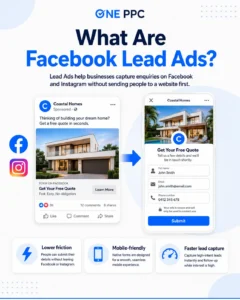
What Are Facebook Lead Ads?
Facebook Lead Ads are adverts created under Meta’s Leads campaign objective. They allow businesses to generate enquiries across Facebook, Instagram and other eligible Meta placements.
Although the terms “Facebook Lead Ads” and “Facebook Lead Forms” remain widely used, Meta now supports several different lead-generation routes. Depending on the account, market and campaign configuration, the conversion location may include:
| Conversion location | What happens after the advert is clicked | Common use case |
|---|---|---|
| Instant Forms | A native form opens within Facebook or Instagram | Quotes, consultations, downloads and general enquiries |
| Website | The prospect visits a landing page and completes a website form | Complex services, detailed applications and higher-consideration offers |
| Messenger | A conversation begins in Messenger | Guided qualification and conversational lead capture |
| A conversation begins through Instagram Direct | Brands with an active Instagram audience | |
| The prospect starts a WhatsApp conversation | Rapid, mobile-first enquiries where available | |
| Calls | The advert encourages the prospect to telephone the business | Urgent services and telephone-led sales |
| App | The conversion takes place inside an eligible app | App-based lead-generation journeys |
Meta’s lead-generation overview explains the principal form, messaging and calling options. Availability and interface labels can vary, so advertisers should check the controls shown in their own Ads Manager account rather than relying on an old tutorial.
How Do Facebook Instant Forms Work?
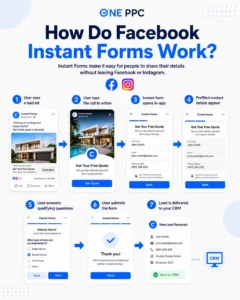
An Instant Form opens inside the Meta platform when someone responds to an advert. Meta may pre-populate fields such as the person’s name, email address and telephone number using information associated with their account.
This reduces typing and can improve the completion rate, particularly on mobile devices. The advertiser can also add custom questions to understand the prospect’s requirements.
A form can include elements such as:
An introductory message
Images or other rich content
Contact fields
Multiple-choice questions
Short-answer questions
Conditional questions
A privacy-policy link
Additional notices or consent wording
A completion screen and next-step button
The lead can then be delivered to Meta Business Suite, downloaded manually or transferred automatically into a CRM or lead-management platform.
This makes Instant Forms particularly useful when a company’s website is slow, difficult to use on mobile or poorly optimised for conversions. However, convenience is also their main weakness: a person can submit a pre-filled form without fully considering the offer.
The form, advert and follow-up process must add enough useful friction to establish intent without creating unnecessary barriers.
Instant Forms Versus Website Forms
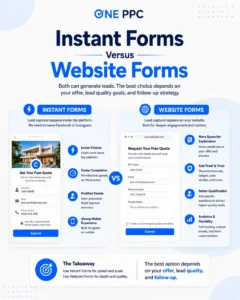
Instant Forms are not automatically better than website forms, and website forms are not automatically higher quality. The best conversion location depends on the offer, audience, website, sales process and measurement setup.
Advantages of Instant Forms
Instant Forms can:
Load quickly within Facebook and Instagram
Reduce mobile landing-page friction
Pre-populate common contact details
Produce useful volume for testing
Support custom and conditional questions
Work without a sophisticated website
Connect directly to many CRM systems
Be effective for simple, clearly explained offers
They are often suitable for quotation requests, consultations, brochure downloads, local services, property enquiries, event registrations and other actions that do not require a complex purchasing journey.
Limitations of Instant Forms
Instant Forms can also:
Generate low-intent or accidental submissions
Capture outdated account contact details
Give the advertiser less space to explain a complex proposition
Reduce the prospect’s exposure to website content and proof
Produce leads who do not remember the business
Increase sales workload if qualification and routing are weak
Look successful when judged only by cost per lead
A low cost per lead can become expensive once uncontactable, ineligible and unqualified enquiries are removed.
Advantages of Website Forms
A website landing page provides more room for:
Detailed service explanations
Testimonials, reviews and case studies
Eligibility information
Pricing or indicative costs
Interactive calculators
Appointment calendars
Product comparisons
More flexible analytics and experimentation
The extra effort required to visit a website and complete a form can also filter out some low-intent users. However, this only helps when the page is relevant, persuasive and technically sound. A slow or confusing landing page merely wastes otherwise valuable demand.
The strongest approach is often to test both routes using the same commercial definition of success. Meta may also offer a combined website and Instant Form conversion location in eligible configurations, but this should be evaluated carefully because mixed destinations can make lead-quality analysis less transparent.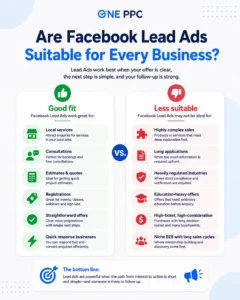
Are Facebook Lead Ads Suitable for Every Business?
Lead ads can work across many industries, but they are not universally appropriate.
They are usually strongest when:
The service can be understood quickly
The offer provides a clear reason to enquire
A lead has meaningful potential value
The target audience uses Facebook or Instagram
The business can respond promptly
Eligibility can be established with a few questions
A CRM can record and manage the resulting enquiries
Enough budget and sales volume exist to evaluate quality
They may be less suitable when:
The purchase requires extensive education before an enquiry
Qualification requires a lengthy or regulated application
The offer is vague or undifferentiated
The sales team cannot respond reliably
The geographic service area is extremely restricted
The value of a lead is too low to justify manual follow-up
The business cannot identify which leads become customers
For complex professional or B2B services, an Instant Form may still work as the first step in a longer process. The form should not attempt to replace the complete sales conversation. It should capture the minimum information needed to identify a plausible prospect and route them to the correct next action.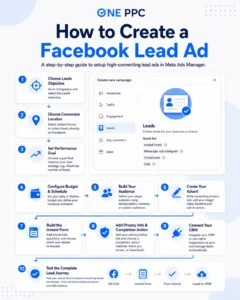
How to Create a Facebook Lead Ad
The precise Ads Manager interface changes regularly, but the underlying setup follows a consistent structure.
1. Select the Leads Objective
Create a campaign in Meta Ads Manager and select Leads as the objective.
The old awareness, consideration and conversion objective structure no longer applies. The current objective describes the business result Meta should attempt to generate.
Before proceeding, define what the business means by a lead. A newsletter subscriber, quotation request, booked consultation and qualified sales opportunity are not interchangeable outcomes.
Our guide to Meta campaign objectives explains how the selected objective influences delivery.
2. Choose the Conversion Location
At the ad-set level, select where the lead action should occur. For a conventional Facebook Lead Ad, this will normally be Instant Forms.
Other options may include a website, Messenger, Instagram, WhatsApp, calls or an app. Select the route that matches the way customers prefer to contact the business and the way the sales team can respond.
Do not choose Instant Forms merely because they often produce the lowest reported CPL. Compare the cost of valid leads, qualified opportunities and customers.
3. Select the Performance Goal
Meta may provide performance goals such as maximising the number of leads or maximising the number of qualified leads.
Maximising lead volume tells Meta to find people most likely to complete the selected lead action. It does not inherently tell the system which submissions are commercially valuable.
Qualified-lead optimisation requires suitable CRM integration and sufficient downstream outcome data. Meta’s guidance confirms that its qualified-lead performance goal uses CRM information supplied through the Conversions API.
This is potentially valuable, but it is not a substitute for accurate sales data. If qualification is inconsistent or CRM stages are poorly maintained, the system receives a misleading definition of success.
4. Configure the Budget, Schedule and Bidding
Select a daily or lifetime budget that can generate enough conversion data to evaluate the campaign. An extremely fragmented structure—with many audiences, adverts and ad sets sharing a small budget—can make it difficult to learn what is working.
Meta’s automated bidding normally seeks the greatest number of results available within the budget and selected optimisation goal. Advertisers should still assess:
Cost per valid lead
Cost per qualified lead
Customer acquisition cost
Lead-to-sale rate
Revenue and return on advertising spend
Campaign controls, bid strategies and automated recommendations should be tested against commercial results rather than accepted solely because Meta recommends them.
5. Build the Audience
The campaign may use:
Broad targeting
Advantage+ audience
Relevant interests and demographics
Customer or qualified-lead Lookalike Audiences
Website and engagement Custom Audiences
CRM-based remarketing lists
Audience automation has become more prominent, but targeting still requires judgement. Location, minimum age, exclusions and other non-negotiable restrictions should be checked carefully. Under Advantage+ audience, some inputs can act as suggestions rather than absolute restrictions.
Our Facebook Ads targeting guide explains the distinction between audience controls and suggestions. For first-party acquisition strategies, see our guides to Facebook Lookalike Audiences and Facebook remarketing.
6. Create the Advert
The advert should qualify the prospect before the form opens.
Communicate:
What is being offered
Who it is for
The principal benefit
Any important eligibility requirements
The location served
Indicative pricing where appropriate
What happens after submission
Why the company is credible
A vague advert may attract more clicks, but it can also transfer the qualification burden to the sales team. If the service is only available to homeowners, companies of a certain size or people within a particular location, say so before asking for contact details.
Use a format that suits the proposition. Static images can communicate a straightforward offer quickly, while video can explain a more complex service. Carousel adverts can present several services, benefits or examples.
The strongest creative is not necessarily the advert with the highest click-through rate. It is the one that helps produce the right commercial outcome.
7. Build the Instant Form
Create a new form or select an existing form that accurately reflects the current campaign.
Meta currently documents form types including More Volume, Higher Intent and Rich Creative, although the options available can vary. Meta also supports features such as conditional logic, and some accounts can use telephone-number verification. Review the current Instant Form options in Meta’s documentation and confirm what is available in the account.
Avoid reusing one generic form across unrelated services merely for convenience. Each form should match the promise made by the advert.
8. Add the Privacy Information and Completion Action
Include a valid link to the company’s privacy notice and explain how the submitted information will be used.
The completion screen should confirm that the form has been received and set a clear expectation for what happens next. It can also encourage the prospect to:
Visit a relevant website page
Book an appointment
Telephone the business
Start a conversation
Download the promised resource
Review supporting information
Do not finish with a vague “thank you” if there is a useful next action the prospect can take immediately.
9. Connect the Form to the CRM
A lead that remains inside Meta until somebody manually downloads a spreadsheet is at risk of being contacted too late.
Connect the Instant Form to the CRM before launching the campaign. Start by assessing the CRM’s native Meta integration. If it does not provide the required functionality, evaluate supported Meta partners, Zapier, Make or a custom API implementation.
The integration should ideally:
Create or update the correct contact
Retain the Meta lead ID
Store campaign, ad set, advert and form information
Map answers into appropriate CRM fields
Record consent and the source of that consent
Assign the correct salesperson
Create an opportunity where appropriate
Trigger immediate notifications and follow-up
Prevent or manage duplicate records
Return qualified-lead and sales outcomes to Meta
Our Facebook Ads CRM integration guide compares native, partner, no-code and API approaches.
10. Test the Complete Lead Journey
Do not test only whether the form opens.
Submit a controlled test lead and confirm that:
The advert opens the intended form
Every field works
Conditional questions follow the correct route
The privacy-policy link is valid
The completion action works
The lead reaches the correct CRM account
Values are mapped into the intended fields
The source and campaign data are retained
The lead owner is assigned
Notifications and workflows start
Duplicate handling works
Sales outcomes can be returned to Meta
Testing the customer-facing form without testing the CRM and follow-up process leaves most of the system unverified.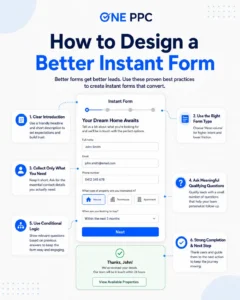
How to Design a Better Instant Form
The best form is not necessarily the shortest form. It is the shortest form that captures enough information to identify, route and follow up a plausible prospect.
Use a Clear Introduction
Restate the offer and explain what the prospect will receive. This helps prevent people from submitting based only on an ambiguous headline or image.
For example:
Request your free initial assessment. Complete the short form and a member of our team will telephone you within one working day to discuss your requirements and confirm whether the service is suitable.
This tells the prospect what is being offered, what action is required and what will happen next.
Select the Appropriate Form Type
A More Volume form prioritises ease of completion. It may suit low-risk offers, content downloads and early-stage campaigns where scale is required.
A Higher Intent form introduces an additional review step before submission. This can reduce some accidental or poorly considered enquiries, although it does not guarantee lead quality.
Rich Creative forms can provide more context within the form itself. They may help explain a more involved proposition without immediately sending the user to a website.
The most appropriate form type should be established through downstream results, not assumed from the name of the setting.
Ask for the Contact Details You Will Actually Use
If the sales team follows up by telephone, collect a telephone number. If the prospect will receive a document by email, collect an email address.
Do not request information merely because the field is available. Every additional field creates friction and increases the amount of personal data the company must manage.
Pre-filled information should also be treated cautiously. People do not always keep their Facebook account details current. Where available and appropriate, telephone-number verification may help reduce incorrect details, but it will not resolve every quality problem.
Add a Small Number of Meaningful Qualifying Questions
Good questions help determine fit, urgency, value or routing.
Examples include:
Which service are you interested in?
Where is the property located?
When would you like the work completed?
What is the approximate project budget?
Are you the property owner?
How many employees does your company have?
Which system are you currently using?
What is the main problem you want to solve?
Multiple-choice questions are usually easier to answer and analyse than open-text questions. They also produce cleaner CRM data for automation and reporting.
Open-text fields can reveal valuable context, but they require more effort and can be difficult to standardise. Use them when the answer genuinely affects the next step.
Avoid asking prospects to provide unnecessarily sensitive information. If a regulated or high-risk service requires detailed personal data, a secure website or specialist application process may be more appropriate.
Use Conditional Logic Where It Improves the Journey
Conditional logic can show different questions or outcomes based on a previous answer.
For example:
A residential prospect can receive household-specific questions.
A commercial prospect can be asked about company size.
Someone outside the service area can be directed to an alternative completion message.
Different services can trigger different qualification paths.
Conditional logic should make the form more relevant, not turn it into an exhausting questionnaire.
Create a Strong Completion Screen
The final screen is part of the conversion journey.
Set expectations clearly:
“We will telephone you within one working day.”
“Book your consultation using the calendar below.”
“Call now if your request is urgent.”
“Check your email to download the guide.”
“Visit the service page to review pricing and examples.”
This can convert a passive form submission into an appointment, call or more informed sales conversation.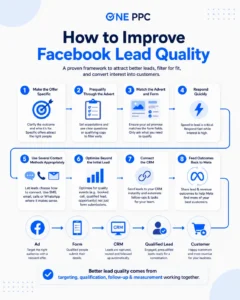
How to Improve Facebook Lead Quality
Lead quality problems should be diagnosed systematically. Adding more questions is only one possible solution.
Make the Offer Specific
“Find out more” is rarely a compelling proposition. Use an offer that explains the exchange of value:
Request a quotation
Book an initial consultation
Arrange an eligibility assessment
Download a buyer’s guide
Receive a personalised estimate
Request a product demonstration
Check availability in your area
Be careful with broad giveaways and competitions. They can generate large numbers of leads from people interested in the incentive rather than the underlying service.
Prequalify Through the Advert
Mention significant restrictions before the form opens.
If the service starts at a particular price, operates only in selected regions or requires a minimum contract size, hiding that information may reduce the reported CPL while damaging sales efficiency.
The advert should attract suitable prospects and discourage clearly unsuitable ones.
Match the Advert and Form
The form headline, introduction, questions and completion message should continue the same promise made by the advert.
A mismatch can cause confusion, abandonment and poor-quality submissions. It can also make it difficult for the prospect to remember why the business is contacting them.
Respond Quickly
Lead intent decays. A prospect who has submitted several forms may speak to the first credible company that responds.
Automate the initial acknowledgement and internal notification, but do not mistake automation for a complete sales process. A personalised human response is often essential for higher-value services.
The CRM should record:
Time of submission
Time of first response
Number of contact attempts
Contact outcome
Qualification result
Appointment status
Opportunity stage
Final revenue
This makes it possible to distinguish an advertising problem from a follow-up problem.
Use Several Contact Methods Appropriately
Depending on consent, customer expectations and applicable regulations, follow-up might include:
A telephone call
Email confirmation
SMS acknowledgement
Appointment reminders
Messenger or WhatsApp
CRM-based nurture sequences
Remarketing
The first message should refer to the specific enquiry. Generic follow-up can make a legitimate lead feel as though it has entered an unrelated marketing database.
Optimise Beyond the Initial Lead
If Meta receives only the form submission, it can learn which users tend to submit forms. It cannot automatically know which submissions became qualified opportunities or customers.
Connect the CRM and return meaningful lifecycle events through an appropriate Conversions API integration. Possible stages include:
Lead received
Contact established
Qualified lead
Appointment booked
Appointment attended
Sales opportunity
Customer
Revenue received
The deepest event is not always the best initial optimisation event. A closed sale may be commercially meaningful but too infrequent or delayed to provide a useful campaign signal. A consistently defined qualified lead or attended appointment may provide more frequent feedback while later sales and revenue are retained for measurement.
Our guides to improving Facebook Ads lead quality and Facebook offline conversion tracking explain this feedback loop in more detail.
How to Measure Facebook Lead Ads Properly
Cost per lead is useful, but it is only the beginning of the analysis.
A practical lead-generation scorecard should include:
| Metric | What it reveals |
|---|---|
| Form completion rate | How effectively the form converts people who open it |
| Cost per lead | The cost of each recorded submission |
| Valid lead rate | The proportion with usable, genuine information |
| Contact rate | The proportion the sales team successfully reaches |
| Qualified lead rate | The proportion meeting the agreed sales criteria |
| Cost per qualified lead | Media cost divided by qualified leads |
| Appointment-booking rate | The proportion progressing to a meeting |
| Appointment attendance rate | The proportion that actually attends |
| Opportunity rate | The proportion entering an active sales process |
| Customer conversion rate | The proportion becoming customers |
| Customer acquisition cost | Advertising cost divided by acquired customers |
| Revenue per lead | Revenue divided by initial leads |
| Return on ad spend | Tracked revenue relative to advertising spend |
Consider two campaigns:
Campaign A produces 100 leads at £15 each, but only 10 become qualified.
Campaign B produces 60 leads at £22 each, but 24 become qualified.
Campaign A has the cheaper headline CPL. However, its cost per qualified lead is £150, compared with £55 for Campaign B. Campaign B is commercially stronger before customer conversion or revenue is even considered.
Allow for sales-cycle delay when comparing recent campaigns. Leads generated this week may not have had enough time to qualify or purchase. Use cohort reporting so that campaigns are compared after a similar maturation period.
A Practical Testing Framework
Avoid changing multiple major variables simultaneously. Use structured tests that answer commercially relevant questions.
Test Instant Forms Against Website Forms
Compare:
Lead volume
Valid lead rate
Contact rate
Qualified lead rate
Cost per qualified lead
Customer acquisition cost
Revenue
A website form may produce fewer but stronger leads. An Instant Form may produce sufficient additional volume to compensate for a lower qualification rate. The correct answer depends on final economics.
Test Form Type
Compare More Volume and Higher Intent forms using the same offer and similar audience conditions. Do not assume the higher-intent label will always improve commercial results.
Test Qualification Depth
Compare a short form with a moderately qualified form. Measure whether the additional questions improve sales efficiency enough to justify any reduction in volume.
Test Offers and Creative Angles
Test different reasons to enquire, such as:
Consultation versus quotation
Assessment versus downloadable guide
Speed versus expertise
Price transparency versus premium quality
Problem-focused versus outcome-focused messaging
The lead magnet or offer often influences quality more strongly than small changes to form formatting.
Test Audience Strategies
Where sufficient budget is available, compare relevant strategies such as:
Broad or Advantage+ audiences
Interest-based audiences
Qualified-lead Lookalikes
Customer Lookalikes
Website remarketing
Engagement remarketing
Judge each test using qualified and revenue-based outcomes. A Lookalike Audience based on every lead may reproduce low-quality behaviour. A source based on qualified leads or customers can be more commercially relevant, provided sufficient reliable data exist.
Privacy, Consent and Data Protection
A privacy-policy link should not be treated as a box-ticking exercise.
UK advertisers must consider the UK GDPR, the Privacy and Electronic Communications Regulations and any sector-specific requirements. The Information Commissioner’s Office guidance states that organisations collecting information for direct marketing must be clear about what they intend to do with it and provide understandable privacy information when the details are collected.
The form and privacy information should explain:
Which organisation is collecting the data
Why the information is required
How it will be used
Whether it will be shared
How long it may be retained
How the person can exercise their rights
How to contact the organisation
An enquiry about a service is not automatically blanket consent for every future marketing channel. Where electronic marketing consent is required, it should be specific, informed and clearly distinguishable from the service enquiry.
Avoid preselected consent assumptions and retain evidence of what the prospect saw and agreed to. Obtain professional legal advice for regulated sectors, sensitive personal data or uncertain use cases.
Common Facebook Lead Ads Mistakes
Optimising Only for Cheap Leads
A low CPL can conceal poor contact rates, low qualification and weak sales. Use downstream CRM outcomes.
Using a Generic Form for Every Campaign
The form should reflect the exact service, audience and offer. Generic forms create ambiguous data and weaker customer experiences.
Asking Too Few Questions
Name, email and telephone number may maximise volume but provide no evidence of eligibility or intent.
Asking Too Many Questions
A long application can suppress useful demand. Ask only for information that affects qualification, routing or follow-up.
Hiding Important Conditions
Concealing prices, geographic limits or eligibility rules may increase form submissions while wasting sales time.
Relying on Manual Lead Downloads
Manual processes introduce delays and missed enquiries. Connect the form to the CRM and monitor the integration.
Failing to Test the Workflow
A published form is not proof that field mapping, attribution, notifications and automation work correctly.
Treating Every Lead as Equal
A downloadable-guide lead, quotation request and booked consultation have different intent. Report and nurture them separately.
Sending Poor CRM Data Back to Meta
Inconsistent qualification corrupts the feedback loop. Define each lifecycle stage before integrating it with Meta.
Accepting Every Automated Recommendation
Meta’s automation can be useful, but its primary interface metrics do not understand every business constraint. Test recommendations against customer acquisition cost, revenue and profitability.
Frequently Asked Questions About Facebook Lead Ads
Are Facebook Lead Ads the Same as Instant Forms?
Not exactly. “Lead ads” can refer broadly to campaigns using Meta’s Leads objective. Instant Forms are one possible conversion location within that objective. Lead campaigns can also direct people to websites, calls or conversations.
Are Facebook Lead Ads Better Than Landing Pages?
Neither option is universally better. Instant Forms usually reduce friction, while landing pages provide more space for education, proof and qualification. Test both using qualified-lead and customer outcomes.
Why Are My Facebook Leads Poor Quality?
Common causes include an overly broad offer, unclear advertising, weak location controls, too little qualification, inaccurate pre-filled details, slow follow-up and optimisation based only on form submissions.
Review the complete acquisition and sales process before attributing the problem solely to Meta’s audience.
How Many Questions Should an Instant Form Have?
There is no universal optimum. Use the minimum number required to collect contact details and establish meaningful fit. Three fields may be enough for a simple offer, while a higher-value service may require several qualifying questions.
Should I Use a Higher Intent Form?
It is worth testing when accidental or low-consideration submissions are a problem. The additional review step may improve intent, but it does not replace clear advertising, sensible qualification or effective follow-up.
Can Facebook Lead Ads Connect to a CRM?
Yes. Many CRM platforms offer native integrations, and other connections can be created through supported partners, automation platforms or APIs. Confirm whether the integration supports both inbound lead delivery and outbound conversion events.
How Quickly Should Facebook Leads Be Contacted?
As quickly as the sales operation can respond competently and consistently. Immediate automated acknowledgement is useful, but high-value enquiries often require prompt human follow-up as well.
Can Meta Optimise for Qualified Leads?
Eligible lead campaigns can use qualified-lead optimisation when the CRM is connected and suitable conversion events are returned. Its effectiveness depends on event volume, data quality, consistent qualification and the delay between enquiry and outcome.
Final Thoughts
Facebook Lead Ads can be an effective acquisition channel, but easy form completion is not the same as successful lead generation.
The strongest campaigns combine:
A specific and credible offer
Advertising that prequalifies the audience
The appropriate conversion location
A carefully designed form
Meaningful qualification questions
Fast CRM delivery and follow-up
Accurate lifecycle-stage definitions
Qualified-lead and sales feedback
Commercial reporting beyond CPL
Instant Forms should therefore be treated as one component of a complete lead-generation system. When advertising, CRM, automation, conversion tracking and sales follow-up work together, Meta can be evaluated on the outcomes that matter: qualified opportunities, acquired customers and profitable revenue.
For broader campaign guidance, explore our Meta and Facebook Ads resources or learn how One PPC approaches Facebook Ads management.