
Facebook Ads A/B testing can help you replace opinion with evidence. Instead of choosing an audience, advert or landing page because it looks better, you create a controlled comparison and measure which option produces the stronger business outcome.
That sounds simple, but much of what advertisers call “split testing” is not a reliable experiment. Duplicating several adverts, placing them in the same ad set and selecting whichever receives the cheapest early conversions may tell you what Meta preferred to deliver. It does not necessarily prove which option would perform better under comparable conditions.
A useful test needs a clear hypothesis, a meaningful difference between the variants, sufficient budget and time, consistent measurement and a decision rule established before the results arrive. For lead-generation businesses, it should also consider qualified leads, sales opportunities and customers—not only Meta’s reported cost per lead.
This guide explains how to plan, create and interpret Facebook and Instagram advertising tests using Meta’s current A/B testing tools, while avoiding the statistical and commercial mistakes that can produce misleading winners.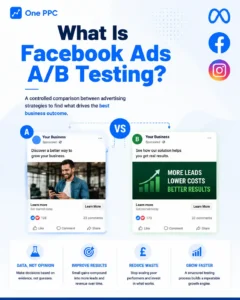
What Is Facebook Ads A/B Testing?
Facebook Ads A/B testing—also called Meta Ads A/B testing or split testing—is a controlled comparison between two or more advertising strategies. The audience is divided into separate, statistically comparable groups, with each group exposed to a different version.
For example, an advertiser could compare:
A customer testimonial video against a product demonstration video.
An Instant Form against a website landing page.
A broad audience against an interest-based audience.
Advantage+ placements against a restricted placement group.
A cost-cap bidding strategy against highest-volume delivery.
A problem-led offer against an outcome-led offer.
Meta’s current A/B testing documentation describes tests involving variables such as images, text, audiences and placements. Its Experiments tool can compare as many as five versions, although two variants are normally a more practical starting point for smaller advertisers.
The defining feature is not the number of adverts. It is the controlled allocation of people between the test cells. Meta explains that its formal A/B testing process creates evenly split, statistically comparable audiences and helps prevent the audience overlap that can affect informal comparisons.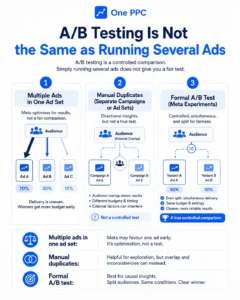
A/B Testing Is Not the Same as Running Several Ads
Suppose you place four adverts in one ad set. Meta is not required to give each advert 25% of the impressions or spend. Its delivery system can quickly favour the advert it predicts is most likely to achieve the selected performance goal.
This is useful for day-to-day campaign optimisation, but it creates a biased comparison. One advert may receive more favourable users, placements, times and auction opportunities. Another may receive little delivery before it has had a realistic opportunity to prove itself.
This distinction matters:
| Method | What it is designed to do | What you can conclude |
|---|---|---|
| Multiple adverts within one ad set | Let Meta optimise delivery across adverts | Which advert Meta preferred within that delivery system |
| Manual duplicated campaigns or ad sets | Create an informal comparison | Directional performance, potentially affected by overlap and unequal auction conditions |
| Formal A/B test | Randomise or separate comparable audience groups | A stronger causal comparison between the selected variants |
| Holdout or lift test | Compare exposed and unexposed groups | Whether advertising created incremental outcomes beyond what may have happened anyway |
Not every decision requires a formal experiment. Routine creative rotation can remain part of campaign management. Use an A/B test when the answer could materially change strategy, budget allocation, account structure or the customer journey.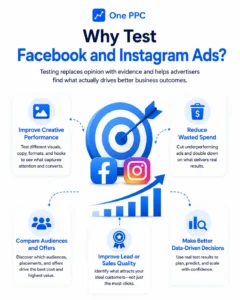
Why Test Facebook and Instagram Ads?
A controlled test can answer a specific question that ordinary reporting cannot answer confidently.
It may help determine whether:
A new creative concept produces genuinely better performance than the current control.
A broader audience gives Meta more useful freedom without reducing lead quality.
A website form produces fewer but more commercially valuable leads than an Instant Form.
A different offer improves customer acquisition rather than merely increasing form submissions.
Automated placements outperform manual restrictions.
A new bidding approach improves volume, cost or value.
A landing-page change increases completed purchases or qualified enquiries.
Testing can also prevent false certainty. A dramatic result from three purchases or five leads may be random variation rather than a repeatable improvement. A structured experiment makes the uncertainty more visible and encourages advertisers to wait for stronger evidence.
However, testing is not automatically valuable. Dividing a small budget across numerous cells can leave every variant underfunded. In that situation, concentrating spend on a well-founded strategy and gathering usable conversion data may be more productive than continuously launching inconclusive experiments.
Start with the Business Outcome, Not the Advert
Before choosing what to test, define what success means.
Meta can optimise and report many immediate actions: clicks, landing-page views, video views, messages, leads, app events and purchases. The cheapest platform result is not always the best commercial result.
For ecommerce, useful measures may include:
Purchase conversion rate.
Cost per purchase.
Revenue and return on ad spend.
New-customer acquisition cost.
Contribution margin after product, fulfilment and promotional costs.
Refund or cancellation rate.
For lead generation, consider:
Cost per initial lead.
Valid-lead rate.
Qualified-lead rate.
Cost per qualified lead.
Appointment-booked and appointment-attended rates.
Cost per sales opportunity.
Customer acquisition cost.
Revenue per lead and return on ad spend.
This is especially important when testing Instant Forms against website leads. The Instant Form may win on cost per submission while losing on qualified leads and customers. Our guide to improving Facebook Ads lead quality explains why low-cost leads can be commercially expensive.
Meta needs reliable event data to optimise effectively, while the advertiser needs a CRM or ecommerce system to judge the mature outcome. The Meta Pixel, Conversions API and datasets should be checked before a significant test begins. Otherwise, the experiment may compare tracking differences rather than advertising performance.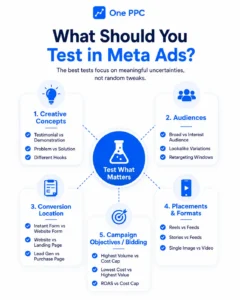
What Should You Test in Meta Ads?
The best tests address a meaningful uncertainty. They do not simply change something because the interface makes it possible.
Creative Concepts
Creative is often the most productive testing area because it influences attention, qualification, message comprehension and conversion intent.
Start by comparing materially different concepts:
Customer problem versus desired outcome.
Product demonstration versus customer testimonial.
Founder or expert explanation versus user-generated-style content.
Price-led message versus value-led message.
Before-and-after narrative versus process explanation, where permitted by Meta’s policies.
Educational content versus direct-response offer.
Product benefits versus evidence and proof.
This normally provides more useful learning than changing one button colour, one emoji or a few words in the primary text.
Once a winning concept emerges, test its execution: opening hook, first frame, image, video length, headline, primary text, call to action or aspect ratio. The sequence is important. Concept-level tests find large gains; element-level tests refine them.
Be careful with automated creative combinations. Flexible formats and Advantage+ creative features can allow Meta to adapt or combine assets. That may improve performance, but it makes a strict one-element comparison harder to interpret. Decide whether the question is “Which complete creative system performs better?” or “What is the isolated effect of this asset?” and configure the test accordingly.
Audiences
Audience tests may compare:
Broad or Advantage+ audience expansion against a defined interest audience.
One strategically distinct persona against another.
A customer-based Lookalike Audience against a qualified-lead lookalike.
Prospecting audiences against relevant retargeting groups.
Different geographical groups where the commercial opportunity is comparable.
Avoid testing arbitrary demographic fragments unless they reflect a genuine business hypothesis. A result for women aged 35–44 in one short period does not prove that this group is permanently the best audience. Demographic performance can be influenced by the creative, offer, season, placement and auction cost.
Meta’s targeting has become more automated, so audience inputs may sometimes act as suggestions rather than absolute restrictions, depending on the campaign and settings. Our current Facebook Ads targeting guide explains the difference between audience controls, suggestions, Custom Audiences and Lookalike Audiences.
Conversion Location and Customer Journey
For lead generation, one of the highest-value questions is where the conversion should take place:
Meta Instant Form.
Website form.
Messenger, Instagram Direct or WhatsApp conversation.
Telephone call or callback request.
Appointment-booking journey.
Keep the proposition as consistent as possible when comparing conversion locations. If the Instant Form offers a free consultation while the website promotes a paid assessment, the result cannot be attributed to the form location alone.
Judge the outcome after enough time has passed for leads to progress. Our Facebook Lead Ads guide covers Instant Forms, qualification questions, follow-up and CRM delivery in more detail.
Placements and Formats
You can compare Advantage+ placements with selected manual placements, or test a strategically important placement group such as Reels and Stories against feeds.
Do not restrict placements merely because one placement shows a higher surface-level cost. Different placements can assist the journey in different ways, and excluding inventory reduces the opportunities available to Meta’s delivery system. A placement test should use creative that genuinely fits both test conditions; a feed-only design placed into vertical Reels inventory creates a creative-quality test as well as a placement test.
Campaign Objectives, Performance Goals and Bidding
These tests examine how Meta is instructed to find results. Possible comparisons include campaign objectives, conversion events, optimisation locations, attribution settings or bidding approaches.
They require care because changing the optimisation target can change the users, auctions and conversion volume available to the system. A campaign optimised for landing-page views should not be declared the winner over a sales campaign because it generated cheaper traffic. Each strategy must be judged against the intended business outcome.
Review our guides to Meta campaign objectives and Facebook Ads bidding strategies before testing these account-level decisions.
Offers and Landing Pages
The advert is only one part of the conversion system. You may need to test:
Consultation versus quotation.
Discount versus added value.
Free trial versus demonstration.
Short landing page versus detailed page.
Short form versus a qualifying multi-step form.
Product page versus category or collection page.
Different pricing, delivery or guarantee presentations.
When Meta creates the traffic but the variant exists on the website, use a suitable landing-page experimentation method and preserve attribution parameters. Confirm that both pages load at similar speeds and fire the same conversion events. Otherwise, a technical discrepancy can masquerade as a marketing insight.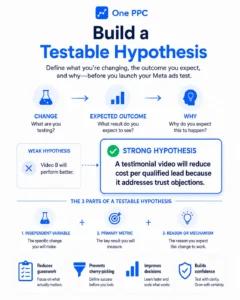
Build a Testable Hypothesis
A hypothesis should explain what you are changing, the expected outcome and why.
A weak hypothesis is:
Video B will perform better.
A stronger hypothesis is:
A customer testimonial video will reduce cost per qualified lead compared with the product demonstration because it addresses trust objections before the prospect submits the form.
This identifies:
The independent variable: testimonial versus demonstration.
The primary outcome: cost per qualified lead.
The mechanism: stronger trust and objection handling.
The decision: whether to make testimonial-led creative the next control.
Write the hypothesis before launching the test. This reduces the temptation to search through dozens of metrics afterwards and promote whichever accidental difference looks favourable.
Test One Main Variable at a Time
If variant A uses a video, broad targeting and an Instant Form while variant B uses a static image, interest targeting and a website form, you are testing two complete strategies. You may find a winner, but you will not know whether the result came from the creative, audience or conversion location.
There are two valid approaches:
Single-variable test: keep everything material constant except one factor. Use this when you need causal learning about that factor.
Strategy or package test: compare complete systems. Use this when the practical decision is simply which system to deploy, even if the contribution of each component remains unknown.
The mistake is calling a package test a single-variable experiment and then claiming that one element caused the result.
Choose a Primary Metric and Decision Rule
Select one primary metric that reflects the hypothesis. Secondary measures can help explain the outcome, but they should not replace the primary measure after the test has finished.
For example:
Primary metric: cost per qualified lead.
Secondary metrics: cost per initial lead, qualification rate, appointment rate and cost per customer.
Guardrails: minimum lead volume, no material increase in invalid leads and no deterioration in customer acquisition cost.
Decision rule: adopt the challenger only if it improves cost per qualified lead by a commercially meaningful amount and the effect remains credible after lead maturation.
“Commercially meaningful” matters. A 2% improvement may be statistical noise, operationally irrelevant or easily reversed next week. Before testing, decide what level of improvement would justify implementation.
Set a Realistic Budget and Duration
There is no universal daily budget or duration for every Meta Ads test. The requirement depends on expected conversion rate, conversion cost, audience size, difference between variants and the confidence needed.
A practical budget calculation begins with the number of primary outcomes required per variant:
Test budget = target outcomes per variant × expected cost per outcome × number of variants
If a qualified lead normally costs £100 and you want 30 qualified leads in each of two cells, the indicative test budget is £6,000. That is not a statistical guarantee, but it exposes whether the proposed test is financially plausible.
If the account produces only two qualified leads per month, a two-week test using qualified leads as the platform result cannot provide a dependable answer. You may need to:
Run the experiment for longer.
Test a higher-volume upstream event while separately monitoring quality.
Make a larger creative change capable of producing a more visible effect.
Consolidate variants.
Delay the test until the account has more volume.
Accept that the result will be directional rather than conclusive.
Avoid one-day or two-day tests. Meta delivery varies by weekday, auction conditions and user behaviour. Most acquisition tests should cover at least a complete weekly cycle, and often longer, while higher-consideration lead generation needs an additional maturation period before sales quality can be judged.
Do not stop as soon as one cell takes an early lead. Repeatedly checking and ending a test at the most favourable moment increases the probability of selecting a false winner.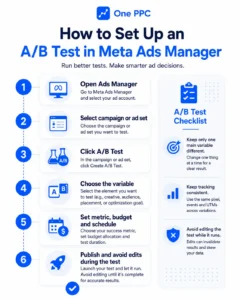
How to Set Up an A/B Test in Meta Ads Manager
Meta changes interface labels and account eligibility over time, but its current documentation provides two main routes for advertising experiments.
Create a Test from Ads Manager
For many accounts, the simplest route is:
Open Meta Ads Manager.
Select the eligible campaign or ad set you want to use as the control.
Click A/B test in the toolbar above the reporting table.
Select the available variable or comparison method.
Create or choose the challenger version.
Confirm the key metric, budget, schedule and test name where prompted.
Review every setting to ensure the intended variable is the only material difference.
Publish the test and avoid editing it while it is running.
Meta currently recommends the Ads Manager toolbar as a common way to create an A/B test using an existing campaign or ad set as the template. Exact options can differ according to campaign type, objective, account and feature rollout.
Create a Test in Experiments
You can also open Experiments from Meta’s business tools and create an A/B test there. Depending on eligibility and the test type, you may create new versions, duplicate an existing strategy or compare existing eligible campaigns.
Meta’s Experiments documentation states that an A/B test can compare up to five versions. For most small and medium-sized advertisers, two cells are preferable because each additional version divides the available audience, budget and conversions.
Before publishing, use a checklist:
Same objective and performance goal unless that is the variable.
Same conversion event and dataset unless measurement is the variable.
Same attribution setting unless attribution is the variable.
Same audience unless audience is the variable.
Same placements unless placement is the variable.
Same schedule and geographical eligibility.
Same bid strategy unless bidding is the variable.
Same offer, page and form unless one of those is the variable.
Correct URL parameters and CRM source tracking.
No competing test targeting the same strategic question.
What to Do While the Test Is Running
The most useful action is often restraint.
Do not:
Edit creative, targeting, budget, optimisation or tracking mid-test.
Pause a cell because its first few days look expensive.
Launch another campaign that materially contaminates the same comparison.
Change the landing page for one cell without recording the intervention.
Move budget towards the early leader.
Judge delayed sales using same-day lead data.
Monitor for genuine failures: rejected adverts, broken links, missing conversion events, severe underdelivery or a website problem. If the test becomes invalid, document the reason, stop it and rerun it cleanly. Quietly repairing one variant mid-test can make the final report look complete while destroying comparability.
How to Analyse A/B Test Results
Begin with the preselected primary metric, then inspect the evidence around it.
Check Delivery and Data Quality
Confirm that:
Both cells delivered for the intended period.
Spend and reach were sufficient to support the comparison.
Conversion tracking remained consistent.
There were no major advert rejections, stock issues or website outages.
CRM events were matched to the correct campaign and test cell.
Leads or sales had enough time to mature.
Review Meta’s Reported Confidence Carefully
Meta reports a confidence percentage for eligible experiments and describes 65% or higher confidence as a winning A/B test result. This threshold is useful for understanding Meta’s own result label, but it is not especially strong evidence by conventional experimental standards.
A 65% confidence result should therefore be treated as directional, particularly when the decision is expensive or difficult to reverse. Look for:
A meaningful performance difference, not merely a nominal winner.
Adequate conversion volume in both cells.
Consistency across the test period rather than one unusual day.
A plausible explanation connected to the hypothesis.
Confirmation in downstream CRM or revenue data.
Repeatability in a later campaign, audience or period.
Do not reinterpret confidence as certainty. Even a strong test reflects the audience, offer, market and auction conditions during that period. The result may not transfer perfectly to another country, product or season.
Separate Platform Performance from Commercial Performance
Consider this lead-generation result:
| Metric | Variant A | Variant B |
| Spend | £3,000 | £3,000 |
| Leads | 120 | 75 |
| Cost per lead | £25 | £40 |
| Qualified leads | 18 | 30 |
| Cost per qualified lead | £167 | £100 |
| Customers | 3 | 8 |
| Customer acquisition cost | £1,000 | £375 |
Variant A wins on Meta’s initial lead cost. Variant B is substantially stronger when the business measures quality and customers. Choosing A would train the account and creative process towards cheap submissions rather than profitable acquisition.
This is why Facebook Ads CRM integration and offline CRM event tracking are central to mature testing. The advertising platform should receive useful downstream signals where appropriate, while the business retains its own source of truth for lead status, sales and revenue.
Use Breakdown Data as Diagnosis, Not Proof
Age, gender, device, placement, geography and time breakdowns can explain a result, but small subgroups create more opportunities to find accidental patterns.
If the overall test has no clear winner but one small demographic segment looks exceptional, treat it as a hypothesis for a future test—not proof that the account should immediately exclude everybody else.
What If There Is No Clear Winner?
An inconclusive result is still a result. It may mean:
The variants were too similar.
The sample and budget were too small.
Normal performance variation was larger than the effect.
Both strategies genuinely perform similarly.
The primary metric was too far down the funnel for the available volume.
Tracking or operational differences introduced noise.
Do not automatically keep the challenger because the team likes it. Retain the established control unless the new version offers another material advantage, such as lower production cost, easier compliance, stronger brand fit or greater scalability.
If the question remains commercially important, refine the hypothesis and rerun the test with a larger difference, more volume or cleaner measurement.
A Practical Meta Ads Testing Roadmap
Random tests produce random learning. A roadmap creates cumulative knowledge.
Stage 1: Fix Measurement and the Offer
Confirm that the conversion event fires correctly, CRM stages are defined and revenue or qualified outcomes can be connected to advertising. Clarify the proposition, customer and commercial constraint.
Stage 2: Test Major Creative Concepts
Compare meaningfully different messages, proof types, problems and outcomes. Creative normally offers more potential than minor interface adjustments.
Stage 3: Test the Conversion Journey
Compare Instant Form, website, message or call journeys where relevant. Measure lead quality and sales, not only completion rate.
Stage 4: Test Audience Strategy
Evaluate broad or Advantage+ delivery against strategically relevant audience inputs. Use suitable exclusions and consistent creative.
Stage 5: Test Delivery and Economics
Once conversion volume is stable, assess placements, optimisation events, bid strategies, budget approaches or value optimisation.
Stage 6: Validate and Scale
Move the winner into the main campaign carefully, monitor whether performance persists and keep the previous control documented. Scaling changes auction participation and may change the result, so a test winner is not a guarantee of identical performance at a much larger budget.
Our broader guide to optimising Facebook Ads explains how testing fits alongside measurement, creative development, targeting, bidding and budget management.
Common Facebook Ads Testing Mistakes
Testing Too Many Variables
If the image, copy, audience, placement and landing page all change, the cause of the result becomes unknowable. Test one main variable or explicitly describe the comparison as a package test.
Launching Too Many Variants
Meta may allow several versions, but each extra cell requires more audience, budget and conversions. Two strong hypotheses are usually better than five weak variations.
Using Tiny Cosmetic Changes
Minor changes tend to produce minor effects that require large samples to distinguish from noise. Begin with meaningful differences.
Ending the Test Early
The first few conversions can make either cell appear dominant. Let the planned period finish unless the experiment is technically invalid or creates unacceptable risk.
Optimising for the Wrong KPI
Cheap clicks, video views or forms do not automatically create profitable customers. Match the metric to the business decision.
Ignoring Lead Maturation
B2B and higher-value consumer leads may take weeks or months to become customers. Use early indicators cautiously and schedule a later analysis of qualified opportunities and revenue.
Trusting Meta’s Result in Isolation
Meta supplies useful experimental tools, but its reporting remains a platform view of performance. Reconcile it with ecommerce orders, CRM outcomes, payment data, call records and genuine revenue. Platform guidance should inform the decision, not replace independent commercial analysis.
Failing to Record the Learning
Store the hypothesis, dates, variants, screenshots, settings, budget, results, confidence, anomalies and final decision. Otherwise, teams repeat old tests or lose the context behind account decisions.
Frequently Asked Questions About Facebook Ads A/B Testing
How Many Variables Should I Test at Once?
Test one main variable when you need to understand causation. Compare complete packages only when the business decision is between the packages themselves and you accept that the winning component will remain unknown.
How Many Variants Should a Beginner Use?
Two. Although Meta’s Experiments tool can support more versions for eligible tests, an A-versus-B comparison is easier to fund, interpret and document.
How Long Should a Meta Ads Test Run?
There is no universal duration. Cover at least a complete weekly cycle in most acquisition tests, then allow enough additional time for the primary outcome to occur and mature. Low-volume or long-sales-cycle tests may need several weeks or a different measurement plan.
What Budget Do I Need?
Estimate the number of primary outcomes required in each cell, multiply it by the expected cost per outcome and then multiply by the number of cells. If the resulting budget is unrealistic, simplify the test or choose a higher-volume question.
Can I Test Facebook and Instagram Separately?
Yes, placements or placement groups can be compared where the setup is eligible. Ensure the creative is suitable for each placement and remember that restricting placements changes the delivery opportunities available to Meta.
Is Dynamic or Flexible Creative an A/B Test?
No. Automated asset selection helps Meta optimise combinations, but it does not necessarily provide an equal, controlled comparison of every component. Use a formal experiment when you need causal evidence about a specific creative strategy.
Should I Test Audiences or Creative First?
For many accounts, creative concepts should come first because they affect attention, qualification and conversion across audiences. Audience testing becomes more useful after the offer, measurement and creative foundations are credible.
Should I Always Choose Meta’s Declared Winner?
No. Review the size of the improvement, conversion volume, confidence, test validity and downstream business results. A low-confidence or commercially trivial winner may not justify changing the control.
Final Takeaways
Facebook Ads A/B testing is most valuable when it answers an important commercial question under controlled conditions. The process is not simply “run two adverts and choose the cheaper one”.
A strong Meta Ads experiment should:
Begin with a clear hypothesis.
Change one main variable or openly compare complete strategies.
Use a primary KPI connected to the business outcome.
Give each cell enough budget, time and conversion volume.
Use Meta’s formal A/B testing tools when causal evidence matters.
Avoid edits and premature decisions while the test runs.
Treat platform confidence as evidence, not certainty.
Validate lead quality, customers and revenue outside Ads Manager.
Document the learning and make it the starting point for the next test.
The goal is not to run the greatest number of experiments. It is to make better decisions, build a reusable body of evidence and steadily improve the economics of customer acquisition across Facebook and Instagram.
If you need help designing, tracking or scaling controlled experiments, One PPC provides Facebook Ads management focused on creative testing, conversion measurement and commercial outcomes—not surface-level platfor