
Google Display advertising is changing. The Google Display Network has not disappeared, but Google is moving standalone Display campaigns into Demand Gen.
Demand Gen can serve image, video and carousel adverts across:
- The Google Display Network
- YouTube, including Shorts, in-feed and in-stream
- Discover
- Gmail
- Google Maps
Advertisers can use channel controls to include all eligible Google surfaces or isolate particular channels, including the Google Display Network. Existing Display campaigns may remain visible during the transition, but Demand Gen is becoming the new campaign environment for creating and managing this type of visual advertising.
This is more than a change of name. Traditional Display advertising was largely associated with banner adverts across websites and apps. Demand Gen combines this inventory with Google’s feed-based, video and visual placements, supported by audience targeting, automated bidding and creative optimisation.
Used correctly, it can create awareness, influence consideration, reconnect with previous visitors and generate conversions. Used carelessly, it can consume a substantial budget while producing cheap clicks, low-quality leads and conversions that look more valuable in Google Ads than they are commercially.
The following Display and Demand Gen advertising tips explain how to improve reach without losing control of return on investment.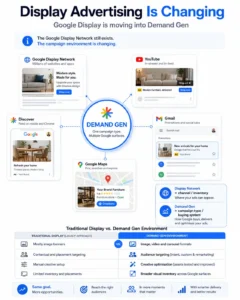
Is Google Display Now Demand Gen?
Broadly, yes—but it is important to distinguish the network from the campaign type.
The Google Display Network remains an advertising channel consisting of websites, apps and other eligible visual inventory. What is changing is the campaign structure used to access that inventory.
Google is moving eligible standalone Display campaigns into Demand Gen. Within Demand Gen, advertisers can select the Google Display Network alongside YouTube, Gmail, Discover and Maps—or use it as a more isolated channel.
According to Google’s Demand Gen documentation, existing eligible Display campaigns can be moved using a migration tool. Google also states that new Display advertising will eventually be created within Demand Gen rather than through a separate Display campaign type.
This means that “display advertising” remains a useful description of the media format and inventory, while “Demand Gen” increasingly describes the campaign system used to buy it.
Display, Demand Gen and Performance Max Are Not the Same
Several Google Ads campaign types can now use visual inventory, but they do not serve identical strategic purposes.
| Campaign type | Principal role | Typical inventory | Level of channel control |
|---|---|---|---|
| Search | Capture existing demand | Google Search and search partners | High control over keyword-led targeting |
| Demand Gen | Create, influence and recapture demand | YouTube, Discover, Gmail, Maps and the Google Display Network | Channels can be selected at ad-group level |
| Performance Max | Maximise conversions across Google | Search, Shopping, Maps, YouTube, Display, Discover and Gmail | Google largely determines channel allocation |
| Shopping | Capture product-led demand | Shopping and eligible Search placements | Product-feed-led targeting |
Performance Max is designed to pursue conversions across nearly all Google inventory. Demand Gen gives advertisers greater scope to organise campaigns around audiences, creative formats and selected visual channels.
Demand Gen is therefore closer to paid social advertising than conventional keyword-based Search advertising. The campaign reaches people while they are consuming content, checking Gmail, watching videos or browsing websites—not necessarily when they are actively searching for the advertised service.
Read our complete Demand Gen campaign guide for a more detailed explanation of its formats, bidding strategies and audience capabilities.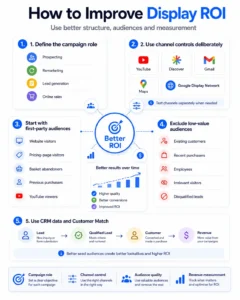
Define the Campaign’s Role Before Launching It
The first question should not be which audience or image to use. It should be what the campaign is expected to accomplish.
Possible objectives include:
- Increasing awareness among a defined market
- Introducing a new product or service
- Reaching prospective customers before they search
- Re-engaging previous website visitors
- Promoting educational or problem-led content
- Generating online sales
- Acquiring leads
- Supporting a longer B2B buying journey
- Increasing branded search demand
- Expanding beyond saturated Search campaigns
A campaign intended to reach new customers should not be evaluated in exactly the same way as a remarketing campaign. The prospecting campaign is reaching colder audiences, while remarketing is concentrating spend on people who have already encountered the business.
Separating these purposes improves budgeting, audience control, creative relevance and reporting.
Use Channel Controls Deliberately
Demand Gen can automatically distribute adverts across its available channels, but this does not mean every advertiser should begin with unrestricted coverage.
Advertisers can choose between automatic channel selection and manual channel controls at ad-group level. Manual selections can include:
- YouTube in-stream
- YouTube in-feed
- YouTube Shorts
- Discover
- Gmail
- Maps
- The Google Display Network
Google generally recommends allowing its system to optimise across all compatible channels. That can provide more conversion opportunities, but the recommendation should be tested against the advertiser’s actual objective, creative resources and need for transparency.
For example, a polished vertical video created for Shorts may not translate effectively into a conventional website banner. A high-quality static image may be well suited to Discover and Gmail but unable to communicate a complex B2B proposition on every Display placement.
Use broader channel coverage when the objective is scalable performance and the campaign has strong conversion data. Consider isolating channels when:
- Different channels require different creative
- A channel has a specific strategic purpose
- Brand-safety requirements are strict
- You need a clean test of Google Display Network inventory
- The campaign is producing poor-quality leads from particular environments
- The reporting needs to distinguish feed, video and website performance
Google provides channel-level reporting for Demand Gen, so results can be segmented by YouTube, Discover, Gmail, Maps and the Google Display Network. Review this breakdown rather than treating Demand Gen as a single undifferentiated source.
Begin with First-Party Audiences
Previous website visitors, customers, leads and engaged users usually provide a more commercially relevant starting point than completely cold audience targeting.
Potential first-party segments include:
- All website visitors
- Visitors to specific product or service pages
- Pricing-page visitors
- People who began but did not complete a form
- Basket abandoners
- Previous purchasers
- Existing customers suitable for cross-selling
- Lapsed customers
- YouTube viewers and subscribers
- Marketing-qualified leads
- Sales opportunities that have not yet converted
Avoid placing every previous visitor into one broad remarketing audience. Someone who briefly read a blog post is not equivalent to someone who viewed a pricing page, added a product to their basket or requested a demonstration.
Use Google Ads Audience Manager to organise audiences around intent, lifecycle stage and commercial value.
Exclude People Who Should Not See the Advert
Audience exclusions are as important as audience inclusions.
Depending on the campaign, consider excluding:
- Recent purchasers
- Existing customers
- Employees
- Suppliers
- Current job applicants
- Irrelevant website visitors
- Converted leads
- People outside the service area
- Low-quality or disqualified CRM contacts
A customer-acquisition campaign should not claim to be generating new customers if much of its budget is being spent on existing customers. Similarly, a remarketing campaign should not continue encouraging someone to request a quotation after the person has already become a customer.
Exclusions need to reflect the campaign’s objective rather than being copied indiscriminately across the account.
Use Customer Match and CRM Data
Website audiences are valuable, but they represent only the activity that occurred on the website or app. CRM data can provide much stronger commercial information.
Customer Match audiences can be created from consented first-party data such as customer email addresses and telephone numbers. Depending on eligibility and audience size, these lists can support:
- Customer retention
- Cross-selling
- Re-engagement
- Suppression of existing customers
- Lookalike audience creation
- High-value customer acquisition
- Targeting by sales lifecycle stage
For lead-generation businesses, the strongest seed audience may not be every person who completed a form. It may be the smaller group that became qualified opportunities or paying customers.
This distinction helps Google look for people resembling commercially valuable customers rather than people who are simply likely to submit forms.
Test Lookalike Segments Carefully
Demand Gen includes lookalike segments that use a first-party seed audience to find other people with similar characteristics.
Useful seed lists might include:
- High-value purchasers
- Repeat customers
- Sales-qualified leads
- Customers buying a particular service
- Customers within a profitable location
- Customers with high lifetime value
Avoid using poor-quality leads or all website visitors as the default seed. An audience model can faithfully reproduce weaknesses in the source data. If the original list contains job seekers, spam leads, suppliers and unsuitable enquiries, expansion may find more people with those same characteristics.
Audience size also matters. A very small list may be commercially precise but provide insufficient information, while a very broad list may contain too many conflicting customer types.
Use Custom Segments to Express Commercial Intent
Custom segments allow advertisers to provide signals related to the websites, interests, search behaviour or applications associated with the intended audience.
They can be useful for reaching people who:
- Research specific problems
- Visit relevant industry websites
- Compare competing products
- Search for commercially relevant terminology
- Use related applications or services
However, custom segments are not Search keywords. Adding a phrase does not mean the advert will only reach people who searched for that exact term.
Treat these inputs as audience signals and behavioural indicators. If the business needs precise control over active search terms, a Google Search campaign remains the more appropriate campaign type.
Our guide to Google Ads targeting options explains how audience, contextual, keyword and automated targeting differ.
Treat Managed Placements Differently from the Old Display Model
Traditional Display campaigns made extensive use of managed placements, allowing advertisers to select particular websites, applications or YouTube channels.
Placement reporting and exclusions remain important, but Demand Gen is more audience-led and automated than the old managed-placement model. Do not assume that every legacy Display targeting setting will transfer into Demand Gen in precisely the same way.
When migrating an existing campaign:
- Review which placements and targeting settings are transferred
- Check whether targeting has become broader
- Inspect the selected channels at ad-group level
- Confirm that exclusions remain appropriate
- Monitor the “Where ads showed” report
- Compare lead quality before and after migration
- Avoid approving every Google recommendation automatically
Specific placements may still be useful where the target market frequently uses a small number of specialist websites or channels. However, a list of five referral websites from analytics is not automatically a viable advertising plan. The sites may not offer eligible inventory, may deliver too little volume or may have produced referrals for reasons unrelated to paid-ad suitability.
Separate Remarketing from Prospecting
Remarketing is often one of the strongest uses of Display inventory because the audience already knows the business. However, it should not be mixed carelessly with new-customer prospecting.
Create separate structures for:
- Website and product remarketing
- Basket or form abandonment
- CRM re-engagement
- High-intent prospecting
- Broader demand generation
- Existing-customer retention or cross-selling
This makes it easier to allocate budgets, apply exclusions, change frequency, tailor messaging and understand whether the campaign is creating new demand or simply harvesting people who were already likely to convert.
Remarketing adverts should also reflect what the person previously did. A pricing-page visitor may need reassurance, evidence or an incentive. A basket abandoner may need delivery information or a reminder. A previous customer may need a related product rather than the same introductory offer.
See our Google Ads remarketing guide for audience and funnel examples.
Build Creative for the Placement, Not Just the Brand
Demand Gen is a visual campaign type. Weak creative cannot be repaired by sophisticated targeting alone.
Effective creative should communicate:
- Who the offer is for
- What is being offered
- Why it matters
- What differentiates the company
- What the user should do next
Prepare a varied set of assets rather than repeatedly resizing one image. Demand Gen can use:
- Landscape images
- Square images
- Portrait images
- Landscape video
- Square video
- Vertical video
- Carousel adverts
- Product-feed creative
- Headlines and descriptions
- Brand logos
- Calls to action
Google can combine and adapt these assets, but automation does not guarantee that every combination will communicate the intended message. Check previews across the available placements.
Important text should not be built into the extreme edges of an image because cropping may vary. Product details, faces and visual focal points should remain clear at small sizes.
Make the Advert Understandable Without Context
Users may encounter a Demand Gen advert while watching a video, reading an article or checking their inbox. They have not necessarily searched for the business or expressed an immediate need.
The advert must therefore provide enough context to make sense on its own.
Weak message:
Improve your results today.
Stronger message:
Reduce wasted Google Ads spend with a conversion-tracking audit.
The second version explains the service, identifies the problem and presents a specific next step.
Avoid vague claims such as “best service”, “industry-leading solutions” or “take your business to the next level” unless the creative provides evidence and context.
Useful message angles include:
- A recognisable customer problem
- A product demonstration
- A commercial benefit
- A customer result
- A comparison
- An educational insight
- A relevant offer
- A reason to act
- Social proof
- Reduced risk
Match the Call to Action to Audience Temperature
A cold prospect may not be ready to request a quotation immediately. A previous pricing-page visitor may be much closer to taking action.
Possible calls to action should reflect the buying stage:
- Learn more
- Watch the demonstration
- Download the guide
- View products
- Compare options
- Calculate your price
- Book a consultation
- Request a quotation
- Start a free trial
- Buy now
Maintaining consistent positioning between the advert and landing page is important, but this does not mean every advert must use the same call to action. The appropriate action depends on the audience, offer and stage of consideration.
Use Dedicated Landing Pages
Sending all Demand Gen traffic to the homepage makes it harder to continue the advert’s message and measure intent.
A suitable landing page should:
- Match the advert’s proposition
- Explain the product or service clearly
- Load quickly on mobile
- Make the next action obvious
- Provide trust signals
- Address common objections
- Avoid unnecessary navigation
- Use a form appropriate to the offer
- Distinguish customers from unsuitable enquiries
- Record the advertising source correctly
For lead generation, do not reduce friction so aggressively that the business receives a large volume of unusable leads. Asking one or two meaningful qualification questions can be more profitable than maximising form completion rate.
Choose Conversion Goals That Represent Business Value
Demand Gen can optimise towards whichever primary conversions are supplied to it. If the account treats every button click, page view and unqualified form submission as a primary conversion, Google will attempt to generate more of those actions.
Primary goals might include:
- Completed purchases
- Qualified enquiry forms
- Booked appointments
- Suitable telephone calls
- Sales-qualified leads
- Subscriptions
- High-value CRM stages
Secondary conversions can record useful activity without instructing bidding to prioritise it. Examples might include:
- Brochure downloads
- Email clicks
- Page engagement
- Chat openings
- Form starts
- Job-seeker submissions
- Low-value micro-conversions
Our guide to primary and secondary Google Ads conversions explains why this distinction affects both reporting and automated bidding.
Connect Lead Quality and Revenue Through the CRM
A low cost per lead is not necessarily a strong result.
Demand Gen can sometimes generate inexpensive form submissions from people who are curious, poorly qualified or unaware of what they requested. The campaign should therefore be evaluated using CRM outcomes such as:
- Contacted leads
- Qualified leads
- Appointments attended
- Sales opportunities
- Customers
- Revenue
- Gross profit
- Customer lifetime value
Advertising identifiers and consented first-party customer information can connect the original advert interaction with later commercial outcomes. These CRM events can then be imported into Google Ads using native integrations, Google Ads Data Manager, Enhanced Conversions for Leads, no-code automation or an API-based implementation.
This allows bidding to learn from customers and qualified opportunities rather than raw form volume alone.
Be Careful with View-Through Conversions
Visual advertising can influence a conversion without receiving the final click. Someone may see an advert, remember the brand and later return through Search, direct traffic or another channel.
View-through and engaged-view reporting can help identify this influence, but it can also make campaign performance appear stronger than a click-only analysis.
Review:
- Click-through conversions
- Engaged-view conversions
- View-through conversions
- Conversion windows
- Data-driven attribution
- Branded search activity
- Assisted conversions
- New-customer acquisition
- Geographic or audience lift
- CRM sales and revenue
Do not automatically assign zero value to impressions that were not clicked. Equally, do not assume that every attributed view caused the conversion. Stronger measurement may require controlled experiments, holdout groups or Google’s lift-testing tools.
Control Budget According to Funnel Position
Demand Gen can reach extremely large audiences, so modest targeting changes can create substantial differences in spend.
Begin with a budget that can produce enough information without putting the account’s core Search activity at risk. Search campaigns often deserve budget priority when they are already capturing profitable, high-intent demand.
A practical allocation might separate:
- Core Search and Shopping activity
- High-intent remarketing
- Demand Gen prospecting
- Creative and audience experiments
There is no universal percentage that must be assigned to testing. Ten per cent may be appropriate for one advertiser and completely inadequate for another. The correct amount depends on total budget, conversion rate, customer value, buying cycle and the minimum data required to evaluate the test.
Select Bidding According to the Available Data
Demand Gen supports bidding towards clicks, conversions and conversion value.
Possible approaches include:
- Maximise Clicks for controlled traffic-generation objectives
- Maximise Conversions for conversion volume
- Target CPA when conversion history is sufficiently reliable
- Maximise Conversion Value when different outcomes have meaningful values
- Target ROAS when revenue or conversion value is accurate and sufficiently established
Avoid introducing an aggressive target CPA or target ROAS without enough evidence. A restrictive target can prevent the campaign from entering enough auctions to learn.
For lead generation, automated bidding becomes more useful when the conversion definition represents lead quality. Feeding Google 100 low-quality leads is not necessarily better than feeding it 20 properly qualified opportunities.
Monitor Placements and Brand Safety
The scale of the Google Display Network creates both opportunity and risk.
Review where adverts appeared and look for:
- Irrelevant applications
- Accidental-click environments
- Low-quality websites
- Content unsuitable for the brand
- Placements generating abnormal click-through rates
- High conversion volume with no corresponding CRM outcomes
- Children’s content where the product is intended for adults
- Geographic traffic outside the service area
Use account-level suitability settings, content exclusions, placement exclusions and channel controls where appropriate.
Brand safety is not simply a reputational issue. Poor inventory can generate misleading engagement and waste automated bidding signals.
Analyse Channels, Audiences and Assets Separately
Campaign-level return on ad spend can conceal important differences.
Segment reporting by:
- Channel
- Ad format
- Device
- Location
- Audience
- New versus returning users
- Creative asset
- Placement
- Conversion action
- CRM outcome
Demand Gen includes channel and asset reporting, but remember that asset-level performance labels do not always represent a perfectly controlled experiment. Google may serve some assets more frequently, to different users or in different contexts.
Use asset reporting to identify patterns and generate hypotheses. Use an A/B experiment when a more controlled comparison is required.
Test Meaningful Creative Differences
Changing a button from one shade of blue to another rarely produces a strategically useful insight.
More valuable creative tests compare:
- Product-led and problem-led messaging
- Customer proof and feature explanations
- Static images and video
- Founder-led and brand-led video
- Demonstrations and lifestyle imagery
- Short and detailed propositions
- Different offers
- Different audience problems
- Different landing pages
- Different stages of the buying journey
Test one major hypothesis at a time where possible. If the audience, offer, creative, bid strategy and landing page all change simultaneously, it becomes difficult to understand why performance changed.
Common Display and Demand Gen Mistakes
Frequent causes of poor performance include:
- Treating Demand Gen as a replacement for profitable Search campaigns
- Using every channel without reviewing channel-level results
- Combining remarketing and prospecting
- Using broad audiences without exclusions
- Optimising towards unqualified form submissions
- Relying on one image in multiple sizes
- Using landscape video on vertical placements
- Sending all traffic to the homepage
- Counting micro-conversions as primary goals
- Ignoring CRM lead quality
- Accepting view-through attribution without scrutiny
- Failing to inspect placements
- Making large budget changes during the learning period
- Launching Target CPA or Target ROAS with insufficient data
- Assuming Google’s automated expansion will always find profitable customers
- Evaluating an awareness campaign only by immediate last-click sales
A Practical Demand Gen Campaign Structure
A clear starting structure could include separate campaigns or ad groups for the following purposes.
High-Intent Remarketing
Use pricing-page visitors, product viewers, form abandoners, basket abandoners or returning visitors. Match creative to the action they nearly completed.
Customer and CRM Re-Engagement
Use eligible first-party lists for renewals, cross-selling, upgrades, repeat purchases or reactivation. Exclude audiences from offers they have already accepted.
High-Intent Prospecting
Test in-market audiences, commercially relevant custom segments, selected contextual signals and lookalikes based on qualified customers.
Broader Demand Generation
Use broader audience signals and visual storytelling to introduce the problem, category or brand. Evaluate incremental reach, engagement, branded search and assisted commercial outcomes.
Controlled Channel Testing
Separate the Google Display Network, YouTube, Discover or other strategically important channels when creative or measurement requirements justify the additional structure.
The objective is not to create as many campaigns as possible. It is to preserve the distinctions needed for meaningful control, budgeting and analysis.
Improve ROI by Connecting the Entire System
Demand Gen performance depends on more than audience targeting.
The complete system includes:
- A commercially relevant market
- Appropriate audience signals
- High-quality image and video assets
- Clear advert messaging
- Channel selection
- A suitable landing page
- Accurate conversion tracking
- CRM lead-quality data
- Appropriate bidding
- Placement and brand-safety controls
- Structured experimentation
- Ongoing optimisation
Google AI can combine assets, select inventory and adjust auction-time bids. It cannot independently decide whether a lead is genuinely suitable, whether a sale is profitable or whether a conversion goal reflects the business’s real priorities. Those inputs remain the advertiser’s responsibility.
Conclusion
The Google Display Network has not disappeared, but standalone Display campaigns are being absorbed into Demand Gen. Display advertising now sits within a broader visual campaign environment covering websites, apps, YouTube, Discover, Gmail and Maps.
This creates more reach, more creative formats and stronger cross-channel automation. It also makes measurement, conversion quality and campaign structure more important.
Begin with a defined role for the campaign. Separate remarketing from prospecting, choose channels deliberately, use first-party and CRM data, supply creative designed for each format and optimise towards qualified leads, customers and revenue—not merely inexpensive clicks or form submissions.
When Demand Gen is connected with well-structured Google Ads campaigns, reliable conversion tracking and commercially meaningful CRM outcomes, it can influence demand earlier in the buying journey while still contributing to measurable growth.