
Google Ads is Google’s paid advertising platform that enables businesses to place adverts across Google Search, YouTube, Discover, Gmail, Google Maps, and a large network of partner sites and apps. In the modern era, it’s no longer “just text ads” at the top of a results page. It’s a multi-surface performance system where you can buy attention, shape demand, and optimise toward measurable outcomes like sales, booked calls, qualified enquiries, and revenue.
What makes Google Ads uniquely powerful is intent. Search marketing allows you to appear precisely when someone is actively looking for a solution. That’s categorically different from interruptive advertising, where you’re trying to create intent from scratch. When run properly, Google Ads compresses the journey from “problem recognised” to “purchase made”.
At the same time, the platform has evolved. A growing amount of optimisation now happens automatically at auction time, with Google evaluating context and predicted performance signals in milliseconds. Your job isn’t just “picking keywords”. Your job is building a high-quality commercial system: correct tracking, strong landing pages, clear offers, and inputs that help the algorithm learn what a good customer actually looks like.
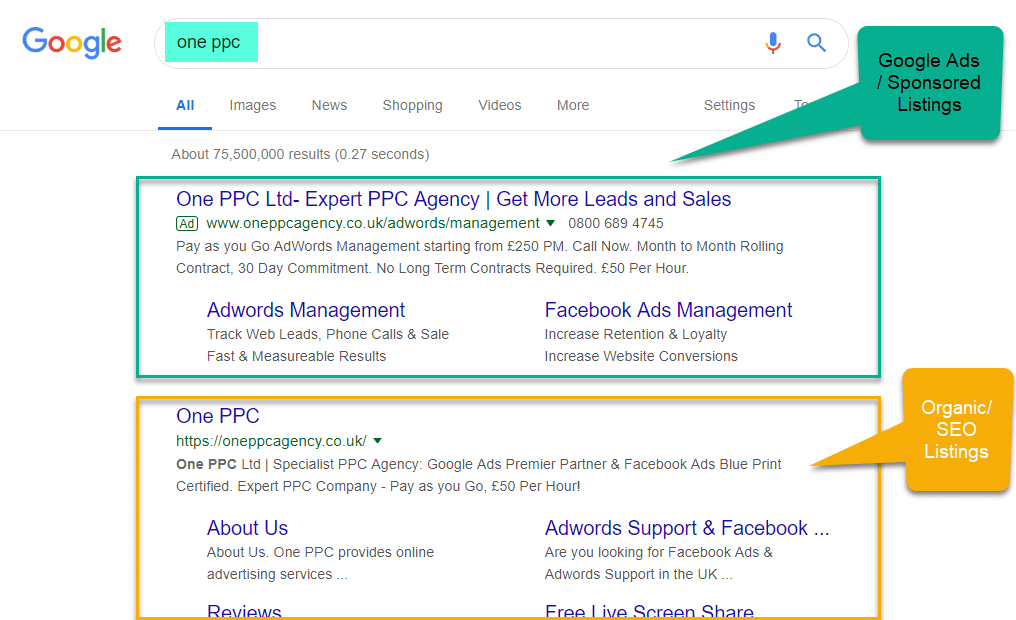
Where Google Ads Can Show Your Adverts
Many advertisers think of Google Ads as a single placement: the top of Search. In reality, your ads can appear across:
Google Search (text-led, intent capture)
Google Maps (local discovery and navigation-driven intent)
YouTube (attention, influence, remarketing, conversion)
Discover (feed-based browsing, visually led demand creation)
Gmail (promotions and social tabs, mid-funnel engagement)
Google Display Network (publisher websites and apps)
Cross-channel inventory via goal-based campaigns that access multiple surfaces from one campaign
This matters because user behaviour is fragmented. People research on YouTube, browse on Discover, compare on Search, and return later via remarketing. Modern Google Ads lets you design for that reality rather than relying on one touchpoint.
How Google Ads Works: The Auction in Plain English
Every time someone searches on Google, a real-time auction runs to decide which adverts show and in what order. It happens in milliseconds. The highest bidder does not automatically win. Google also evaluates quality and predicted performance.
Google explains that Ad Rank is calculated using multiple factors, including competition, the context of a person’s search, and ad quality at the moment of the auction.
A helpful way to think about it is:
Bid is your willingness to pay
Quality is your usefulness to the user
Context is the match between your offer and the moment
If your ads and landing pages are highly relevant, you can often earn strong visibility at a lower cost than competitors with weaker relevance.
Ad Rank: What It Actually Considers
Google’s own Ad Rank definition states it is calculated based on many factors, including:
Your bid amount
The quality of your ads and landing page
Auction thresholds
How competitive the auction is
the context of the person’s search (including location, device, time, and the nature of the search terms)
expected impact of assets and other ad formats
That last point is often missed: ad assets (formerly commonly called extensions) can improve performance and influence outcomes because they change what the user sees and how likely they are to engage.
What “Pay-Per-Click” Really Means
Google Ads is commonly described as PPC (pay per click). In practice, Google Ads supports multiple pricing models depending on campaign type and objective. You might pay for:
Clicks (CPC) for Search and many traffic-led campaigns
Impressions (CPM) for awareness-led placements
Views (CPV) for certain video formats
Conversions or conversion value optimisation via automated bidding, where you still pay per click/impression in the background, but optimisation is focused on conversion outcomes rather than raw traffic
For beginners, the key concept is this: you’re buying measurable opportunities to convert, not “advertising space”.
The Modern Campaign Types That Matter
Google Ads offers multiple campaign types because different goals require different inventory, creative formats, and optimisation logic. The most commercially important ones for most businesses are below.
Search Campaigns: Capture Existing Demand
Search campaigns show text ads when people actively search for something relevant, such as “emergency plumber near me” or “best accounting software for small business”.
Search is powerful because it targets declared intent. The user is telling you what they want. The best Search campaigns are built around:
tight keyword-to-offer alignment
high-quality landing pages that match the search intent
disciplined negative keyword management
conversion tracking that reflects real business outcomes
Search is also the easiest campaign type to audit and improve because you can see which queries triggered your ads and how those queries performed.
Performance Max: One Campaign, Full Google Inventory
Performance Max is a goal-based campaign type that allows advertisers to access all of Google Ads inventory from a single campaign, designed to complement keyword-based Search and find additional converting customers across Google’s channels.
Performance Max can be exceptional when:
your conversion tracking is accurate
you have enough conversion volume for learning
your creative assets are strong
your product feed (for ecommerce) is clean and competitive
your business can handle scale without lead quality collapsing
It can also underperform when advertisers treat it as a shortcut. If you optimise to low-quality conversions (for example, “contact page views” or unqualified enquiries), Performance Max will often scale the wrong thing efficiently. It will do exactly what you asked, not what you meant.
Demand Gen: Feed-Based Prospecting and Mid-Funnel Growth
Demand Gen campaigns are designed to capture engagement and action across YouTube (including Shorts), Discover, Gmail, and the Google Display Network, and are positioned as ideal for visually appealing, multi-format ads across Google’s impactful surfaces.
Demand Gen is best used when you want to:
create new demand rather than only capture existing demand
use strong visuals and short-form creative to drive consideration
build remarketing pools that later convert via Search
run structured prospecting with audience signals and creative testing
It is not a replacement for Search. It is a complement that strengthens the funnel.
Shopping: Product-Led Acquisition for Ecommerce
Shopping placements can be some of the highest-converting traffic for ecommerce because they show product price, image, and merchant information upfront. The user self-qualifies before clicking.
Your Shopping success is frequently determined by feed quality:
product titles aligned to how users search
correct identifiers and categorisation
competitive pricing and clear shipping/returns
landing pages that match the listing and load quickly
If Shopping is weak, the fix is often feed and merchandising, not “bidding tweaks”.
YouTube: From Awareness to Conversion (When Used Strategically)
YouTube is often treated as a pure awareness channel. In reality, it can support conversion outcomes when used with the right structure:
cold audience prospecting with strong hooks and clear value propositions
sequential remarketing (people who watched X% of a video get follow-up ads)
offer-led creative designed for action, not just views
landing pages that load instantly and match the ad promise
A modern YouTube strategy is typically most profitable when it’s part of a multi-touch journey, not a standalone campaign that lives or dies based on last-click attribution.
Display and Remarketing: Efficient When Segmented, Wasteful When Generic
Display can be incredibly efficient for remarketing, especially when you segment audiences by intent:
pricing page visitors
product page depth
“add to basket” but not purchased
visited contact page but did not submit
engaged for a long time on high-value pages
Generic remarketing (“everyone who visited the site”) tends to be weaker because it treats low-intent and high-intent users the same. Segmenting improves both conversion rate and user experience.
Ads in AI Overviews and Modern Search Experiences
Google’s Search experience is evolving with generative AI features such as AI Overviews, which appear when Google’s systems determine generative AI is helpful. Google also provides specific guidance about ads and AI Overviews.
From a practical advertising perspective, the implication is straightforward: Search results pages are becoming more dynamic. Your visibility can be influenced not only by classic placements but also by AI-shaped layouts. That increases the importance of:
strong brand signals (users trust what they recognise)
clear differentiation in ad messaging
high-quality landing pages that reduce hesitation
measurement that reflects true business outcomes, not vanity clicks
Targeting in Google Ads: How You Control Who Sees What
Targeting is how you control entry into the auction. In modern Google Ads, targeting still matters enormously, but you must understand that some campaign types use your targeting as signals rather than hard constraints.
A high-performing targeting strategy typically combines:
Keywords and match types for Search intent
Audience signals (first-party lists, remarketing, customer match where applicable)
Location targeting (especially for local services)
Device adjustments and creative fit (mobile-first reality)
Scheduling (if conversion likelihood varies by day/time)
Keyword Match Types and Why “Broad” Can Either Win or Waste Spend
For Search, match type strategy is one of the biggest profit levers.
Exact and Phrase are best when you need tight control, qualification, and predictability.
Broad can scale efficiently, but only when you have strong conversion signals and active query management.
Broad match without strong tracking and negatives is one of the fastest ways to buy irrelevant traffic.
Negative Keywords: The Most Overlooked “Budget Protection” Tool
Negative keywords tell Google what you do not want to show for. They are essential for relevance and cost control.
A disciplined negative keyword process usually looks like:
start with a baseline negative list (free, cheap, jobs, training, DIY, template, meaning, definition, etc.)
Review search terms weekly in early stages,
add negatives based on patterns, not one-off anomalies
Avoid over-blocking valuable variations
This is not optional hygiene. It is core campaign governance.
Tracking and Measurement: The Difference Between “Traffic” and “Profit”
Modern Google Ads is increasingly conversion-optimised. That means tracking is not merely reporting; it is the training data for optimisation.
A strong measurement setup typically includes:
Primary conversions that reflect real commercial outcomes (sales, qualified leads, booked calls)
Secondary conversions for insight (micro-actions like PDF views that should not steer bidding)
Clean attribution discipline, so you can separate marketing influence from genuine incremental value
Offline conversion tracking for lead gen businesses with longer sales cycles (feeding back qualified stages or closed revenue)
If you optimise Google Ads to low-value actions, you will get a large volume of low-value actions. The platform will appear to “work” in the interface while commercial performance deteriorates.
Bidding Strategies: Trust Automation, But Build Guardrails
Bidding has evolved from “manual bid adjustments” to auction-time optimisation that responds to user context signals. Used correctly, automated bidding can reduce wasted spend and improve conversion efficiency. Used incorrectly, it can scale poor-quality demand.
A practical way to frame bidding strategy is:
Use manual control when you have limited data, tight brand constraints, or very specific economics that automation can’t infer quickly
Use conversion-led bidding when conversion tracking is accurate, conversion volume is stable, and you have confidence in lead quality signals
Use value-based bidding when you can reliably measure conversion value (ecommerce revenue or qualified lead value proxies)
Automation is not a strategy by itself. It is an optimiser. The strategy is the system you build around it.
The Landing Page: Your Conversion Engine and Your Algorithmic Feedback Loop
Landing pages are not just “where the click lands”. They directly influence:
conversion rate (commercial impact)
user behaviour signals (algorithmic impact)
perceived relevance (auction impact via quality evaluation)
A modern landing page that converts typically does five things:
Matches the intent of the ad (message match is non-negotiable)
Communicates the offer in seconds (clarity beats cleverness)
Removes friction (speed, mobile usability, simple forms)
Builds trust quickly (reviews, case studies, credentials, proof)
Provides a clear next step (call, book, buy, enquire)
If you want better Google Ads performance, you often need fewer “account tweaks” and more landing page engineering.
Budgeting: How to Spend Like a System, Not a Gambler
Google Ads gives you control over daily budgets and the ability to pause campaigns at any time. The risk is not that you must spend a lot. The risk is that you can waste budget quickly without structure.
A commercial budgeting approach usually follows:
start narrow with the highest-intent queries or best-performing products
confirm tracking accuracy before scaling
prove conversion economics (cost per sale/lead, close rate, margin)
expand gradually into broader keywords, additional surfaces, and new creative
scale only when marginal performance remains acceptable
Scaling before measurement is stable is how you buy confusion.
A Beginner-Friendly Step-by-Step Setup That Actually Works
If you were starting today and wanted the highest probability of success, this is the order that prevents most expensive mistakes.
Step 1: Define the Goal in Commercial Terms
Don’t start with “more traffic”. Start with:
“booked consultations at £X or less”
“sales at a minimum return on ad spend”
“qualified leads that meet criteria Y”
If you can’t define success, Google can’t optimise toward it in a meaningful way.
Step 2: Build a Tight First Campaign
For local services, start with Search and:
phrase/exact match around core service terms
local location targeting
strong call assets where appropriate
landing page built for immediate action (call or booking)
For e-commerce, prioritise feed quality, then Shopping or Performance Max once revenue tracking is correct.
Step 3: Implement Proper Conversion Tracking Before You Scale
This is the point where most beginners go wrong. If tracking is wrong, every optimisation is wrong.
Ensure that your primary conversion reflects the action that generates revenue, not a proxy event that simply indicates interest.
Step 4: Optimise in Weekly Cycles
A simple modern optimisation cadence:
review search terms and add negatives
identify which queries or products produce the best outcomes
test new ad creative and improve messaging
improve landing pages based on user behaviour
adjust budgets toward profitable segments
evaluate lead quality (not just volume)
Consistency beats sporadic “big changes”.
Three Practical Pro Tips That Prevent Most Budget Waste
Liam, these are the highest ROI habits for beginners and intermediates alike.
Pro Tip 1: Treat Negative Keywords as a Core Strategy Lever
Negatives aren’t housekeeping. They are how you protect intent and ensure you’re paying for the right demand.
Pro Tip 2: Optimise for Value, Not Volume
If you generate leads, build a way to measure which leads turn into revenue. If you sell products, track revenue accurately. Optimising for “more conversions” without defining conversion quality is how accounts drift into low-value performance.
Pro Tip 3: Use Automation Where Your Inputs Are Strongest
Automation performs best when it has:
accurate conversion signals
stable offer and pricing
strong creative assets
sufficient data density
If those foundations are missing, manual controls often outperform until the system is ready.
Common Mistakes That Still Ruin Accounts
Most poor-performing accounts aren’t failing because the platform is “too complex”. They fail because fundamentals are broken.
Tracking the wrong primary conversion
Sending all traffic to a generic page with weak relevance
Using broad match without negatives and without clean conversion signals
Scaling Performance Max before measurement is stable
Relying on platform recommendations without evaluating commercial impact
Ignoring lead quality and only looking at front-end metrics (CTR, CPC)
If you fix these, performance typically improves without needing advanced tactics.
Frequently Asked Questions Beginners Actually Need Answered
Is Google Ads only for big budgets?
No. You can start with modest daily budgets. What matters is whether you can afford enough clicks to generate statistically useful conversion data and whether your conversion rate supports your economics.
Does Google Ads replace SEO?
No. Search ads buy immediate visibility; SEO compounds over time. In mature growth strategies, they work together: ads drive demand and learnings; SEO reduces reliance on paid over time and strengthens trust.
How long does it take to “work”?
Campaigns can generate traffic immediately, but stable performance usually requires learning time, tracking validation, and iterative improvements. The speed depends on conversion volume, competition, and how tight your targeting is.
Is it “AI-run” now?
Many optimisation features rely on machine learning, especially bidding and creative selection. That does not remove the need for strategy. It increases the importance of correct inputs: goals, conversion definitions, landing pages, and audience quality.
Conclusion: Google Ads Is a Growth Engine When You Treat It Like a System
Google Ads remains one of the most powerful and measurable acquisition channels available, because it connects your offer to intent across Google’s ecosystem. In the modern environment, the platform rewards advertisers who build a complete commercial system: correct tracking, relevant messaging, strong landing pages, and disciplined optimisation.
If you treat it as “set up some ads and hope”, you’ll pay for noise. If you treat it as an engineering problem — where every click is data and every conversion is feedback — you can build predictable, scalable growth.