Facebook Ads Data Studio Template : Free Advertising Report

Table of Contents

Signup to our Newsletter

Looker Studio (formerly Data Studio) is a powerful, free reporting tool for digital marketing. While it integrates seamlessly with Google products, it can also connect to Facebook Ads and other third-party platforms through external data connectors.

To maximise the value of Google Looker Studio, you can integrate data sources such as Facebook Ads, Microsoft Advertising (Bing Ads), LinkedIn Ads, Amazon Ads, and more. This enables centralised, cross-channel reporting within a single dashboard.

Google provides ready-made templates for Google Ads, Google Analytics, and Search Console. You may already have downloaded one of our templates; if not, explore our Google Ads Looker Studio Template and Google Analytics Looker Studio Report Template.

In this article, we focus specifically on how to use Facebook Ads data within Google Looker Studio.

We explain how our Facebook Ads reporting template can be adapted to different industries and business objectives. As Facebook offers multiple campaign formats, reporting requirements vary depending on the campaign type. For this reason, we have developed several template variations that can be mixed and matched according to your needs.

Types of Facebook Ads Campaign Objectives

Facebook provides a structured range of campaign objectives designed to reach users at different stages of the buying journey. Each objective aligns with a specific point in the marketing funnel and supports defined business goals, whether that is brand awareness, engagement, lead generation, or direct sales.

Commonly used campaign types include:

  • Website Conversions

  • Lead Ads

  • Messages

  • Awareness campaigns

  • Engagement campaigns

  • Traffic campaigns

At a strategic level:

  • Awareness campaigns focus on cold audiences at the top of the funnel.

  • Consideration campaigns engage warm audiences in the middle of the funnel.

  • Conversion campaigns target high-intent users at the bottom of the funnel.

Each objective uses different optimisation events and measurement frameworks. As a result, reporting requirements can vary significantly between campaign types. For example, Facebook Lead Ads collect data directly within the platform, whereas leads generated on your website are categorised as Website Conversions and tracked via the Pixel or custom conversions.

If you generate leads directly on Facebook, the appropriate objective is Lead Ads. If leads are captured on your website, you should use the Website Conversions objective. Your reporting structure must therefore reflect the objective selected, as performance metrics and KPIs differ accordingly.

Different businesses use different combinations of objectives. Some may focus exclusively on one campaign type, while others deploy multiple objectives across the funnel. Because each campaign type has unique optimisation signals and measurement criteria, performance reporting must be adapted to reflect those differences.

Our templates include dedicated pages for the primary campaign objectives, making it straightforward to analyse performance by funnel stage and conversion type. You can also use the top navigation filter to segment data by campaign objective, allowing for flexible and granular performance analysis.

Menu Bar to Filter Page Data

The report consists of several pages, accessible via a left-hand navigation menu. Each page also includes a menu bar that allows you to filter the data. You can filter individual report pages by campaign name, campaign objective, placement, ad set, advert, age, and gender.

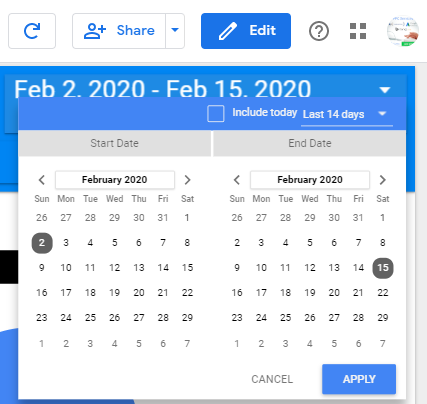
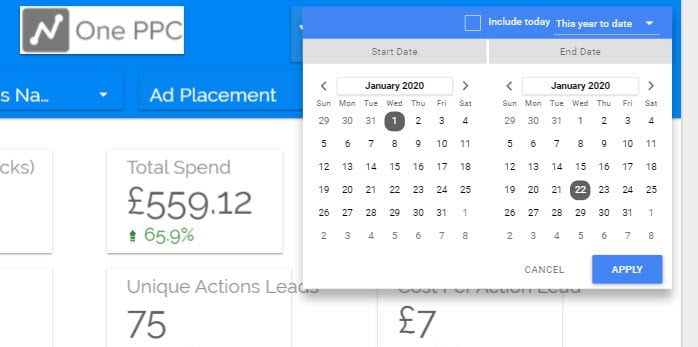
The left-hand side has a calendar which can be changed based on the reporting period you want to view. 

Template Types - by Campaign Objective

We have included several example reports below, covering some of the most frequently used campaign objectives, including Conversions and Lead Ads.

The first two examples focus on Website Conversions. The first is designed for e-commerce businesses, and the second is tailored to lead generation and professional services. The third example is built specifically for Facebook Lead Ads.

Website Conversions- eCommerce Report

The first report example is designed for eCommerce companies looking to measure and optimise their marketing campaigns. It includes approximately eight example images representing the different pages that make up the full report template.

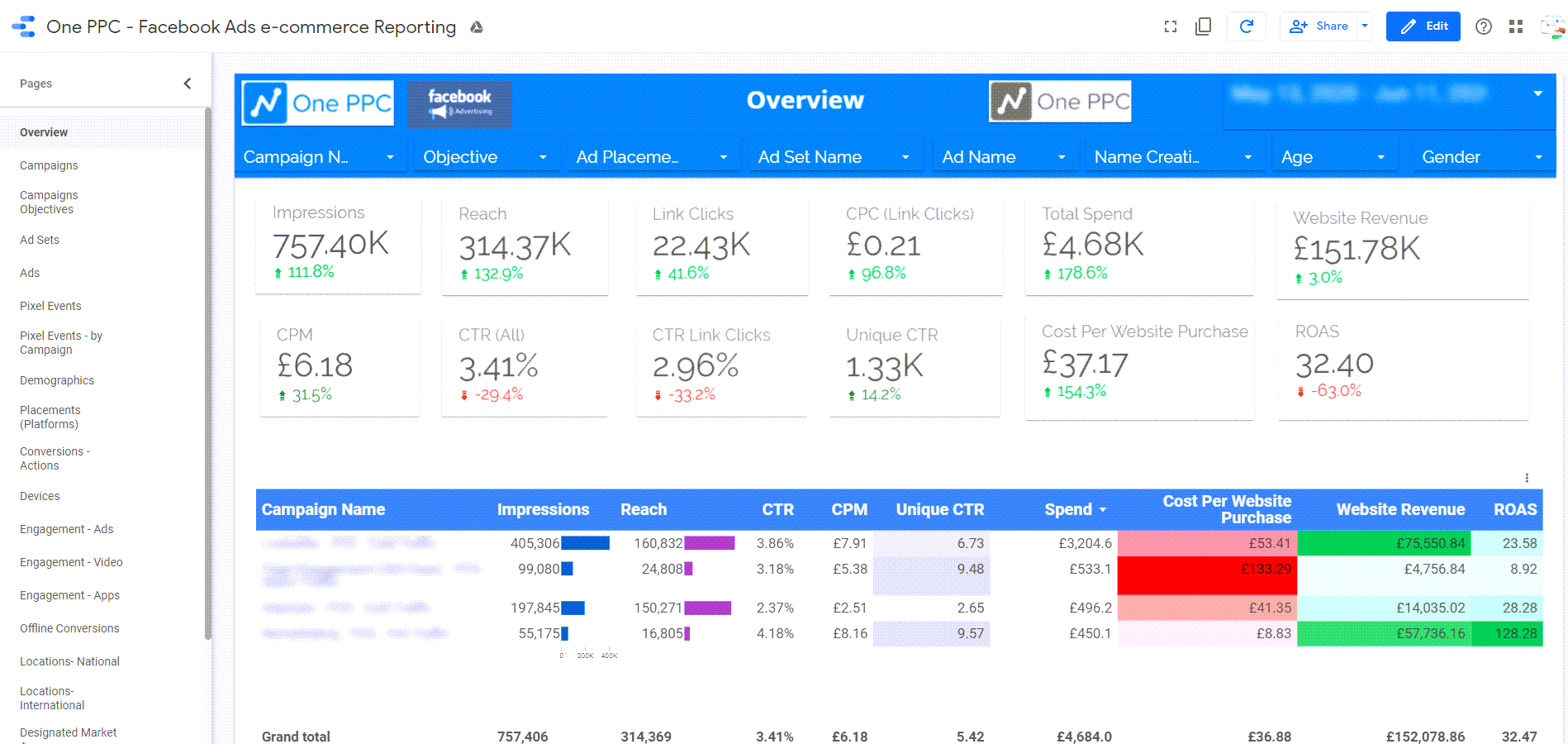
Overview Report

The overview page provides at-a-glance summary statistics. It uses scorecards that compare performance for the selected date range against the previous period.

As with all report pages, you can adjust the date range using the calendar in the top-right corner. A performance table is also included, and this can be customised with additional visuals or resized to suit your reporting preferences.

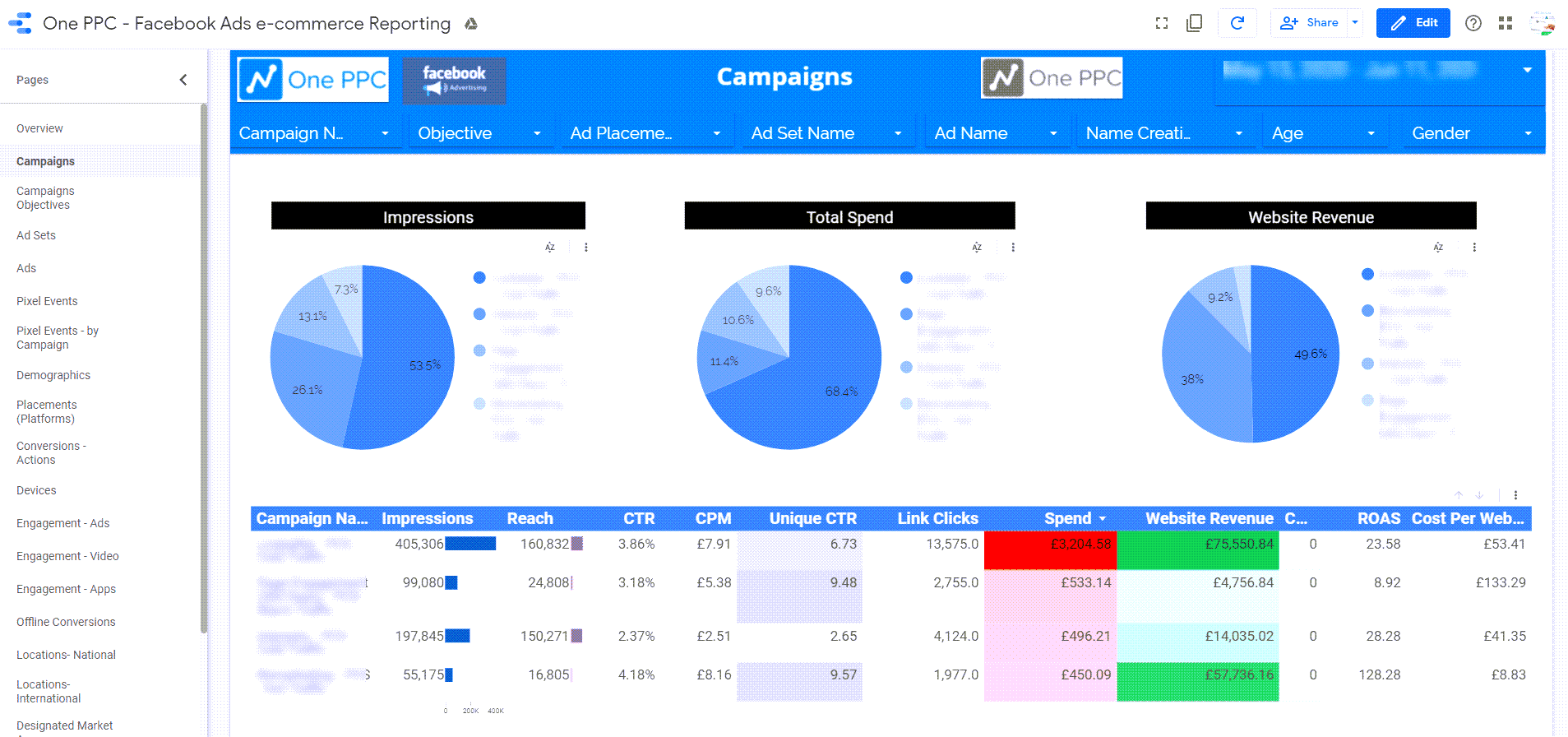
Campaigns Report

This page provides a breakdown of campaigns, including key metrics such as spend, revenue, and ROAS.

In the bottom-right corner, you can scroll through all campaigns within your Facebook Ads account.

Ad Sets Report

Similar to the campaigns page, the ad set report allows you to sort tables and hover over pie charts for additional performance insights.

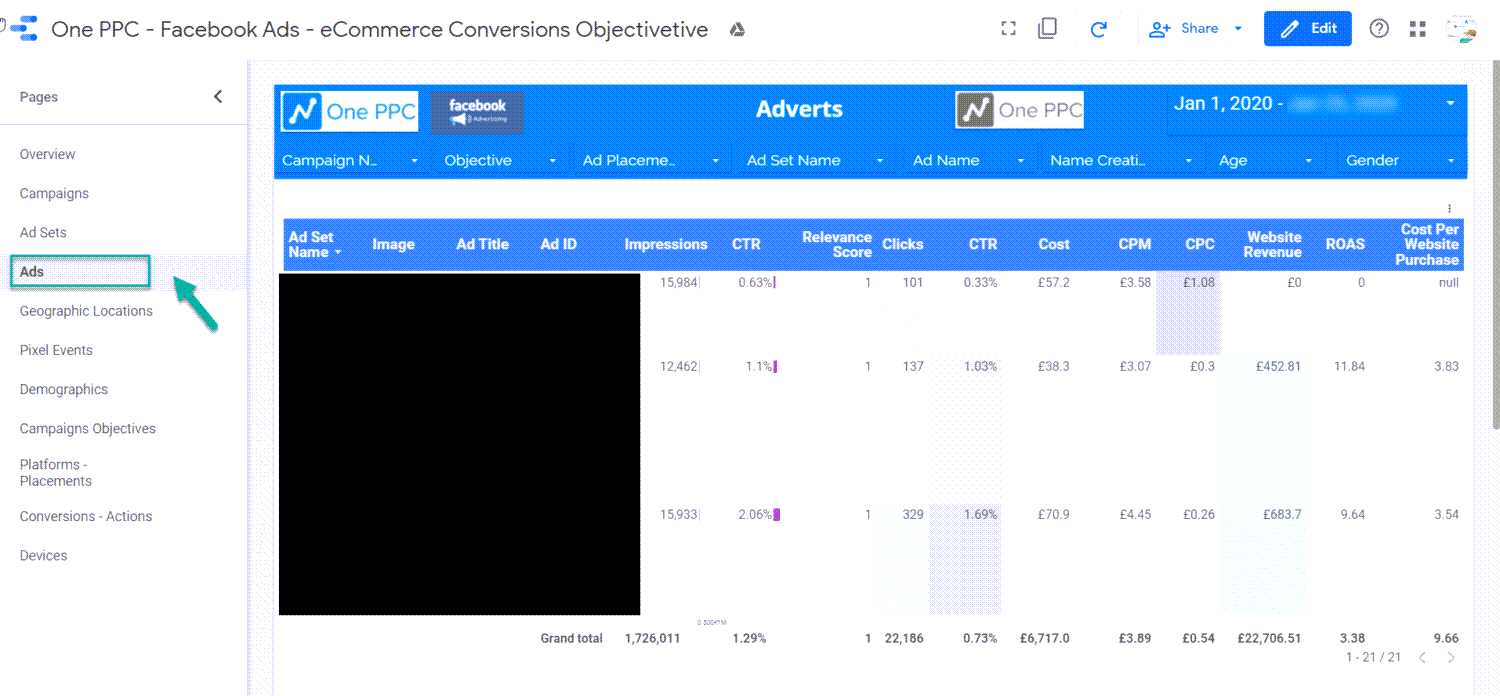
Adverts Creatives Report

This page enables you to review the performance of individual adverts. You can use the menu bar in the top-left corner to filter by campaign or campaign objective.

The preview section displays the image advert currently in use, along with the ad name and ad ID, allowing for clear creative-level analysis.

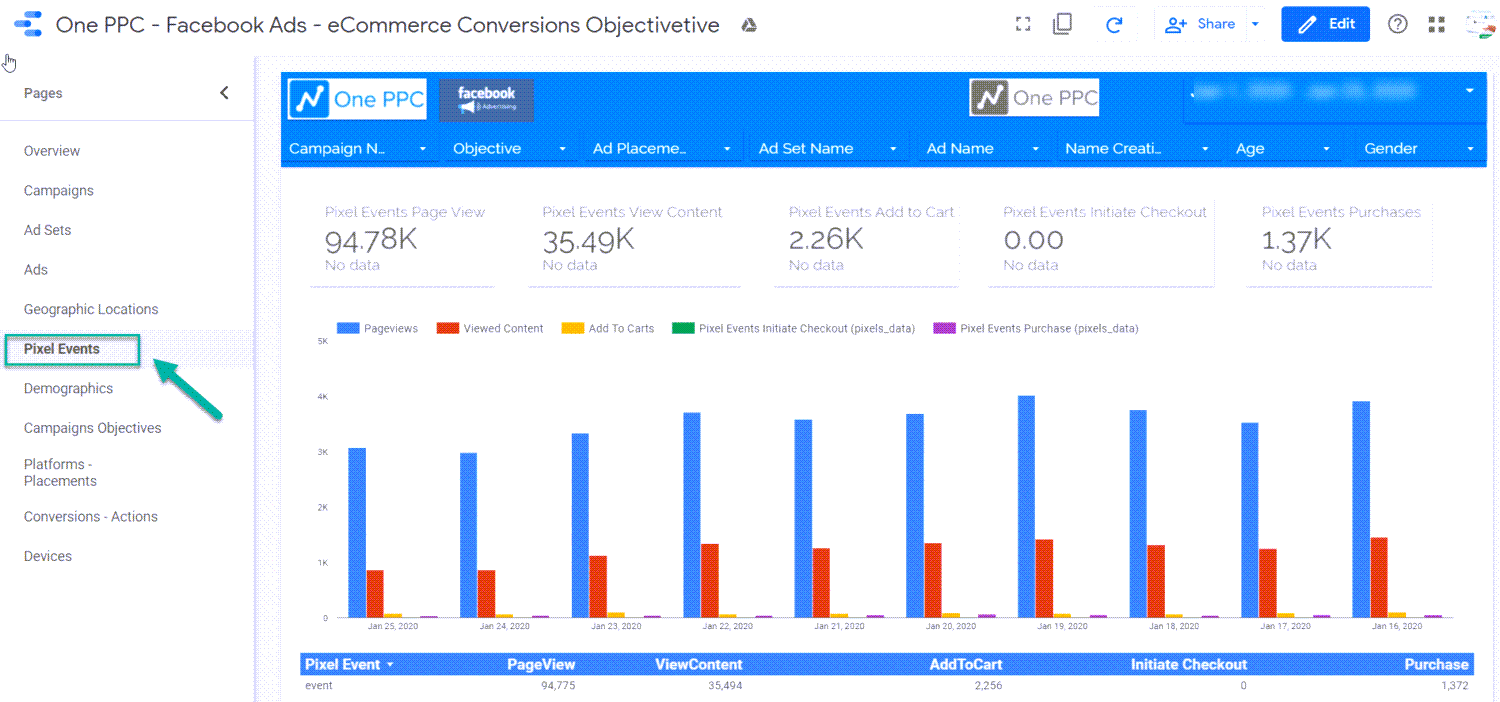
Pixel Event Report

This report displays tracked Pixel events, including:

  • Page View

  • View Content

  • Add to Cart

  • Initiate Checkout

  • Purchase

If an event, such as Initiate Checkout, shows no data, this may indicate that the event code has not been installed correctly.

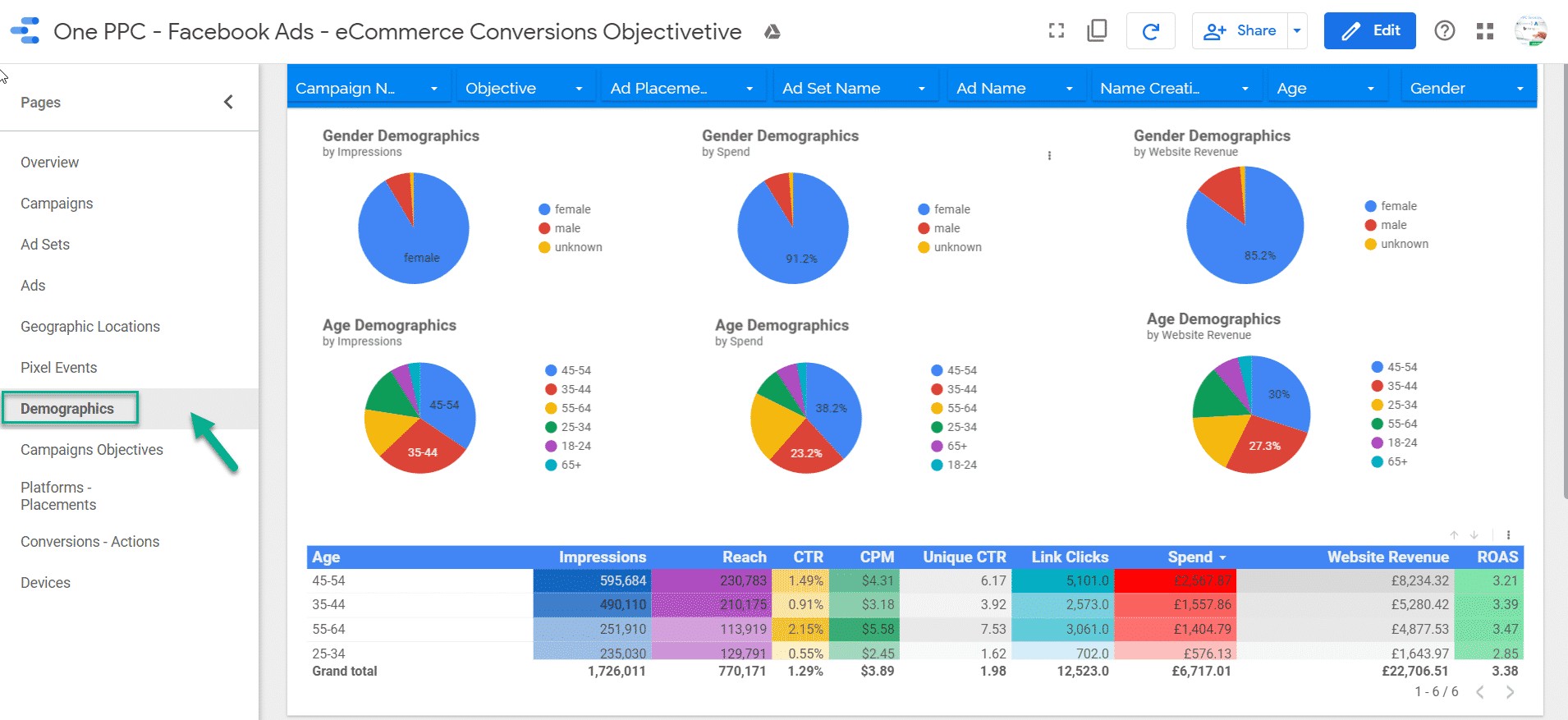
Demographics Report

This page provides demographic insights into your audience, including age and gender breakdowns.

It also allows you to analyse performance by placement, helping you decide whether to run ads across all placements or refine your targeting.

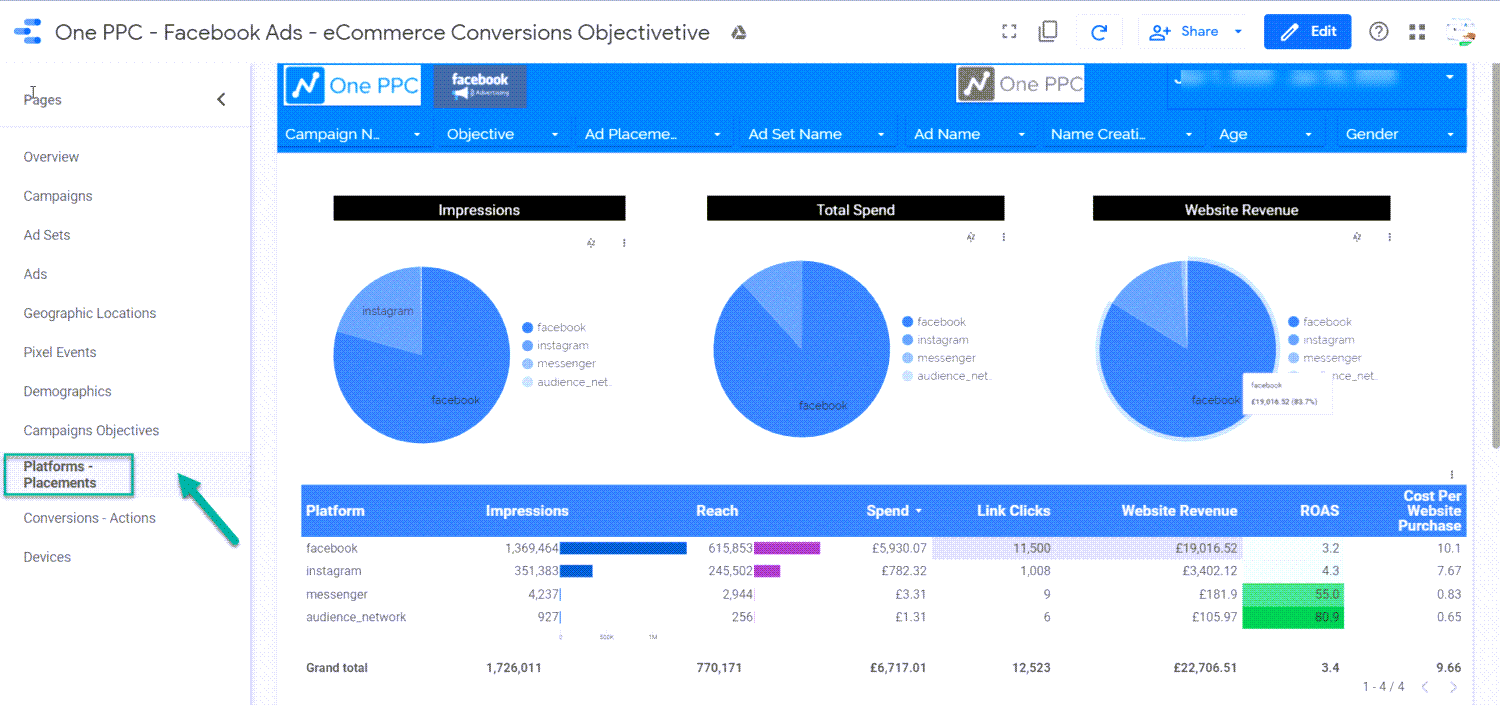
Placements/Platforms Report

This report shows where your Facebook Ads are displayed, including:

  • Facebook

  • Instagram

  • Messenger

  • Audience Network

You can choose automatic placements or manually refine your placement selections based on performance data.

Summary of Facebook eCommerce report.

This Looker Studio template is designed for Website Conversion objectives focused on online sales. Additional campaign reports can be used for other objectives, or merged into a larger, multi-page report depending on your business requirements.

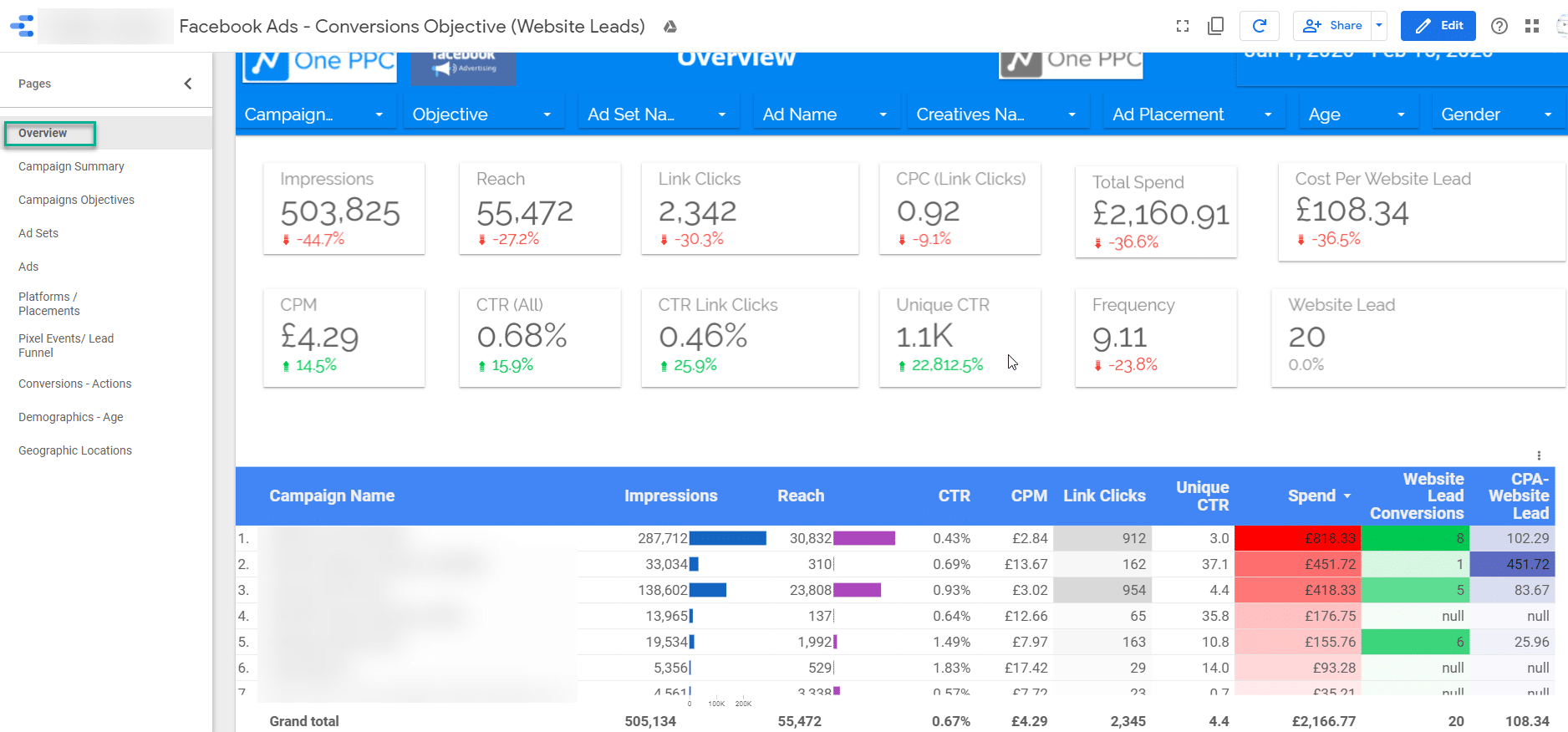
Website Conversions - Lead Gen Report

This report template is used for website conversions objective, but to record leads.  It suits professional services companies that record the number of leads. Conversions can be recorded within Facebook by using a Lead Pixel Event, or using a custom conversion (destination URL thank you page). 

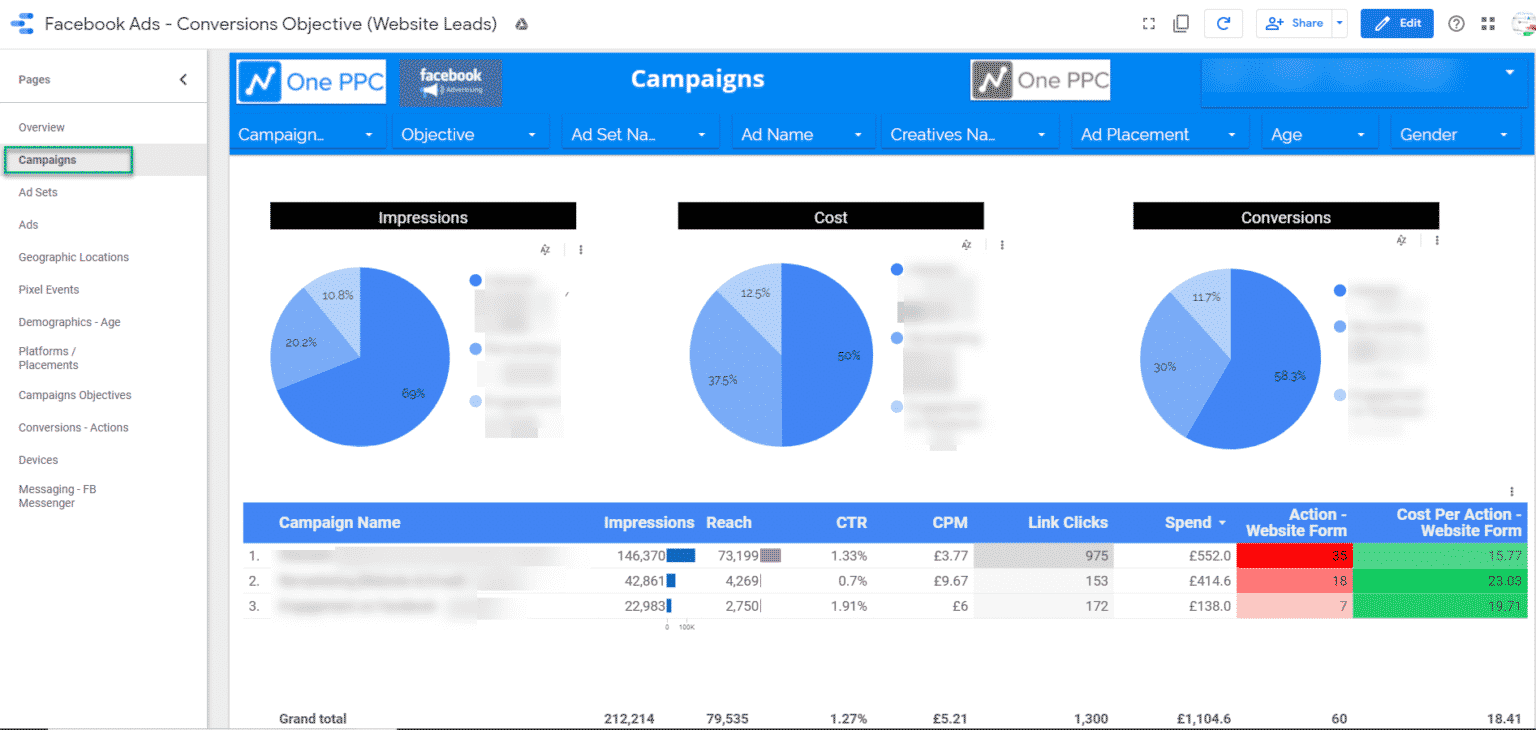
Campaigns Report - Website Conversions Objective

This report provides a breakdown of campaign performance, including metrics such as spend, leads, and cost per lead.

You can scroll through all campaigns in the bottom-right corner.

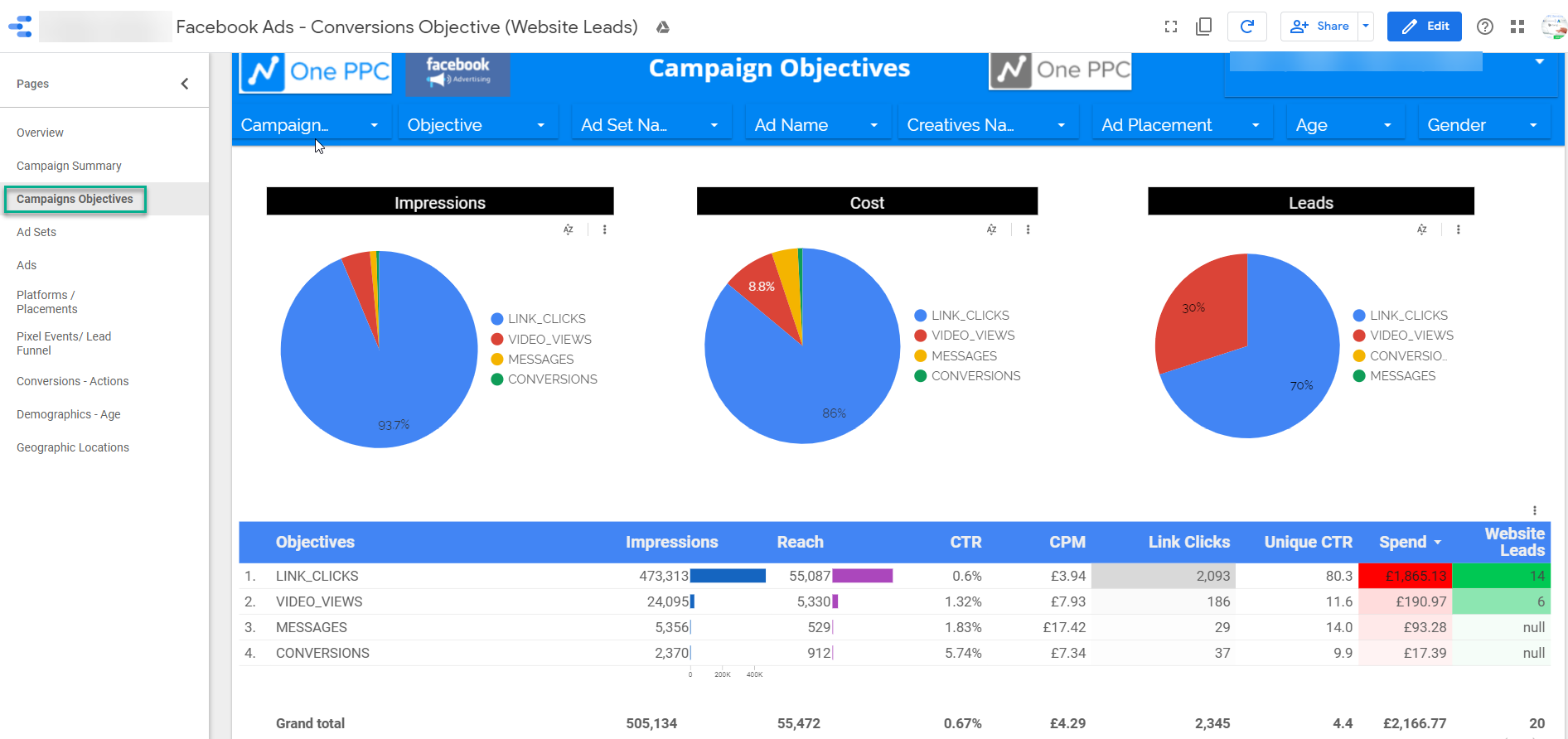
Campaign Objectives - Website Conversions Objective (Leads)

This report page gives a breakdown of campaigns including key metrics such as spend, revenue and ROAS.

The bottom right corner has an option to scroll through all campaigns within your Facebook Ads account. 

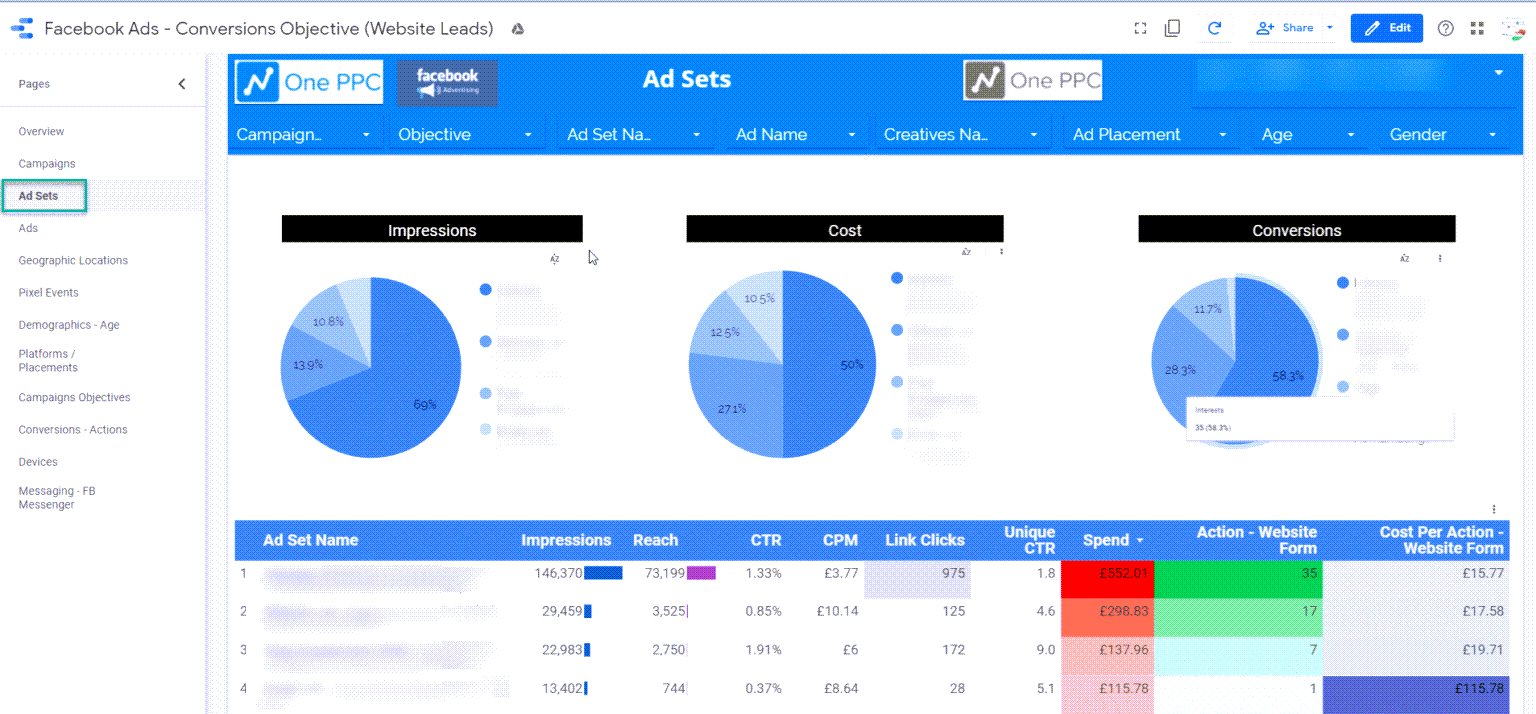
Ad Sets- (Website Conversions Leads Objective)

This report page gives a breakdown of ad sets including key metrics such as spend, revenue and ROAS.

The bottom right corner has an option to scroll through all ad sets within your Facebook Ads account. 

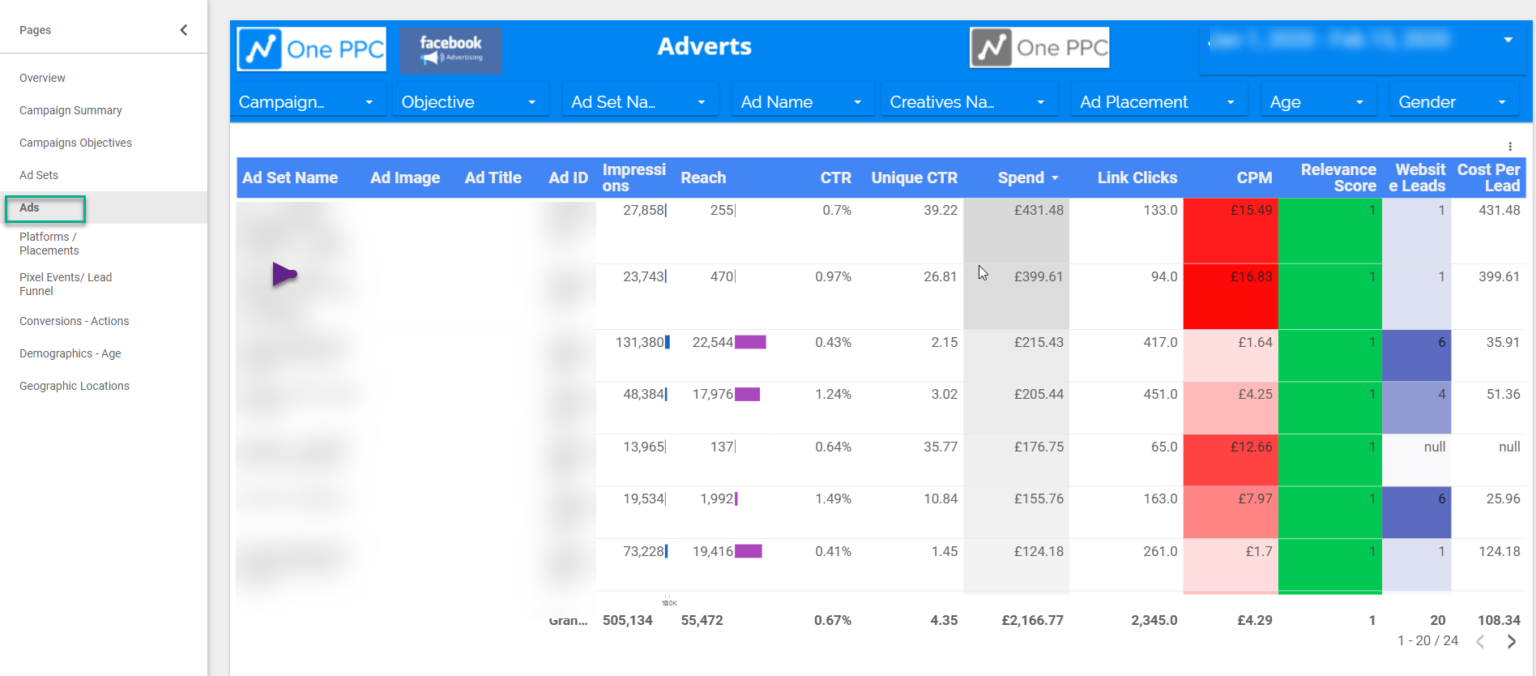
Adverts - (Website Conversions Objective)

This report page shows performance at the advert level, including key metrics relevant to lead generation.

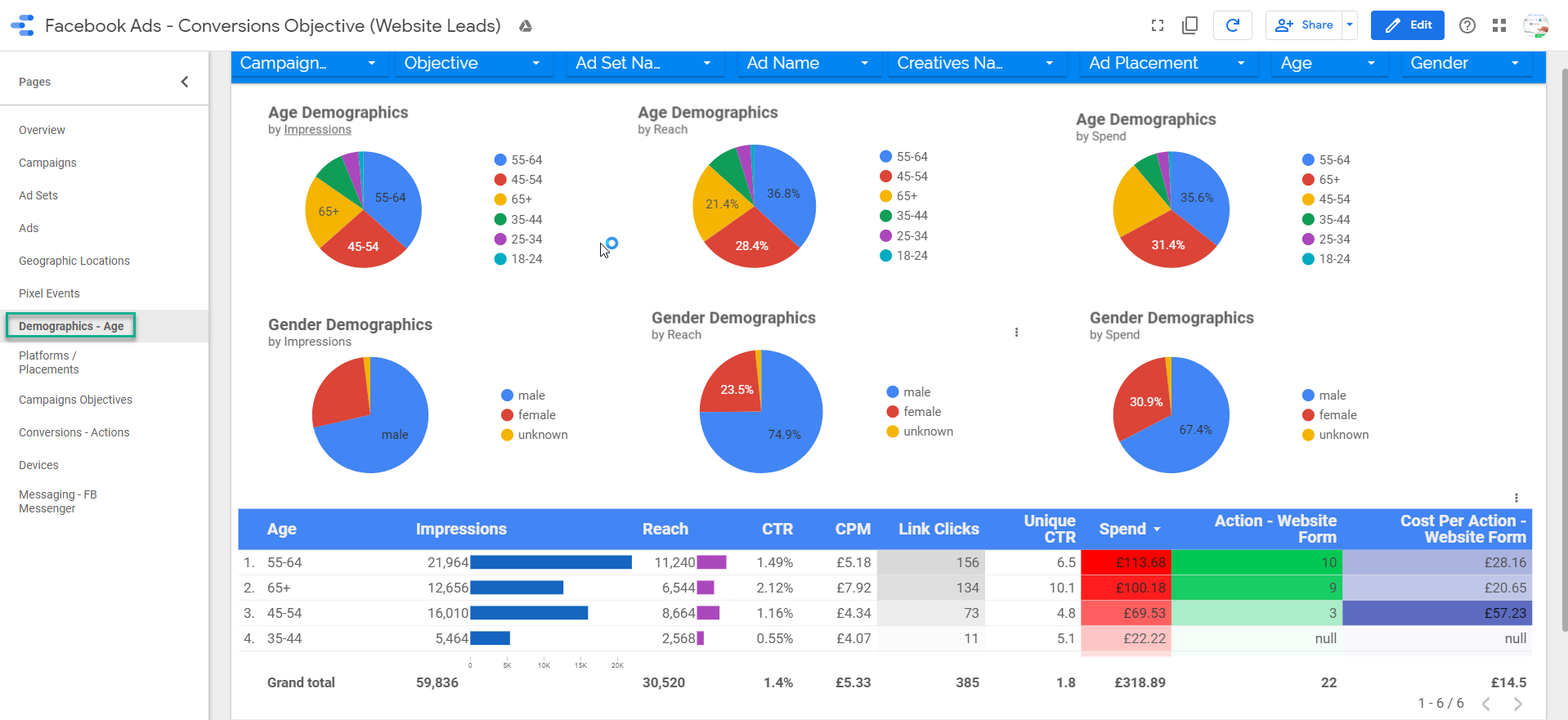
Demographics - (Website Conversions Objective)

This page provides a breakdown of prospects and customers by:

  • Age

  • Gender

  • Campaign

  • Objective

  • Ad set

  • Creative

  • Placement

It allows you to evaluate which audience segments generate the strongest results.

Facebook Pixel: Conversion Tracking

The Facebook Pixel conversion tracking script can be used to record both leads and sales. You can expand tracking to measure each stage of your marketing funnel, enabling more detailed performance analysis.

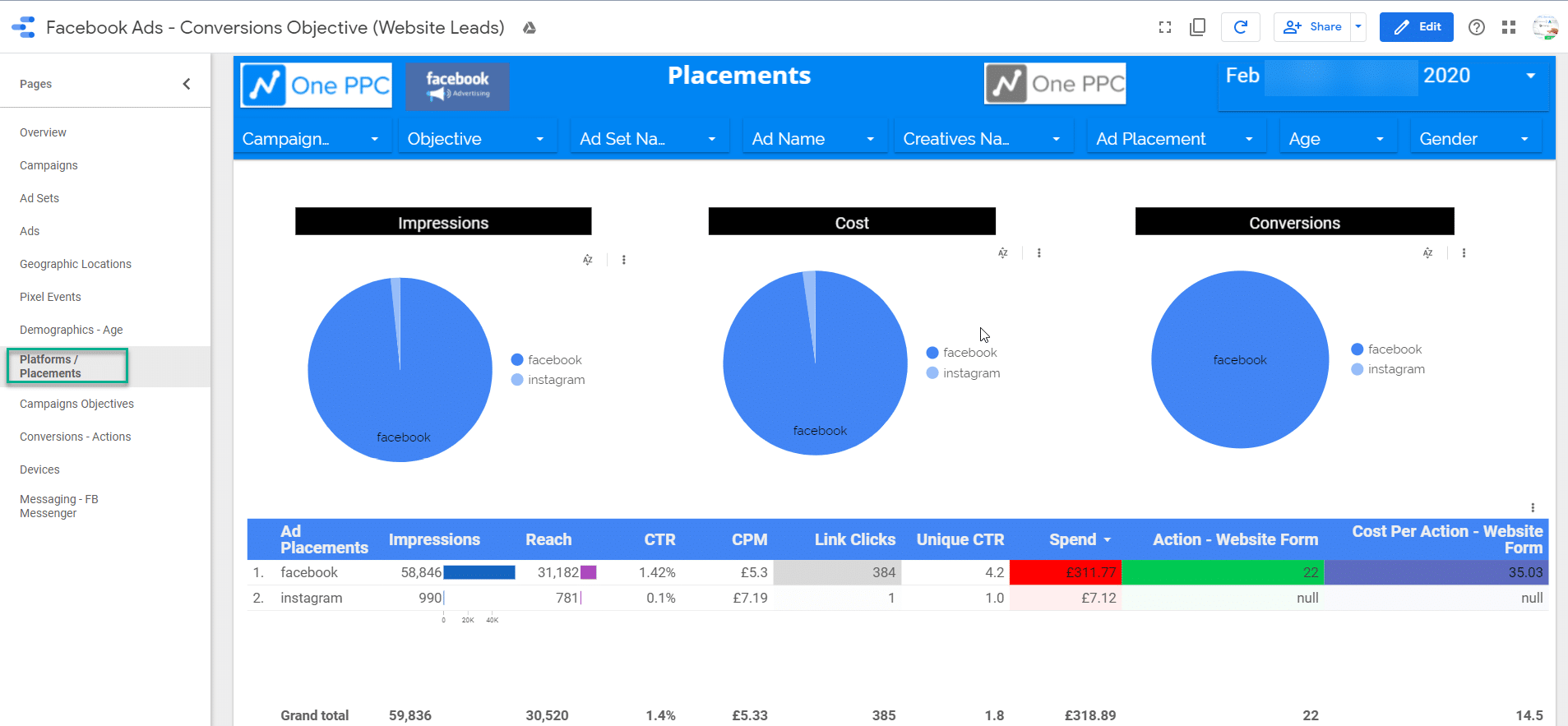
Placements- (Website Conversions Objective)

This page provides a breakdown of performance by placement, allowing you to assess where leads are being generated most efficiently.

Summary of Website Conversions (Website Leads)

Capturing leads via your website and optimising campaigns accordingly is one of the most widely used campaign strategies. It enables measurable, ROI-driven direct response marketing.

Lead Ads - Leads Captured on Facebook

This report template is designed specifically for generating leads directly within Facebook using the Lead Ads objective, rather than directing users to your website.

Even when using Lead Ads exclusively, it is still recommended to install the Pixel with a Lead event. Some conversions may still occur on your website from Facebook traffic.

Overview – Lead Ads Objective

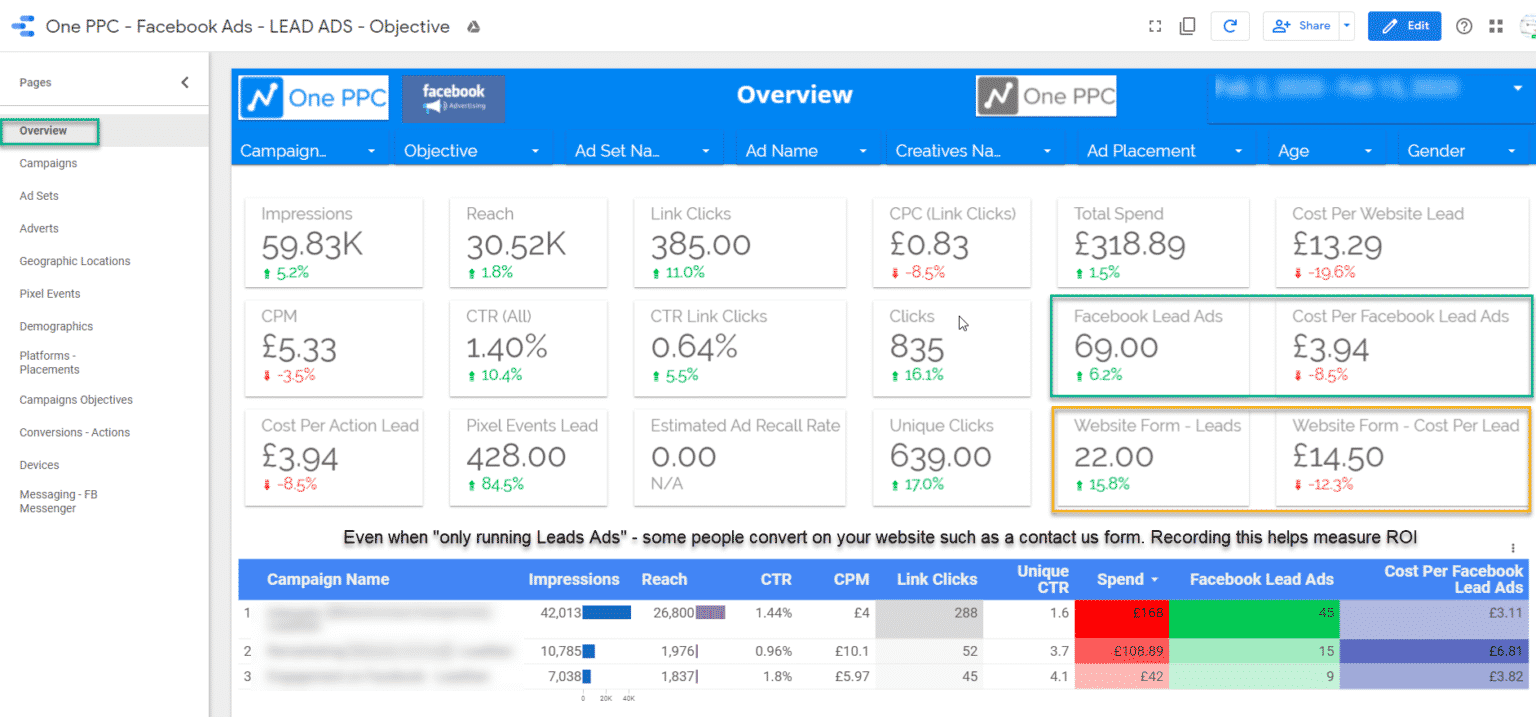
When running a single campaign objective, other types of conversions may still occur. For example, if you are using Facebook Lead Ads, some users may still complete a contact form on your website.

In this report:

  • Green boxes highlight the number of Facebook leads and the cost per lead (on-platform).

  • Yellow boxes highlight the number of website leads and the cost per website lead (off-platform).

Scorecards also display percentage changes compared with the previous period based on the selected date range.

Campaigns - (Leads Ads Objective)

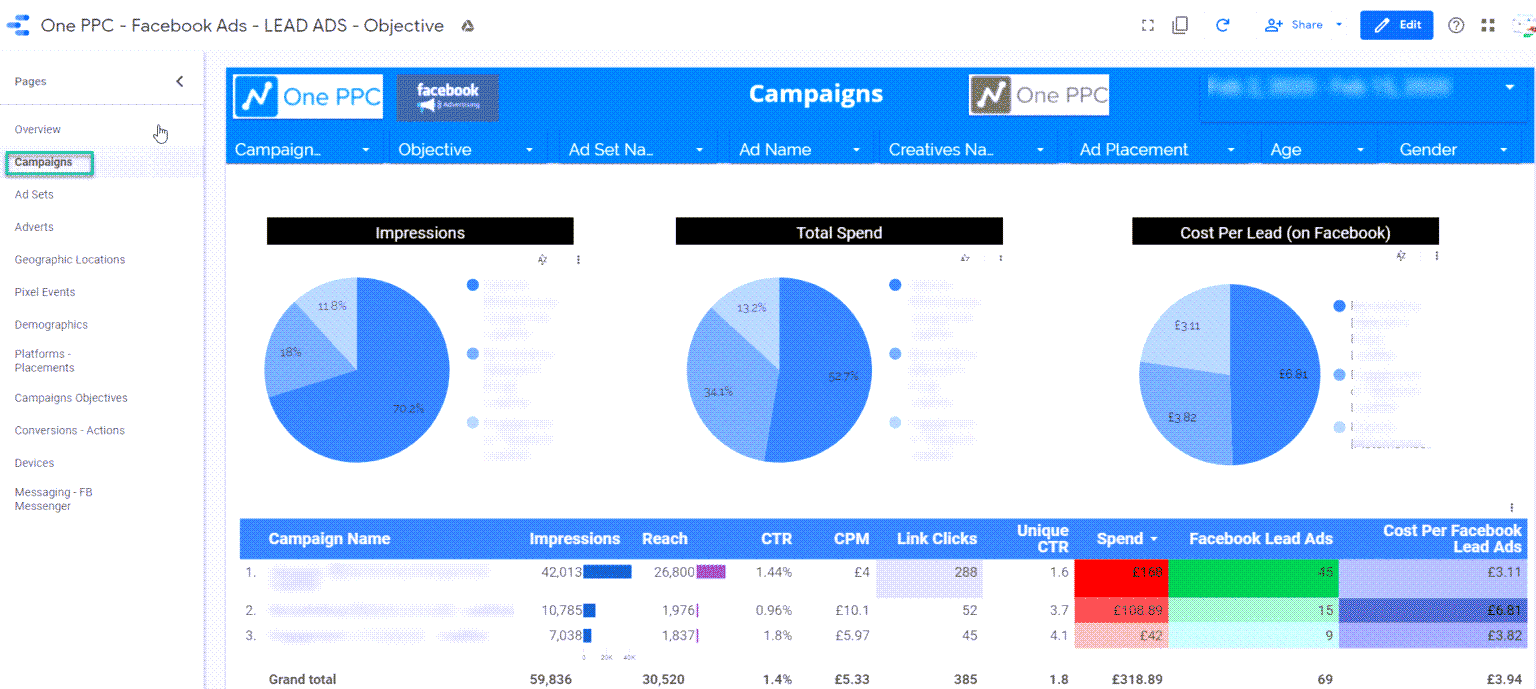
This page displays campaign performance metrics, including impressions, total spend, and cost per lead generated through Facebook Lead Ads.

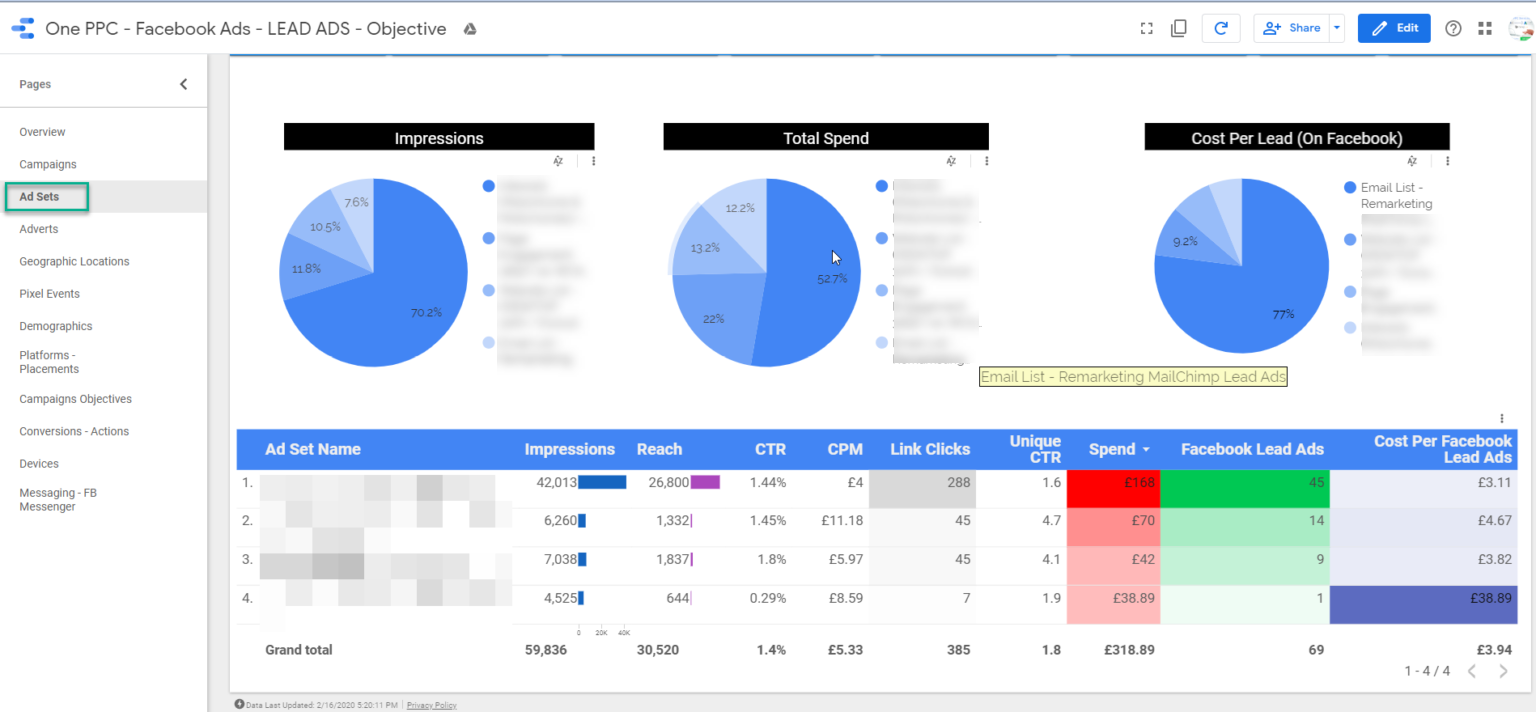
Ad Sets - (Leads Ads Objective)

Each campaign contains at least one ad set. This page provides impressions, spend, and cost per lead at ad set level, enabling detailed optimisation.

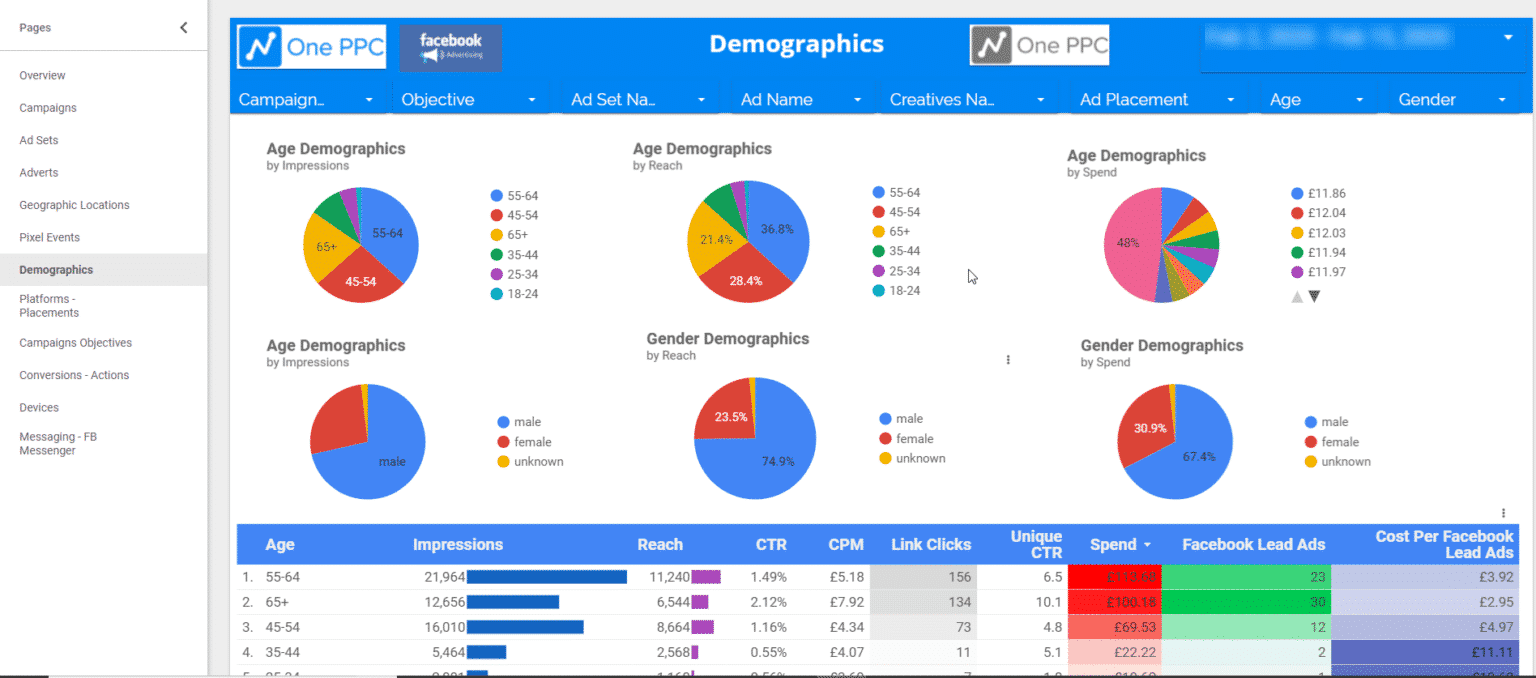
Demographics - (Leads Ads Objective)

Pie charts provide performance breakdowns by age and gender, including impressions, reach, and spend.

A detailed table provides further segmentation by demographic dimensions, allowing for deeper audience analysis.

Facebook Ads Free Looker Studio Template

Signup to our Newsletter

Related Blog Posts