
Google’s AI Max is a collection of artificial intelligence features that can be activated within an existing Search campaign. It gives Google greater freedom to expand keyword targeting, generate ad copy and select alternative landing pages when its systems predict that doing so will improve performance.
AI Max is not a new campaign type, and it does not replace Search campaigns with Performance Max. It is better understood as an additional optimisation layer for Search campaigns.
For advertisers, this distinction matters. A campaign can retain its familiar Search structure—including campaigns, ad groups, keywords, negative keywords and responsive search ads—while allowing Google to automate more of the decisions that traditionally sat with the advertiser.
The potential advantage is additional reach and more individually relevant adverts. The principal risk is reduced control over which searches trigger an advert, what message Google displays and where the visitor lands.
This is particularly important for lead-generation businesses. More conversions do not necessarily mean more qualified leads, customers or revenue.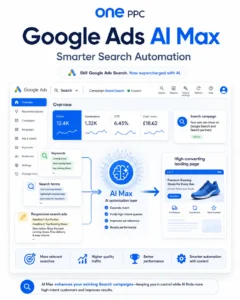
How Does Google Ads AI Max Work?
AI Max combines targeting and creative automation that previously existed across several separate Google Ads features. Its core components are:
Search term matching
Text customisation
Final URL expansion
When the full feature set is enabled, Google can go beyond an advertiser’s keywords, construct a more tailored advert and direct the searcher to a different relevant page on the advertiser’s website.
In simplified terms, AI Max combines elements of Broad Match, Dynamic Search Ads and automatically created assets within a single Search campaign framework.
However, the individual components can be controlled. Search term matching is managed at ad-group level, while text customisation and final URL expansion are campaign-level settings.
AI Max Search Term Matching
Search term matching expands the range of searches for which an ad group can compete. Google uses several sources to understand the products or services being advertised, including:
Existing keywords
Advert headlines and descriptions
Landing-page content
Other pages included through URL controls
The meaning and intent of the user’s search
Real-time signals available to Google’s bidding systems
This involves Broad Match technology as well as keywordless matching. Consequently, an AI Max ad group can enter auctions for relevant searches that are not directly covered by its Exact, Phrase or Broad Match keywords.
This does not mean keywords disappear. Advertisers can continue using conventional keyword targeting, but Google gains another route through which it can match the ad group to searches.
Google has added an AI Max match-type classification and source information to its reporting. This is intended to show whether an additional query was reached through Broad Match expansion or keywordless matching. Search-term reporting can also connect the query with the headline and landing page used for the visit.
Negative keywords continue to apply. They remain one of the most important controls for preventing irrelevant searches, although negative-keyword management becomes reactive: an advertiser must identify and exclude unsuitable themes after they emerge unless they were anticipated beforehand.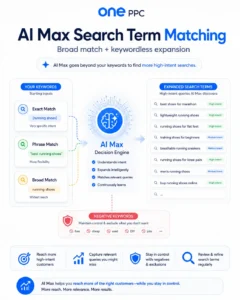
AI Max Text Customisation
Text customisation allows Google to generate additional advert text using information taken from existing adverts, assets and website pages. This feature was previously known as automatically created assets.
The objective is to make the advert more closely reflect each user’s search. For example, Google could identify a particular service on the landing page and generate a headline that is more specific than the advertiser’s original responsive search ad.
This can increase relevance, but it also introduces brand and compliance considerations. Advertisers should check that the website contains accurate, current and suitable marketing language because its content can influence the generated assets.
Google provides asset reporting and allows generated assets to be removed. Text guidelines can also be used to steer automated messaging where the feature is available. Nevertheless, advertisers should not assume that every automatically generated combination will follow the nuance of an internally approved advert.
Businesses in regulated sectors, those with strict offer terms or those that require tightly controlled wording should review this feature especially carefully.
AI Max Final URL Expansion
Final URL expansion allows Google to replace the landing page specified in the advert with another page from the same domain. Google does this when it predicts that another page is more relevant to the search and more likely to produce a conversion.
For a large and well-structured website, this can connect a detailed search with a highly relevant service, category or product page. It can therefore perform a role similar to Dynamic Search Ads.
For a smaller lead-generation website, the outcome may be less helpful. Google could bypass a carefully designed paid-media landing page and send traffic to a blog post, general service page or page with a weaker conversion journey.
Advertisers can use URL inclusions and exclusions to guide which pages are eligible. Before enabling final URL expansion, it is sensible to exclude pages such as:
Blog posts that are primarily informational
Recruitment and careers pages
Privacy policies and legal pages
Customer support content
Existing-customer login pages
Services that are outside the campaign’s scope
Pages without reliable conversion tracking
Final URL expansion requires text customisation because Google needs the generated advert copy to remain consistent with the selected landing page.
There is another significant control issue: when final URL expansion selects a different page, pinned responsive search ad assets may not be respected. Advertisers that require a particular headline or disclaimer to appear in a fixed position should therefore review Google’s current pinning rules before enabling it.
Tracking templates must also be compatible with dynamic landing pages. Google recommends using the {lpurl} parameter correctly so the template can accept whichever landing page AI Max selects. A static or malformed tracking template can override the dynamic URL or produce a 404 error.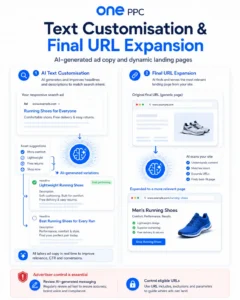
Is AI Max Just Broad Match?
AI Max includes Broad Match technology, but describing it only as Broad Match understates its scope.
Traditional Broad Match expands from a keyword. AI Max can also use keywordless matching based on the wider meaning of the ad group, advert assets and website content. It can then combine that expanded matching with generated advert text and a dynamically selected landing page.
The practical difference is that AI Max can automate three stages of the search journey:
Deciding whether the search is relevant
Deciding which message to display
Deciding which website page should receive the click
That is considerably broader than changing the match type of an individual keyword.
Does AI Max Replace Target CPA or Target ROAS?
No. AI Max is not a bidding strategy.
Search term matching and asset optimisation determine which auctions the campaign may enter and how the advert is constructed. The bidding strategy determines how much Google is prepared to bid in those auctions.
AI Max is designed to operate with conversion-based Smart Bidding, including:
Maximise Conversions
Maximise Conversions with a Target CPA
Maximise Conversion Value
Maximise Conversion Value with a Target ROAS
According to Google’s current documentation, AI Max search term matching does not operate with Manual CPC. This is important for brand campaigns and other tightly controlled campaigns where manual bidding is still used.
Google also warns that AI Max may not be effective when a campaign is limited by budget. Expanded targeting cannot create efficient growth if the campaign lacks sufficient budget to evaluate and pursue the additional opportunities.
AI Max Versus Performance Max
Although both products use Google’s machine learning, they operate differently.
| Feature | AI Max for Search | Performance Max |
|---|---|---|
| Campaign structure | Applied within a Search campaign | Separate campaign type |
| Main inventory | Google Search | Search, Shopping, YouTube, Display, Discover, Gmail and Maps |
| Keywords | Conventional keywords remain available | Search themes are signals rather than standard keywords |
| Ad-group structure | Retained | Replaced by asset groups |
| Search-specific controls | Stronger | More limited |
| Creative automation | Optional AI Max settings | Central to the campaign type |
| Landing-page expansion | Can be enabled or disabled | Available within Performance Max |
AI Max therefore offers a middle position between a conventionally managed Search campaign and the much broader automation of Performance Max. Advertisers retain more Search-specific structure and reporting, but surrender more control than they would in a tightly managed Exact and Phrase Match campaign.
If an AI Max Search campaign and a Performance Max campaign are both eligible for the same query, Google states that the candidate with the highest Ad Rank can serve.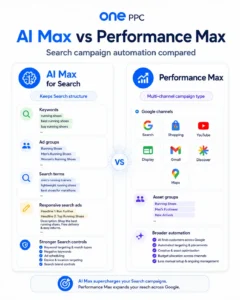
The Potential Benefits of AI Max
Search behaviour is becoming more varied and conversational. Users can express the same underlying requirement through thousands of different query combinations, making it difficult to cover every valuable search with manually selected keywords.
AI Max may help advertisers:
Discover valuable long-tail searches not covered by the existing keyword list
Adapt advert messaging more closely to the searcher’s intent
Send visitors to a more specific page on a large website
Reduce the need to maintain extensive Dynamic Search Ad structures
Consolidate several automation features within a standard Search campaign
Use brand, location and URL controls to guide automated expansion
Google reports that advertisers using the complete AI Max feature set have, on average, generated additional conversions or conversion value at a similar CPA or ROAS. As with all aggregated Google performance claims, this should be treated as a case for testing—not as a forecast for an individual account.
Performance will depend on conversion quality, website structure, existing campaign coverage, budget, bidding strategy and the accuracy of the signals supplied to Google.
The Risks for Lead-Generation Campaigns
AI Max is capable of increasing conversion volume while simultaneously reducing commercial quality.
Google can only optimise towards the conversion information it receives. If every form submission is reported as an equally valuable conversion, the system cannot reliably distinguish between:
A genuine sales enquiry
An existing customer seeking support
A job application
A supplier enquiry
Spam
A prospect outside the service area
A high-value opportunity
Expanded search matching can locate more people who are willing to complete a form, but that is not necessarily the same as locating more prospective customers.
Lead-generation advertisers should therefore assess AI Max using downstream CRM outcomes rather than relying exclusively on the conversion column in Google Ads.
Useful commercial measures include:
Cost per qualified lead
Sales-qualified lead volume
Appointment or consultation rate
Quote rate
Customer acquisition cost
Conversion from lead to customer
Pipeline value
Revenue and return on advertising spend
If Google receives qualified-lead, converted-lead and revenue data through offline conversion tracking, Smart Bidding has a better chance of learning which AI Max searches create genuine business value.
Conversion Tracking Requirements Before Testing AI Max
AI Max increases the importance of conversion measurement. More automation means the campaign depends more heavily on the quality of its feedback signals. This makes a strong Google Ads conversion tracking setup essential before testing additional automation.
Before testing AI Max for lead generation, an account should ideally have:
A reliable Google Ads conversion tag or correctly configured conversion source
Primary conversions limited to commercially significant actions
Calls tracked beyond a simple telephone-button click
Spam and duplicate leads excluded where possible
GCLID, GBRAID and WBRAID values captured where applicable
CRM stages mapped consistently
Qualified leads and customers returned to Google Ads as offline conversions
Conversion values that reflect meaningful differences in lead quality or revenue
A telephone-button click, page view or short call should not carry the same optimisation weight as a qualified enquiry or completed sale.
For businesses using a CRM such as HighLevel or HubSpot, a dedicated CRM integration with Google Ads can help preserve attribution data and improve offline conversion tracking., The strongest setup is usually to preserve the advertising identifiers and attribution data on the contact record, then send later lifecycle outcomes back to Google Ads. This changes the optimisation objective from finding people who submit forms to finding people who become commercially valuable leads or customers.
Controls Available Within AI Max
AI Max is more automated, but it is not entirely uncontrolled. Depending on campaign configuration and feature availability, advertisers can use:
Negative keywords
Campaign-level brand exclusions
Brand inclusions at campaign or ad-group level
Locations of interest at ad-group level
URL inclusions
URL exclusions
Search term matching controls at ad-group level
Separate controls for text customisation and final URL expansion
Text or messaging guidelines for generated content
Search-term, landing-page and asset reporting
These controls should be configured before the test begins. They are not a substitute for reviewing actual search terms, generated assets, landing pages and lead quality after launch.
How to Test AI Max Safely
AI Max should normally be evaluated through an experiment rather than enabled across every eligible Search campaign at once. A structured Google Ads audit can help identify whether conversion tracking, campaign structure and search-term controls are ready before testing.
A structured test should follow these principles:
Select a campaign with reliable tracking and sufficient conversion volume.
Confirm that the campaign is not severely limited by budget.
Review primary conversion actions and remove weak optimisation signals.
Upload qualified-lead or sales outcomes wherever possible.
Establish URL exclusions before activating final URL expansion.
Review website content that could be used to generate advert copy.
Preserve a comparison group through a Google Ads experiment where available.
Allow enough time and conversion volume for a meaningful comparison.
Compare qualified leads, customers and revenue—not merely form submissions.
Review search terms, generated text and selected landing pages throughout the test.
Advertisers do not necessarily need to test every component simultaneously. A cautious first experiment could enable search term matching while leaving text customisation and final URL expansion disabled. This isolates the effect of expanded query matching while protecting approved advert wording and dedicated landing pages.
The complete feature suite could then be tested separately if the initial results support further automation.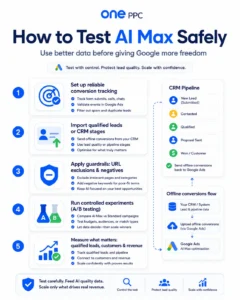
When AI Max Is Most Likely to Work Well
AI Max is more likely to be useful when:
The account has accurate, high-volume conversion data
Offline lead-quality or revenue signals are available
The campaign has enough budget to explore additional demand
The website contains several strong, clearly differentiated landing pages
The advertiser serves a broad range of closely related searches
Existing keyword coverage leaves genuine long-tail opportunities uncaptured
The business can tolerate some exploration while the system learns
Large websites with comprehensive service or product content may benefit particularly from the combination of keywordless matching and landing-page selection.
When Advertisers Should Be More Cautious
AI Max deserves greater scrutiny when:
The campaign has very low conversion volume
Lead quality is not recorded in the CRM
The budget is small or tightly constrained
The service is highly specialised
Irrelevant enquiries are expensive for the sales team
The website contains mixed services or informational content
Advert wording must meet strict legal or brand requirements
A dedicated landing page is fundamental to conversion performance
The advertiser relies on Manual CPC
The campaign targets a tightly defined local area
In these circumstances, Exact and Phrase Match targeting with carefully written adverts may still provide the stronger starting point. AI Max can be introduced later, once tracking and offline conversion data are sufficiently mature.
Is AI Max Replacing Dynamic Search Ads?
AI Max is becoming Google’s successor to Dynamic Search Ads. It retains the ability to use website content to identify relevant searches and landing pages, while adding broader intent signals, generated text and additional controls.
Google originally planned to begin automatically upgrading Dynamic Search Ads in September 2026. It subsequently extended the timetable: the Dynamic Search Ads sunset and automatic migration are now scheduled to begin in February 2027.
However, eligible Search campaigns using automatically created assets or the campaign-level Broad Match setting are still scheduled to begin upgrading into the AI Max framework from September 2026.
An automatic upgrade does not necessarily mean that every AI Max capability will suddenly be enabled. Google says migrated settings will be configured to reflect the legacy features previously used by the campaign. Advertisers should still review each migrated campaign rather than assume that the resulting configuration is appropriate.
Should You Use Google Ads AI Max?
AI Max should be treated as an opportunity to test broader Search automation, not as a universal upgrade that every campaign requires.
Its underlying proposition is credible: search queries are becoming more complex, and machine learning can identify patterns that a manually maintained keyword list may miss. The additional reporting and control features make AI Max more transparent than simply replacing Search with a fully automated cross-channel campaign.
Nevertheless, its success depends on the objective Google is given. When the platform is optimising towards poor-quality conversion signals, increasing its freedom can magnify the problem. When it receives accurate qualified-lead, sales and revenue data, the same automation has a much stronger commercial foundation.
For lead-generation advertisers, the correct question is therefore not:
Did AI Max generate more conversions?
It is:
Did AI Max generate more qualified leads, customers and revenue at an acceptable acquisition cost?
That distinction should determine whether the feature is expanded, restricted or switched off.
Frequently Asked Questions About AI Max
Is AI Max a separate Google Ads campaign type?
No. AI Max is activated within a Search campaign. The campaign retains its Search structure while gaining additional automated targeting and creative features.
Can AI Max work with Exact and Phrase Match keywords?
Yes. Existing keywords can remain in the campaign. However, AI Max search term matching can reach additional queries through Broad Match and keywordless technology.
Does AI Max respect negative keywords?
Yes. Google states that negative keywords continue to apply when AI Max is enabled.
Can AI Max change my landing page?
Yes, if final URL expansion is enabled. URL exclusions and other URL controls should be used to prevent unsuitable pages from receiving paid traffic.
Can AI Max rewrite my adverts?
Text customisation can generate assets using existing adverts, website content and other available assets. It can be disabled independently of search term matching.
Does AI Max work with Manual CPC?
The complete capability does not. Google states that AI Max search term matching does not work with Manual CPC because it depends on conversion-based automated bidding signals.
Is AI Max the same as Performance Max?
No. AI Max applies automation to Search campaigns. Performance Max is a separate campaign type capable of serving across multiple Google channels.
What should lead-generation advertisers measure?
Measure qualified leads, appointments, sales opportunities, customers, revenue and acquisition cost. Raw form submissions alone are not a reliable basis for judging AI Max.
Related Google Ads Resources
For advertisers wanting to improve their Search campaign performance, these related guides may also be useful: