
Responsive search ads are the standard text-ad format used in Google Ads Search campaigns. Instead of writing one advert with a fixed sequence of headlines and descriptions, advertisers provide a collection of assets that Google can combine in different ways.
A responsive search ad can contain up to:
15 headlines
Four descriptions
Two display-path fields
One final landing-page URL
When somebody searches on Google, the system selects an eligible combination based on the search, campaign settings and predicted performance. An advert may show up to three headlines and two descriptions, although fewer can appear when the available space or format is limited.
This gives Google more flexibility, but it also gives advertisers a different creative challenge. The objective is no longer simply to write one persuasive advert. You must create a collection of headlines and descriptions that can work both independently and in different combinations.
The strongest responsive search ads achieve three things:
They closely reflect the user’s search intent.
They communicate a compelling and credible reason to choose the business.
They send the visitor to a landing page that fulfils the promise made in the advert.
Google’s automation controls which eligible combination appears, but the advertiser still controls the strategy, offer, messaging, targeting, landing page and conversion data.
What Is a Responsive Search Ad?
A responsive search ad, commonly abbreviated to RSA, is an adaptable Search advert assembled from multiple advertiser-supplied headlines and descriptions.
For example, a roofing company could provide headlines such as:
Local Roofing Company
Roof Repairs in Bristol
Request a Free Roofing Quote
Emergency Repairs Available
Experienced Local Roofers
Fully Insured Roofing Team
Repair or Replace Your Roof
Book Your Roof Inspection
Descriptions might include:
Request a free roofing quotation from an experienced local team.
Roof repairs, replacements and emergency call-outs across Bristol.
Fully insured roofers with clear quotations and reliable workmanship.
Speak with a local roofing specialist and arrange an inspection today.
Google can combine these assets differently depending on the auction. One searcher may see a location-focused message, while another sees a stronger emphasis on emergency availability or obtaining a quotation.
This flexibility can help the advert accommodate more searches, devices and available placements. However, it does not mean every combination will be equally persuasive, nor does it remove the need for tightly themed Google Ads ad groups.
If one ad group contains several unrelated services or forms of intent, an RSA will struggle to provide a convincing response to every search.
Responsive Search Ads Versus Expanded Text Ads
Expanded text ads used a comparatively fixed structure. Advertisers selected the headlines and descriptions, and the ad normally displayed those components in the specified order.
Responsive search ads changed this model by separating the creative into assets that can be recombined.
| Feature | Expanded text ads | Responsive search ads |
|---|---|---|
| Maximum headlines supplied | 3 | 15 |
| Maximum descriptions supplied | 2 | 4 |
| Advertiser controls the default order | Yes | Partially, using pinning |
| Google tests different combinations | Very limited | Yes |
| Standard editable Search format | No | Yes |
Expanded text ads may still appear within the historical data of older accounts, but responsive search ads are now the principal editable text-ad format for Search campaigns.
The important distinction is control. An RSA offers more creative flexibility, but the advertiser does not completely control which eligible assets will appear together unless pinning is used.
How Responsive Search Ads Work
Every time an eligible search occurs, Google conducts an advertising auction. The system evaluates the available adverts, bids, targeting, advert and landing-page quality, auction context and expected effect of additional assets.
If your RSA is eligible, Google selects the headlines and descriptions it predicts will be most useful in that particular context.
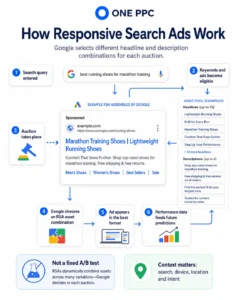
The process can be summarised as:
The searcher enters a query.
Google determines which keywords and adverts are eligible.
An auction takes place.
Google selects an eligible RSA asset combination.
The advert appears in an appropriate format.
Performance data contributes to future predictions.
Google may test different combinations over time, but the system does not necessarily distribute traffic equally across every possible combination. It prioritises the combinations it predicts are more likely to perform.
This is not a conventional A/B test in which two complete adverts receive an equal and random share of traffic. It is an automated selection system operating within each auction.
Responsive Search Ad Character Limits
The current responsive search ad limits are:
| Component | Limit |
|---|---|
| Headlines | Up to 15 |
| Characters per headline | 30 |
| Descriptions | Up to 4 |
| Characters per description | 90 |
| Display-path fields | 2 |
| Characters per path | 15 |
The final URL determines the page somebody visits. The display paths provide additional context within the visible advert URL but do not need to represent real website folders.
For example:
Final URL:https://example.co.uk/services/roof-repairs
Display URL:example.co.uk/Roofing/Repairs
Headlines and descriptions may also be shortened in some placements. The advert preview is therefore a guide rather than a guarantee that every asset will always appear in full.
Google now also has greater flexibility over where RSA assets can appear. In certain layouts, unused RSA headlines may be presented as link-based elements pointing to the same domain. This makes it even more important that each headline is accurate, useful and understandable by itself.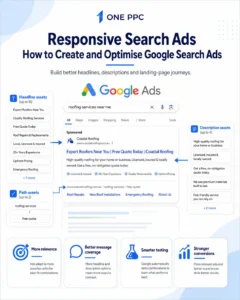
The Advantages of Responsive Search Ads
Responsive search ads provide several genuine advantages when they are built around a clear strategy.
Greater Message Coverage
A single RSA can contain headlines addressing different elements of the buying decision, including:
The service or product
Location
Customer problem
Primary benefit
Competitive advantage
Price or promotion
Trust and credibility
Call to action
Availability
Eligibility or suitability
This makes it possible to cover more customer motivations without creating dozens of nearly identical adverts.
Better Adaptation to Search Intent
Different searches may express slightly different needs.
Someone searching for “emergency roof repair” may respond to speed and availability. Someone searching for “roof replacement quotation” may care more about price, guarantees and workmanship.
When both searches genuinely belong in the same ad group, an RSA gives Google several relevant messages from which to choose.
However, flexibility should not be used to compensate for poor account structure. If searches require fundamentally different offers, adverts or landing pages, they should usually be separated.
Our Google Ads account structure guide explains how to group searches around shared intent rather than arbitrary keyword limits.
Compatibility With Different Placements
The number of headlines and descriptions shown can vary according to device, screen size and available advertising space.
Responsive formatting gives Google more options for adapting an advert without requiring a separate version for every possible layout.
Faster Creative Deployment
An advertiser can provide a broad collection of useful messages within one RSA instead of manually building every possible variation.
This can reduce repetitive advert creation, particularly across larger accounts. The time saved should be reinvested in more valuable work, such as:
Researching customer language
Reviewing search terms
Improving offers
Testing landing pages
Analysing lead quality
Connecting CRM and sales outcomes
More Useful Asset Reporting
Google Ads provides RSA asset reporting showing how individual headlines and descriptions have served.
Full asset-level performance statistics are now available for eligible data from 5 June 2025 onwards, replacing the older dependence on broad labels such as “Low”, “Good” and “Best”. Advertisers can inspect metrics associated with individual assets and review the combinations that have received impressions.
However, asset statistics still need careful interpretation because assets are not necessarily shown under identical conditions. A headline that receives more conversions may also have appeared more frequently, entered different auctions or been combined with different supporting assets.
The Limitations of Responsive Search Ads
RSAs are useful, but their flexibility introduces several limitations.
Reduced Control Over the Final Message
Two individually strong headlines can become repetitive when shown together.
For example:
Get a Free Roofing Quote
Request Your Free Quote
Free Roof Quotations
Each headline may be acceptable by itself, but displaying several together wastes space and produces an awkward advert.
Every asset should contribute something distinct.
Not Every Asset Combination Receives Equal Testing
An RSA with 15 headlines and four descriptions has a very large number of potential combinations. Google will not necessarily test every combination evenly—or at all.
The system selects combinations based on predicted performance. Consequently, RSA optimisation should not be described as a clean, controlled test of every headline against every other headline.
Limited Visibility Into Cause and Effect
Even with improved asset statistics, determining why one component performed better can remain difficult.
Results may be affected by:
Search intent
Keyword matching
Device
Location
audience context
Advert position
Supporting assets
Landing page
Time and seasonality
The other headlines and descriptions shown
Asset reports provide evidence, but they do not turn every RSA into a laboratory-quality experiment.
Automation Can Produce Weak Combinations
Google can only combine the assets it is given. If the inputs are repetitive, vague or incompatible, the resulting advert may also be weak.
Machine learning does not repair an unclear offer or invent a meaningful competitive advantage.
Excessive Pinning Restricts Flexibility
Pinning gives advertisers more control, but each pin reduces the number of possible combinations.
This is not automatically a problem. Control may be more important than maximum flexibility when:
A legal disclaimer must appear.
A regulated statement is required.
The brand name must always be included.
The offer could be misunderstood without context.
A particular message must precede another.
Brand wording must follow strict approval rules.
The purpose of pinning is to manage a genuine message requirement—not merely to satisfy a preference about how the advert looks.
Ad Strength Versus Advert Performance
Ad Strength is Google’s assessment of the quantity, relevance and diversity of the creative assets provided within an RSA.
The possible ratings include:
Poor
Average
Good
Excellent
Google may recommend:
Adding more headlines
Making headlines more distinctive
Including popular keywords
Avoiding repetitive wording
Adding further descriptions
Reducing unnecessary pinning
Ad Strength can be a useful creative checklist. It may identify an advert with too few assets or excessive repetition.
However, Google confirms that Ad Strength does not directly determine whether an advert serves. It is not a component of Ad Rank or Quality Score, and an “Excellent” rating does not guarantee more customers, a lower CPA or a higher return on advertising spend.
This distinction matters.
A business should not replace a commercially strong headline with generic wording simply to satisfy the interface. Nor should it remove essential pins if doing so creates a misleading or non-compliant advert.
Use Ad Strength as diagnostic feedback, then judge actual performance using business metrics such as:
Conversion rate
Cost per conversion
Qualified-lead rate
Cost per Qualified Lead
Sales Opportunity rate
Customer acquisition cost
Revenue
Return on advertising spend
Profit
The interface grade is not the objective. Commercial performance is.
How to Write Effective RSA Headlines
A strong collection of RSA headlines normally contains several different message categories.
Search and Service Relevance
Use headlines that clearly identify the product, service or solution being offered.
Examples include:
Google Ads Management
Emergency Boiler Repairs
DEXA Scans in London
Commercial Landscaping
CRM Implementation Services
This reassures the searcher that the advert relates to what they requested.
Do not repeat the same keyword in every headline. One or two clear relevance assets may be enough when the ad group is well organised.
For more guidance, see our Google Ads keyword research guide.
Customer Benefits
Explain what the customer receives rather than only describing the service.
Examples include:
Generate More Qualified Leads
Reduce Wasted Advertising Spend
Get Results in 24 Hours
Save Time With One CRM
Improve Your Sales Follow-Up
Benefits answer the customer’s most important question: “What is in it for me?”
Competitive Differentiators
Include credible reasons to choose the business.
Examples include:
UK-Based Google Ads Partner
No Long-Term Contracts
Fully Insured Local Engineers
Over 200 Verified Reviews
Same-Day Appointments
Transparent Monthly Pricing
Avoid vague claims such as “Best Service”, “Leading Company” or “High Quality” unless they are supported by meaningful evidence.
Offers and Commercial Information
If price, availability or an incentive materially affects the decision, make it visible.
Examples include:
Free Initial Consultation
Plans From £60 Per Month
Request a Free Quotation
Book Your Assessment Online
Free Delivery Over £50
The offer in the advert must match the landing page. Advertising a free consultation and then placing conditions or unexpected charges on the page creates friction and may breach advertising requirements.
Trust and Risk Reduction
Searchers frequently need reassurance before taking action.
Useful trust messages may include:
Certified and Experienced Team
Rated Excellent by Customers
Secure Online Booking
Manufacturer-Approved Installer
Guaranteed Workmanship
Only use claims that can be substantiated.
Calls to Action
A call to action should reflect the next realistic step in the customer journey.
Examples include:
Request Your Free Quote
Book an Appointment
Speak With a Specialist
Compare Available Plans
Shop the Latest Collection
Arrange Your Consultation
“Buy Now” may suit ecommerce. It is usually too aggressive for a complex B2B service where the next step is a discovery call or assessment.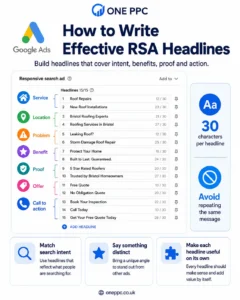
How to Write Effective RSA Descriptions
Descriptions provide more space to connect the problem, solution, evidence and next action.
A useful structure is:
Customer need + service benefit + differentiator + call to action
For example:
Improve lead quality with professionally managed Google Ads, accurate tracking and transparent reporting. Request a free account review.
Another approach is:
Service scope + proof + next step
For example:
Roof repairs, replacements and emergency call-outs completed by experienced local roofers. Arrange a free inspection today.
Across four descriptions, aim to cover different persuasive angles:
The main service and outcome
Credibility and differentiation
The process, offer or commercial terms
A clear call to action
Descriptions should complement the headlines, not simply repeat them in longer form.
Make Every Asset Work Independently
RSA assets may appear in different sequences. A headline should therefore make sense without depending on another optional headline.
Weak sequence:
Headline 1: Looking for a Better Way?
Headline 2: We Can Help
Headline 3: Get Started Today
The individual statements are vague and only become marginally meaningful when shown together.
Stronger sequence:
Reduce Google Ads Waste
UK Google Ads Management
Request a Free Account Review
Each headline communicates something useful by itself, while the combined advert remains coherent.
Before publishing, read each headline alongside every other headline. Remove combinations that produce:
Repetition
Contradiction
Incomplete claims
Misleading offers
Awkward grammar
Meaningless generic language
How Pinning Works
Pinning instructs Google to reserve a particular position for one or more selected assets.
You can pin headlines to:
Headline position 1
Headline position 2
Headline position 3
Descriptions can be pinned to:
Description position 1
Description position 2
If one headline is pinned to position one, that headline occupies position one whenever the pinned position is shown.
If several headlines are pinned to position one, Google can select between those pinned headlines for that position.
Pinning every position can make an RSA behave more like an older fixed text advert, but it significantly reduces Google’s ability to vary the creative.
Importantly, headline position three and description position two are not guaranteed to appear. Information that must always be present should therefore be placed in or pinned to headline position one, headline position two or description position one, subject to Google’s current format guidance.
Use pinning deliberately when message control outweighs the potential benefit of additional combinations.
How Many Assets Should an RSA Contain?
Google encourages advertisers to provide numerous unique assets, but filling every available field is not the real objective.
Ten distinctive, persuasive headlines can be more valuable than 15 headlines containing repeated or diluted variations.
A practical starting structure might include:
Two or three service and keyword headlines
Two customer-benefit headlines
Two differentiator headlines
Two trust or evidence headlines
Two offer or pricing headlines
Two call-to-action headlines
Three or four materially different descriptions
The exact number should depend on how many genuinely different messages the business has.
Do not create filler solely to reach the maximum. Each additional asset should introduce a useful reason to click or a more relevant response to a meaningful search.
How Many Responsive Search Ads Should an Ad Group Have?
Every active Search ad group should normally have at least one relevant responsive search ad.
A second RSA can be useful when there is enough traffic and you have a clear hypothesis to test, such as:
Price-led versus benefit-led messaging
Local expertise versus national capability
Free consultation versus audit offer
Product features versus customer outcomes
Two genuinely different landing pages
Creating several near-identical RSAs does not automatically create a reliable A/B test. Google may favour one advert, combinations differ internally and traffic may not be distributed evenly.
For a controlled test of a meaningful change, consider using Google Ads campaign experiments or ad variations rather than drawing conclusions from two ordinary RSAs running together.
How to Create a Responsive Search Ad
The Google Ads interface changes periodically, but the general process is:
Open the relevant Search campaign.
Select the appropriate ad group.
Open the Ads section.
Select the option to create a new advert.
Choose Responsive search ad.
Confirm the final landing-page URL.
Add the display paths where useful.
Write the headlines and descriptions.
Apply any necessary pins.
Review the advert preview and policy checks.
Save the advert.
Confirm that the advert becomes eligible after review.
Before creating the advert, check that the ad group is sufficiently focused.
The same advert and landing page should be capable of answering every important keyword within the group. If that is not possible, the ad group may cover too many forms of intent.
Responsive Search Ad Optimisation
Optimising an RSA involves more than repeatedly replacing headlines.
Review Search Terms First
An advert cannot perform efficiently if it is appearing for unsuitable searches.
Use the Google Ads Search Terms Report to understand the actual queries producing impressions, clicks, leads and sales.
Look for:
Irrelevant searches
Informational searches entering a commercial campaign
Jobs, training or DIY intent
Locations outside the service area
Unwanted products or services
Brand traffic entering non-brand campaigns
Valuable queries that deserve more tailored messaging
Searches producing leads but not customers
Use negative keywords to remove unsuitable traffic. Better copy cannot compensate for fundamentally incorrect targeting.
Evaluate the Whole Advert Journey
Assess performance across the full sequence:
Search term → Keyword → Advert → Landing page → Conversion → Sales outcome
If click-through rate is poor, the advert may be uncompetitive or insufficiently relevant.
If click-through rate is strong but conversion rate is weak, the problem may be the offer, landing page, pricing, page speed, form or mismatch between the advert and page.
If leads are inexpensive but rarely qualified, the messaging may be attracting the wrong audience or making the service appear broader, cheaper or more accessible than it really is.
Use Asset Reports Carefully
Review asset statistics and the combinations report to identify:
Headlines receiving little or no exposure
Repetitive messages
Assets associated with stronger commercial results
Combinations that appear awkward
Important propositions that are missing
Google-generated assets that do not accurately represent the business
Do not automatically remove an asset because it has fewer conversions. Consider impressions, traffic allocation, context, statistical volume and the role the asset serves.
A qualification headline may reduce click volume while improving lead quality. That can be commercially valuable even if its surface-level click-through rate is lower.
Make Significant Tests
Small wording changes often produce ambiguous results.
Instead of testing:
Get a Free Quote
Get Your Free Quote
Test materially different propositions:
Free Account Audit
Improve Lead Quality
UK-Based Google Ads Partner
No Long-Term Contract
Track Leads Through to Revenue
Large, meaningful differences are easier to interpret and more likely to influence customer behaviour.
Avoid Changing Assets Too Frequently
Constant edits make performance difficult to evaluate and can reset the review or learning associated with new assets.
Make changes for a defined reason. Record what changed, why it changed and what commercial metric should improve.
Allow enough time and conversion volume before concluding.
Responsive Search Ads and Landing Pages
Ad quality does not stop at the click.
A successful landing page should continue the message introduced by the RSA. If the advert promises a specific service, location, price or offer, the page should make that information immediately visible.
Strong alignment includes:
The same service or product
Consistent terminology
The advertised offer
Relevant location information
Matching proof and trust signals
A clear next action
Accurate pricing or eligibility details
For example, an advert targeting “commercial solar panel installation” should lead to a commercial solar page—not a generic renewable-energy homepage covering domestic panels, batteries, heat pumps and unrelated services.
Advert and landing-page alignment can improve conversion performance while supporting stronger relevance and landing-page experience.
Our guide to the three main Google Ads success factors explains how targeting, landing pages and AI bidding work together.
Responsive Search Ads and Conversion Tracking
Google optimises using the conversion information available to it.
If the campaign records low-value actions such as page views, telephone-button clicks or unqualified form submissions as primary conversions, automated systems may learn to generate more of those actions without increasing sales.
A stronger measurement structure tracks outcomes that reflect business value.
For ecommerce, this normally means:
Completed purchases
Transaction revenue
Margin or value adjustments where appropriate
For lead generation, the journey may include:
Website enquiry
Qualified Lead
Sales Opportunity
Customer
Revenue
Use accurate Google Ads conversion tracking and, where appropriate, offline conversion tracking to connect adverts with later CRM and sales outcomes.
An RSA should not be judged solely by which copy generated the cheapest form submission. The better advert is the one that contributes to profitable customers.
Responsive Search Ads and AI Max
AI Max for Search campaigns can introduce additional automation beyond the assets entered manually by the advertiser.
Text customisation can generate additional headlines and descriptions using information from sources such as:
Existing adverts
Keywords
The final URL
Website content
Final URL expansion can also direct traffic to other pages Google considers relevant, subject to the campaign’s settings and controls.
These features are separate from the standard RSA process and should not be treated as automatically beneficial.
Before enabling them, assess:
Whether every eligible website page is suitable for advertising
Whether website wording is accurate and compliant
Whether the business requires strict message control
Whether Google-generated claims can be reviewed
Whether URL exclusions are required
Whether tracking works across all potential landing pages
Whether lead quality is measured beyond the initial form
Google-generated text assets can be inspected through asset reporting and removed when they are inaccurate or unsuitable.
AI can expand creative coverage, but it should not be allowed to invent positioning, select unsuitable pages or conceal poor commercial outcomes behind higher click and lead volume.
Common Responsive Search Ad Mistakes
The most frequent problems include:
Repeating the keyword in nearly every headline
Filling all 15 headline fields with weak variations
Writing assets that depend on appearing in a fixed order
Sending every advert to the homepage
Combining unrelated search intent in one ad group
Chasing an “Excellent” Ad Strength rating at any cost
Pinning every asset without a strategic reason
Avoiding all pinning when compliance requires message control
Using generic claims without evidence
Failing to include a clear offer
Testing insignificant wording changes
Evaluating only clicks and form submissions
Ignoring lead quality and revenue
Replacing assets before enough data has accumulated
Assuming Google tests every combination equally
Enabling generated assets without reviewing them
Treating RSA optimisation as a substitute for keyword and landing-page work
Responsive Search Ad Checklist
Before publishing an RSA, confirm that:
The ad group covers one coherent service or search intent.
The advert matches the principal keywords and likely search terms.
Each headline contributes a distinct message.
Headlines make sense independently.
Descriptions add information rather than repeating headlines.
Claims can be substantiated.
Offers match the landing page.
The call to action reflects the buying stage.
Necessary legal or brand wording is pinned appropriately.
Display paths are accurate and useful.
The final URL is the most relevant available page.
Conversion tracking has been tested.
Telephone and form journeys work on mobile.
Relevant sitelinks, callouts and other assets are available.
Google-generated text settings have been reviewed.
Performance will be assessed using commercial outcomes.
Frequently Asked Questions
How Many Headlines Can a Responsive Search Ad Have?
A responsive search ad can contain up to 15 headlines, with a limit of 30 characters per headline.
You do not need to fill every available field if the additional headlines would be repetitive or weak. Prioritise distinct, accurate and commercially persuasive messages.
How Many Headlines Will Google Show?
An RSA can show up to three headlines, but three are not guaranteed to appear. The number shown depends on the format and available space.
How Many Descriptions Can an RSA Have?
You can provide up to four descriptions, each containing up to 90 characters. An advert can show up to two descriptions, although fewer may appear.
Should I Pin Responsive Search Ad Headlines?
Pin assets when particular information must appear in a defined position. Common examples include brand names, regulated statements, mandatory disclaimers and essential offer details.
Avoid unnecessary pinning because it reduces the combinations available to Google.
Does Excellent Ad Strength Improve Ad Rank?
Not directly. Ad Strength is a creative feedback tool and is not itself an input into Ad Rank or Quality Score.
Relevant, useful adverts can contribute to better campaign performance, but the interface rating should not be confused with an auction or profitability metric.
Can I See Which RSA Combination Generated a Conversion?
Google provides asset and combination reporting, including full asset-level performance statistics for eligible recent data. However, RSA reporting does not make every combination a controlled experiment.
Interpret the statistics alongside impressions, clicks, cost, conversions, search intent and commercial outcomes.
Should I Run One or Two RSAs per Ad Group?
Every active Search ad group should normally have at least one RSA. A second can be useful when testing a genuinely different message or landing page and when there is enough traffic to produce meaningful results.
Avoid creating several nearly identical RSAs merely to increase the number of adverts.
Do Responsive Search Ads Automatically Reduce CPC?
No. An RSA does not guarantee a lower cost per click.
Actual CPC is affected by the auction, competition, bids, advert and landing-page quality, context and other factors. A better advert may improve engagement or conversion performance, but there is no automatic RSA discount.
Conclusion
Responsive search ads combine advertiser-created messaging with Google’s auction-time automation.
Their flexibility can improve coverage and help an advert respond to different searches, devices and customer priorities. However, performance still depends on the quality of the inputs and the wider campaign system.
The most effective RSA strategy is to:
Organise ad groups around coherent search intent.
Write distinctive headlines addressing relevance, benefits, proof, offers and action.
Ensure every asset works in multiple combinations.
Use pinning when message control is genuinely required.
Treat Ad Strength as guidance rather than the business objective.
Align the advert with a relevant landing page.
Review search terms and negative keywords.
Test meaningful commercial propositions.
Measure Qualified Leads, customers, revenue and profit.
Google decides which eligible asset combination to show, but the advertiser decides what the system is allowed to say, which searches it can target and what outcome represents success.
That combination of controlled inputs, reliable measurement and disciplined optimisation is what turns responsive search ads from an automated format into an effective customer-acquisition tool.
Related Google Ads Guides
Continue improving your Search campaigns with these related One PPC resources: