
Google Ads can work across almost every legitimate industry, but it does not work equally well for every business.
The strongest industries normally combine three commercial advantages:
People actively search for the service or product.
A new customer is worth considerably more than the cost of acquiring them.
Leads, bookings and sales can be measured accurately.
A locksmith responding to an emergency, a solicitor winning a valuable legal matter and an ecommerce retailer selling hundreds of products may all generate excellent returns from Google Ads. However, each requires a completely different combination of campaigns, targeting, advertising messages and conversion tracking.
The best Google Ads market is therefore not simply “local businesses”, “ecommerce” or “high-ticket services”. It is the intersection of search intent, customer economics, campaign suitability, operational capacity and reliable measurement.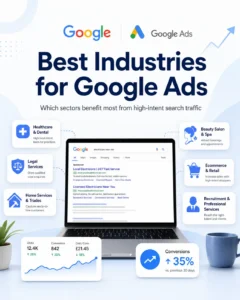
What Makes an Industry Suitable for Google Ads?
Google Ads is strongest when it captures existing demand. Someone searches because they have a problem, requirement or purchasing decision in mind.
Consider the difference between these searches:
“Emergency locksmith near me”
“Dental implants cost”
“Commercial construction company”
“Sales recruitment agency”
“Buy replacement boiler pump”
“Best CRM for a cleaning company”
Each search reveals a potential commercial requirement. The advertiser does not need to persuade the person that the underlying problem exists. The campaign must demonstrate that its business offers the right solution.
Industries usually become attractive when they have several of the following characteristics:
Strong bottom-of-the-funnel search demand
Recognisable products, treatments or services
High average order or customer value
Healthy gross or contribution margins
Repeat purchasing or long-term customer value
Geographic targeting opportunities
Urgent or time-sensitive requirements
A straightforward route to a call, booking, quote or purchase
Enough operational capacity to fulfil additional demand
Reliable conversion and revenue tracking
A high conversion rate alone does not prove that an industry is profitable. Restaurants can generate relatively inexpensive actions, but a £30 order cannot support the same acquisition cost as a £5,000 legal matter or £20,000 home-improvement project.
The reverse is also true. Legal services have some of the highest costs per click, but one instructed client can make the campaign exceptionally profitable.
Ranking the Best Industries for Google Ads
The following ranking considers intent, customer value, measurability, scalability and the range of campaigns available.
| Rank | Industry | Strongest business profile | Google Ads potential |
|---|---|---|---|
| 1 | Home services and trades | Established local or regional operator with several engineers or vehicles | Excellent |
| 2 | Private healthcare and dental | Established clinic or multi-location provider | Excellent |
| 3 | Automotive repairs and services | Workshop, specialist repairer or multi-location group | Excellent |
| 4 | High-value home improvements | Company with sales, surveying and installation capacity | Excellent |
| 5 | Legal services | Specialist practice with valuable case types | Excellent but expensive |
| 6 | Specialist ecommerce and retail | Established retailer with healthy margins and reliable product data | Excellent |
| 7 | Education and professional training | Provider with proven courses and enrolment capacity | Very strong |
| 8 | Veterinary and pet services | Clinic, specialist service or recurring-care provider | Very strong |
| 9 | Specialist B2B and industrial services | Provider with defined services and substantial contract values | Strong |
| 10 | Financial services | Regulated provider with valuable customers and effective follow-up | Strong |
| 11 | Hotels and specialist travel | Business capable of taking direct bookings | Strong but competitive |
| 12 | Software and SaaS | Established product with proven demand and sufficient lifetime value | Strong but difficult |
| 13 | Beauty, aesthetics and personal care | Multi-treatment or multi-location business with repeat customers | Strong |
| 14 | Property, removals and storage | Regional operator with clear service areas | Strong |
| 15 | Recruitment | Sector specialist targeting employers rather than candidates | Strong with careful targeting |
| 16 | Accountancy and professional services | Specialist firm with recurring client value | Strong |
| 17 | Care services | Provider with staffing capacity and valuable long-term clients | Strong |
| 18 | Construction and commercial contracting | Specialist contractor targeting defined project categories | Variable but potentially valuable |
| 19 | Restaurants and food services | Multi-location or high-volume operator | Moderate |
| 20 | Generic consultancy and coaching | Highly specialised providers only | Difficult |
These are not guaranteed performance rankings. The best advertiser in a difficult industry can outperform a poorly managed advertiser in a supposedly attractive one.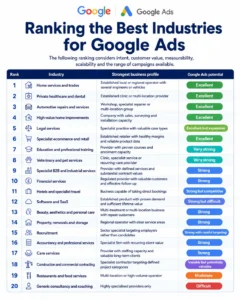
Home Services and Trades
Home services are arguably the most natural fit for Google Search.
Customers frequently search when they need immediate assistance or have already decided to obtain quotations. Examples include:
Plumbers and drainage companies
Electricians
Heating engineers
Locksmiths
Pest-control companies
Roofers
Cleaning companies
Removals and storage businesses
Landscapers
Window and door installers
Painting and decorating companies
Emergency services can have extremely short buying journeys. Someone locked out of a property is unlikely to spend several weeks researching suppliers. They want an available, credible local provider.
This makes Search campaigns, Maps visibility, call assets and Local Services advertising particularly powerful. Our guide to Google Ads for locksmiths explains how urgency, location and call handling shape campaign performance in one of the clearest examples of immediate search intent.
The strongest advertiser is not always a sole trader. A company with several vehicles, employees or service territories can usually absorb more enquiries, answer calls consistently and generate enough conversion data for optimisation.
High-Value Home Improvements
Planned home improvements have a longer buying journey than emergency trades, but their contract values are considerably higher.
Strong categories include:
Kitchens and bathrooms
Windows and doors
Roofing
Extensions
Loft conversions
Landscaping
Driveways
Painting and decorating
Renewable energy installations
Specialist refurbishment
Campaigns should separate small repairs from major projects. A builder looking for extension projects should not allow Google to optimise towards inexpensive handyman enquiries simply because those visitors convert more frequently.
The same principle applies across the wider construction market. Google Ads for builders requires a different strategy from Google Ads for construction companies, where commercial contracts, tenders, subcontracting searches and long sales cycles may be involved.
Project type, location, minimum job value and customer type should all influence the keyword structure, landing pages and conversion strategy.
Dentists, Healthcare and Private Clinics
Private healthcare can be an excellent Google Ads market because patients frequently search for a specific treatment, symptom or provider.
Strong categories include:
Dental implants
Invisalign and orthodontics
Cosmetic dentistry
Emergency dentistry
Private diagnostic scans
Physiotherapy
Osteopathy
Private GP services
Dermatology
Fertility treatment
Eye surgery
Hearing services
A general search such as “dentist near me” may contain mixed intent. Treatment-led searches such as “dental implants consultation” or “emergency private dentist” reveal more about the prospective patient’s requirements and commercial value.
Campaigns should separate treatments because their economics differ. A routine examination, emergency appointment and full implant treatment should not necessarily share the same budget, bidding target or landing page.
Our guide to Google Ads for dentists and orthodontists covers the importance of distinguishing general, private, emergency and high-value treatment demand.
Healthcare advertising also requires careful policy compliance. Advertisers must avoid unsupported promises, inappropriate personalisation and claims that could be considered misleading.
Automotive Services
Automotive repairs and services consistently demonstrate strong Search conversion rates because the user often has an immediate, identifiable requirement.
Suitable categories include:
MOT testing
Vehicle servicing
Mechanical repairs
Tyres
Bodyshops
Accident repairs
Windscreen services
Mobile mechanics
Specialist vehicle maintenance
Scrap and used-vehicle purchasing
Location, availability and vehicle compatibility are important. Advertising a specialist German vehicle service centre to owners of every vehicle type may increase enquiries while reducing booking quality.
For appointment-led services, campaigns can optimise towards completed bookings. For vehicle purchasing, the more useful signals may be completed valuations, qualified vehicles, appointments and acquired stock.
Legal Services
Legal advertising is expensive because the commercial value of an instructed client can be substantial.
Promising areas include:
Family law
Employment law
Conveyancing
Probate
Immigration
Commercial law
Dispute resolution
Personal injury
Criminal defence
Insolvency
The best campaigns are organised around legal matters rather than a generic “solicitor” campaign. Someone searching for an employment solicitor has a different problem, urgency and value from someone researching conveyancing.
The landing page and ad should make the relevant specialism immediately clear. The campaign should also distinguish between enquiries from potential clients and searches from students, job seekers, existing clients or people seeking free information.
Our complete guide to Google Ads for lawyers and solicitors examines how specialisation, location, case value and lead qualification should shape legal campaigns.
Retail and Ecommerce
Ecommerce is one of Google Ads’ largest markets, but “ecommerce” is not a single industry. Results depend on product margin, average order value, competition, repeat purchasing, delivery costs and brand strength.
Stronger ecommerce profiles commonly include:
Specialist products
Replacement parts
Premium or high-margin goods
Products with clear model compatibility
Repeat-purchase categories
Exclusive brands
Large or distinctive product ranges
Products that people actively search for
A retailer reselling widely available, low-margin products may struggle even when the reported return on ad spend looks reasonable. A 3x ROAS can be profitable for a high-margin product and loss-making for a retailer with a 25% gross margin.
Shopping and Performance Max are normally central to ecommerce because they use product-feed data including titles, prices, images, availability and product identifiers. Search campaigns remain valuable for brand terms, product categories, high-margin lines and queries that product feeds do not capture effectively.
The latest ecommerce benchmark data shows substantial differences between product sectors, with categories such as sports, automotive products, apparel and travel accessories producing different conversion rates and returns. However, these figures should remain context rather than universal targets. Read our guide to Google Ads for retail and ecommerce for a complete product-led strategy.
Recruitment Agencies
Recruitment can be highly profitable because one successful placement may be worth thousands of pounds. The main difficulty is separating companies that need staff from candidates who need jobs.
For example:
“Sales recruitment agency” can indicate employer intent.
“Hire a finance director” can indicate employer intent.
“Executive search firm” can indicate employer intent.
“Sales jobs” indicates candidate intent.
“Recruitment jobs” often indicates candidate intent.
Employer and candidate forms should be separate. Employer enquiries should be primary conversions, while candidate applications should normally be secondary conversions or excluded from bidding.
If every completed form is treated equally, Google may learn that candidates are easier to generate and optimise the campaign in exactly the wrong direction.
Our guide to Google Ads for recruitment agencies explains how to target hiring companies while avoiding the large volume of employment-related searches.
Accountants and B2B Professional Services
Accountancy illustrates why lifetime value matters more than initial lead cost.
A new business client may remain with an accountant for years and purchase bookkeeping, payroll, tax, advisory and compliance services. This recurring value can justify an acquisition cost that would be impossible for a one-off consumer service.
Useful targeting angles include:
Accountants for limited companies
Specialist industry accountants
Outsourced bookkeeping
Payroll services
R&D tax advice
Management accounts
Business tax planning
Accountants near a particular location
Generic terms can be extremely broad. Specialisation by service, sector, business size or software platform usually improves intent.
Read our guide to Google Ads for accountants for more detail on recurring revenue, local targeting and B2B lead qualification.
Specialist B2B and Industrial Services
Google Ads can work exceptionally well in B2B when buyers use recognisable language to search for an established solution.
Suitable categories include:
Managed IT
Cybersecurity
Commercial cleaning
Industrial equipment
Packaging
Logistics
Commercial maintenance
Business finance
Compliance services
Specialist software
Professional training
Outsourced business services
B2B search volume is usually lower than consumer volume, but each conversion can be considerably more valuable.
The largest risk is optimising towards unqualified form submissions. A download, enquiry or demo request is not necessarily a sales opportunity. B2B campaigns should send lifecycle information back from the CRM so Google can distinguish initial leads from qualified opportunities and revenue.
Architects and Other High-Consideration Services
Architectural services demonstrate how Google Ads can support a long, considered buying journey.
Prospective clients may search for:
Residential architects
Extension architects
Commercial architects
Planning consultants
Conservation architects
Architects for listed buildings
Architects in a specific city
The campaign must match the practice’s actual project profile. An architectural firm seeking commercial developments should not optimise around large volumes of small residential enquiries.
Our guide to Google Ads for architects explains how project type, service area, portfolio evidence and consultation journeys influence campaign design.
Mortgage Brokers and Financial Services
Mortgage, insurance and financial searches can be extremely valuable, but these sectors are highly competitive and regulated.
Mortgage campaigns may target:
First-time buyers
Remortgages
Buy-to-let investors
Self-employed applicants
Adverse-credit applicants
Commercial mortgages
Bridging finance
Each segment has different customer economics, qualification requirements and advertising messages. A generic mortgage campaign can obscure these differences and encourage Google to prioritise the easiest forms rather than the most valuable completed cases.
The Google Ads guide for mortgage brokers explains how broker specialisation, lender access, eligibility and completed mortgage value should influence campaign design.
Travel Agents and Hospitality
Travel has high transaction values and abundant search demand, but it is also intensely competitive.
Independent travel companies compete with:
Online travel agencies
Airlines
Hotel groups
Comparison websites
Tourism boards
Major package-holiday brands
Google’s own travel results
Specialist travel can be more attractive than broad package holidays. Examples include luxury travel, complex itineraries, specialist destinations, cruises, groups, corporate travel and high-value tailor-made holidays.
Brand and non-brand performance must be separated. A hotel campaign can report an impressive ROAS by capturing searches for the hotel’s own name, but much of that demand may already exist.
Our guide to Google Ads for travel agents and the travel industry explores direct bookings, destination targeting, seasonality and competition from major travel platforms.
Beauty Salons, Spas and Aesthetic Treatments
Beauty and personal care can perform well when treatments have reasonable values, repeat bookings and strong local intent.
Potential categories include:
Hair salons
Day spas
Massage
Laser hair removal
Skin treatments
Injectables
Body-contouring treatments
Bridal packages
Memberships and treatment plans
Low-value treatments may struggle to support expensive clicks unless customers return regularly. Campaign profitability should therefore consider repeat bookings and lifetime value rather than only the first appointment.
Read our guide to Google Ads for beauty salons and spas for a closer look at treatment targeting, local campaigns and booking value.
Google Search Campaigns
Search campaigns remain the foundation for most service businesses because they provide the greatest control over keyword intent, advertising messages and landing pages.
They are particularly suitable for:
Local services
Professional services
Healthcare
Legal services
B2B
High-value enquiries
Emergency requirements
Specialist products
A well-structured Search account usually separates campaigns by service, location, customer type or commercial objective.
Exact and phrase match can provide a controlled starting point. Broad match may expand volume, but it should be introduced only when conversion tracking, negative keywords, budget and bidding data are strong enough to guide it.
Search terms should be reviewed for meaning, not merely individual words. A term may look relevant while representing the wrong audience, project type or point in the buying journey.
Local Services Ads and the Move into Performance Max
Google has announced that Local Services Ads are moving into the main Google Ads platform as a specialised Performance Max campaign with pay-per-lead goals.
This requires an important distinction: these campaigns are not becoming ordinary Performance Max campaigns.
The specialised campaign will retain several defining Local Services characteristics:
Advertisers continue paying for valid leads rather than clicks.
Ads continue appearing in their established Search and Maps positions.
Targeting remains keywordless.
Service categories and service areas continue shaping eligibility.
Eligible verified businesses can display the Google Verified badge.
The campaign does not expand across YouTube, Gmail and the Display Network like standard Performance Max.
Management, budgets, targeting settings and customer enquiries are moving into the main Google Ads interface. Manual maximum cost-per-lead bidding and category-level targets are being removed, while weekly budgets become daily average budgets.
Google is introducing the transition in phases, beginning with selected US service advertisers before extending it to non-US accounts and remaining categories. UK businesses should therefore follow their account notifications rather than assuming every Local Services campaign has already migrated.
Another important issue is historical reporting. Google states that previous performance reports will not transfer into the new campaign, so advertisers should preserve the historical information made available before migration. Lead history will transfer, but the old campaign-level reporting will not. Google’s Local Services transition guidance
For eligible local businesses, the eventual combination may include:
Search campaigns for controlled keyword coverage
Specialised Performance Max with pay-per-lead goals
Maps and Business Profile visibility
Standard Performance Max where there is a separate strategic case
Remarketing or Demand Gen for longer buying journeys
These campaigns should be assessed separately because a valid pay-per-lead enquiry, website form and standard Performance Max conversion are not identical outcomes.
Standard Performance Max
Standard Performance Max can advertise across Search, Shopping, Maps, YouTube, Gmail, Discover and the Google Display Network.
It is usually strongest for:
Ecommerce businesses with accurate product feeds
Retailers with meaningful sales volume
Multi-location businesses
Businesses with strong creative assets
Advertisers with reliable conversion values
Campaigns with enough data for automation
Performance Max should not be treated as a universal replacement for Search.
For lead generation, a campaign optimising towards every form submission can attract low-quality leads. It becomes more valuable when the advertiser imports qualified leads, opportunities, completed sales and revenue from the CRM.
Brand exclusions, search-category reporting, placement insights, asset groups and conversion goals should all be reviewed. A high platform-reported ROAS can conceal branded demand or conversions that would have occurred anyway.
Shopping Campaigns
Shopping advertising is designed for products rather than service leads.
Performance depends heavily on the quality of the product feed. Important attributes include:
Product titles
Product descriptions
Categories
Brand
GTIN or manufacturer identifiers
Price
Availability
Images
Delivery information
Promotions
Custom labels
The feed effectively performs part of the targeting role. Weak or generic product data limits Google’s ability to match products with suitable searches.
Retailers should segment products by margin, popularity, stock position and business priority. Giving every product the same target return ignores major commercial differences.
Demand Gen, YouTube and Display
Not every customer converts during the first search.
Demand Gen, YouTube and Display can help when:
The product needs demonstration.
The service involves a longer decision.
Prospects compare several providers.
The brand needs to remain visible.
The advertiser has strong visual or video assets.
First-party audiences are available.
These campaigns are normally supporting channels rather than direct substitutes for high-intent Search.
A kitchen company could use Search to capture “kitchen installers near me”, then use video or visual advertising to demonstrate completed projects. A B2B software company could capture initial category searches and use remarketing to promote demonstrations, case studies or comparisons.
View-through and engaged-view conversions should be interpreted carefully. They help explain influence but should not automatically be valued like a direct sale.
Brand Campaigns
Brand campaigns capture searches for the advertiser’s own name.
They can protect visibility, control messaging and direct people to the correct landing page. They are also frequently responsible for an account’s highest reported conversion rate and ROAS.
That does not mean they created all the demand.
Brand and non-brand campaigns should be reported separately. Otherwise, an account can appear highly profitable while producing relatively little new customer acquisition.
For established retailers, hotels, legal firms and recognised local companies, this distinction is especially important.
Targeting the Right Search Intent
Keyword selection is one of the largest differences between profitable and unprofitable campaigns.
Good targeting reflects:
What the customer needs
Whether they are ready to buy
Which service they want
Where they are located
Whether they fit the advertiser’s commercial model
Which meanings should be excluded
Negative keywords are essential in industries with overlapping meanings.
Examples include:
Recruitment agencies excluding candidate and job searches
Builders excluding DIY products and employment searches
Legal firms excluding training and free-document searches
Architects excluding degree courses and salaries
Accountants excluding software-support and job searches
Retailers excluding manuals, repairs or free downloads where inappropriate
The objective is not to obtain the maximum number of clicks. It is to obtain enough of the right searches to generate profitable outcomes.
Geographic Targeting
Geography should reflect where the business can realistically sell or deliver.
A local service business may target:
Towns
Cities
Postcodes
Radius areas
Individual service territories
Areas surrounding each location
Location settings should normally focus on people physically in or regularly in the target area, rather than anyone merely expressing an interest in it.
Service areas should also reflect operational economics. A low-value job may be profitable within five miles but unprofitable at the other side of a county. High-value projects may justify a much larger territory.
Multi-location businesses should consider separate campaigns where locations have different budgets, services, landing pages or operational capacity.
Audience Targeting
Search keywords reveal immediate intent, while audiences provide additional context.
Useful audiences include:
Website visitors
Previous customers
Customer Match lists
Cart abandoners
Product viewers
CRM-qualified leads
Similar behavioural segments
Relevant in-market audiences
Demographic groups where permitted and commercially appropriate
Audiences can be used for observation, bidding, exclusion or campaign targeting depending on the campaign type.
First-party CRM audiences are increasingly important because they show Google which contacts became useful customers instead of merely which visitors completed a form.
Writing Better Google Ads
Effective advertising copy connects the search with a relevant commercial reason to choose the advertiser.
Strong ads usually communicate:
The exact product, treatment or service
The target location or audience
A meaningful differentiator
Relevant proof
An appropriate qualification
A clear next action
Generic claims such as “high quality”, “professional service” and “competitive prices” are rarely persuasive because almost every competitor can say the same thing.
More useful messages might include:
Emergency Locksmith – Local Call-Out
Dental Implant Consultations
Accountants for Construction Companies
Commercial Roofing for Industrial Buildings
Executive Recruitment for SaaS Companies
Made-to-Measure Kitchens with Installation
Independent Mortgage Advice for the Self-Employed
Responsive Search Ads should contain enough variation for Google to assemble relevant combinations, but variation should not come at the expense of meaning. Headlines should not merely repeat the same generic claim in different words.
Pinning can be useful where legal wording, brand requirements or message order are essential, but excessive pinning reduces Google’s ability to test combinations.
Landing Pages Must Continue the Search
Targeting generates the opportunity. The landing page determines whether that opportunity becomes a customer.
An effective landing page should quickly confirm:
The visitor has reached the correct service
The business covers their location
The company understands the requirement
The offer is credible
The next action is clear
Important objections have been answered
Useful elements include:
A clear service-led headline
Relevant proof and reviews
Pricing guidance where appropriate
Accreditations
Service areas
Case studies
Photographs of genuine work
Qualification information
Frequently asked questions
Calls, forms or booking options
A generic homepage is rarely the best destination for a highly specific search.
Company Size and Google Ads Suitability
Employee count does not directly determine campaign performance, but it affects budget, capacity, sales processes and data volume.
| Company size | Google Ads suitability | Typical situation |
|---|---|---|
| 1–5 employees | Selectively suitable | Strong local intent but limited budget and fulfilment capacity |
| 6–20 employees | Very strong | Enough capacity to grow while retaining fast decision-making |
| 21–100 employees | Excellent | Best balance of budget, operational capacity and accessibility |
| 101–500 employees | Excellent | Greater scale, multiple services and more conversion data |
| 500+ employees | Excellent as a channel | Complex procurement, attribution and internal marketing structures |
The strongest agency prospect is often a company with approximately 10–100 employees. It is large enough to need professional campaign management but may not yet employ a full specialist paid-media team.
Different industries require different interpretations:
A five-person legal practice may have extremely valuable clients.
A 20-person ecommerce company may spend more than a 200-person service business.
A plumbing company with 15 engineers may have more lead capacity than a consultancy with 50 employees.
A multi-location dental group may justify separate campaigns and budgets for every clinic.
A SaaS company may need substantially more traffic because only a fraction of leads become customers.
For ecommerce, revenue, order volume, margin and advertising spend are more informative than employee count.
B2C and B2B Require Different Strategies
B2C campaigns generally have:
Higher search volume
Shorter buying journeys
More direct bookings or purchases
Greater geographic relevance
Faster conversion feedback
B2B campaigns generally have:
Lower search volume
Higher contract values
Longer sales cycles
Several decision-makers
More complicated qualification
A greater need for CRM integration
B2C advertisers can sometimes optimise towards a purchase or confirmed booking immediately.
B2B advertisers should usually track a progression such as:
Initial lead
Qualified lead
Sales opportunity
Proposal
Closed sale
Revenue
The first form submission is not the final result. If Google receives only that initial conversion, it may optimise towards the easiest people to generate rather than the organisations most likely to buy.
Conversion Tracking Determines Which Industries Appear “Best”
An industry can look successful in Google Ads while producing poor commercial results if the wrong conversions are measured.
Primary conversions should represent actions that genuinely support bidding. Depending on the business, these may include:
Completed purchases
Qualified enquiry forms
Booked consultations
Calls of sufficient duration
Confirmed appointments
Qualified leads imported from a CRM
Sales opportunities
Closed sales
Revenue
Secondary conversions can record useful behaviour without controlling automated bidding. These may include brochure downloads, page views, unqualified chats, candidate applications or other actions that provide context without representing the advertiser’s main objective.
For lead generation, the preferred measurement sequence is:
Website enquiry, qualified lead, sales opportunity, closed sale and revenue.
For ecommerce, Google should receive transaction value, order identifiers and accurate purchase data without duplicate sales.
AI Bidding Needs the Right Data
Automated bidding can be extremely effective, but it amplifies the signals it receives.
If every lead is treated equally, the system will seek more leads—not necessarily more customers.
As a practical planning threshold, a campaign using target CPA should normally have around 15 conversions per month at minimum, with 30–50 providing a healthier foundation. Value-based bidding and Performance Max are more dependable with approximately 50 monthly conversions and become more stable with considerably larger datasets.
Businesses with limited conversion volume may need:
Tighter campaign consolidation
More controlled match types
Manual CPC during the initial stage
Portfolio bidding
Longer evaluation periods
Better first-party conversion data
Splitting a small budget across too many campaigns can prevent any campaign from collecting enough information to optimise effectively.
Industries That Need Extra Caution
Some markets can use Google Ads successfully but require unusually strong economics or positioning.
Restaurants and Low-Value Services
Low transaction values restrict the affordable cost per acquisition. Repeat purchasing, delivery volume and customer retention become essential.
Generic Fashion and Commodity Retail
Major retailers, marketplaces and aggressive discounting create intense price competition. Product differentiation and feed quality are critical.
Early-Stage SaaS
Search cannot compensate for weak product-market fit. Start-ups may face expensive clicks before knowing which audience, use case or offer converts.
General Consultancy
Searches can be vague and informational. A consultancy specialising in a recognisable problem is much easier to advertise than one offering generic “business growth”.
General Construction
Broad construction searches can produce homeowners, job seekers, subcontractors, suppliers and tender enquiries. Campaigns need precise project and customer definitions.
Property Sales
People searching for houses are not necessarily property owners looking for an estate agent. Buyer and vendor intent must be separated.
The Best Industries Share the Same Commercial Foundations
The most successful Google Ads industries are not identical, but they tend to share a recognisable structure:
Customers actively search for the solution.
The business offers something commercially specific.
Customer value supports the acquisition cost.
The company can handle additional demand.
Campaigns target the correct service and audience.
Advertising copy communicates a genuine reason to choose the business.
Landing pages continue the message.
CRM and conversion tracking reveal which leads become revenue.
Home services, private healthcare, automotive repairs, legal services, home improvements, specialist ecommerce, education, pet services and specialist B2B are particularly strong opportunities.
But the deciding question is not simply, “Which industry has the highest conversion rate?”
The more useful question is:
Can Google capture profitable demand for this specific business, and can the advertiser provide enough accurate customer and revenue data to help the campaigns improve?
When the answer is yes, Google Ads can become more than a lead-generation channel. It can become a measurable system for identifying demand, acquiring customers and allocating budget towards the industries, services, locations and products that create the greatest commercial value.