
Google Ads can be highly effective for beauty salons, day spas and specialist treatment providers because it reaches people while they are actively searching for a service.
Someone searching for “beauty salon near me”, “deep tissue massage Bristol” or “lash extensions Manchester” is not casually scrolling through content. They are expressing an immediate need, usually within a defined geographical area and often with the intention of booking.
However, demand alone does not guarantee profitable advertising. A salon can attract plenty of clicks yet struggle to generate worthwhile bookings if it:
Targets broad or ambiguous keywords
Advertises too many services in one campaign
Sends every visitor to the homepage
Competes for low-value treatments without considering customer lifetime value
Measures booking-page visits instead of completed appointments
Optimises for enquiries without knowing which leads attend or purchase
Targets an area that is too large for customers to travel conveniently
The strongest strategy connects search intent, location, treatment economics, availability, landing pages, booking data and repeat customer value.
Why Google Ads Works for Beauty Businesses
Beauty salons and spas are fundamentally local businesses. Most customers want a suitable appointment within a convenient travelling distance, although they may travel further for specialist treatments, premium experiences or highly regarded practitioners.
Google Ads can place a business in front of potential customers at several commercially important moments:
When someone needs a treatment immediately
When someone is comparing nearby salons
When a customer wants a particular treatment
When somebody is buying a spa day or gift voucher
When a visitor needs a treatment while staying in the area
When an existing customer searches for the salon by name
When somebody is comparing prices, availability or reviews
This makes Google Search an excellent starting point. It captures existing demand rather than relying entirely on interruptive advertising.
Social advertising can still play an important role. Facebook Ads and Instagram can introduce treatments, display visual results and generate awareness. Google Search is generally stronger when the immediate objective is to capture people already looking for a provider.
Beauty Salons and Day Spas Are Different Markets
The terms “beauty salon” and “day spa” are sometimes used interchangeably, but customers may have very different intentions.
A beauty salon may generate demand for frequent, individual treatments such as:
Manicures and pedicures
Gel nails and nail extensions
Eyebrow shaping and tinting
Eyelash extensions and lifts
Waxing
Facials
Massage
Spray tanning
Makeup services
Skincare treatments
A spa may attract searches for:
Spa days
Couples’ spa packages
Massage packages
Hotel spa experiences
Afternoon tea and spa packages
Weekend spa breaks
Gift vouchers
Birthday or hen-party experiences
Premium wellness treatments
These services should not automatically share the same campaigns, advertisements or landing pages. Someone searching for a £25 eyebrow treatment has a very different objective and commercial value from someone looking for a £250 couples’ spa package.
Campaign structure should reflect how customers search and how the business makes money.
Start With Treatment Economics
Before opening Google Keyword Planner, establish which treatments are commercially suitable for paid advertising.
Consider more than the advertised treatment price. Important factors include:
Gross profit from the first booking
Treatment duration
Practitioner capacity
Consumable costs
Likelihood of repeat appointments
Average number of annual visits
Cross-selling opportunities
Membership or package potential
Cancellation and non-attendance rates
Customer lifetime value
A £35 treatment may appear less attractive than a £120 treatment. However, the lower-priced service could be more valuable if customers return every four weeks and regularly purchase additional products.
Conversely, a high-ticket treatment is not automatically profitable. It may require expensive equipment, significant practitioner time or an extensive consultation before the customer purchases.
Google Ads should prioritise treatments with a realistic combination of:
Sufficient local search demand
Healthy profit margins
Available appointment capacity
Strong conversion potential
Repeat-purchase opportunities
Clear differentiation from competitors
This commercial assessment prevents the campaign from becoming a simple competition for the most popular keywords.
Define the Ideal Customer for Each Service
A salon rarely has a single ideal customer. Each treatment may appeal to a different audience with different concerns, budgets and booking behaviour.
For each service, consider:
Who normally purchases it?
Why do they want the treatment?
How urgently do they need an appointment?
How far are they willing to travel?
Is the purchase regular, occasional or linked to an event?
Does the customer prioritise price, convenience, expertise or luxury?
Do they book online or prefer to speak with somebody?
What concerns could prevent them from booking?
What evidence would make them trust the salon?
A customer looking for routine eyebrow threading may prioritise location, price and immediate availability. Someone considering an advanced facial may pay closer attention to qualifications, technology, reviews, consultation processes and expected results.
Demographic assumptions should not become a substitute for search intent. Beauty and wellness services can attract customers of different genders, ages, identities and backgrounds. Campaigns should focus on the treatment required, service suitability and commercial intent rather than outdated stereotypes.
Research How Customers Search
Google Keyword Planner can estimate demand, suggest related phrases and provide indicative competition and cost-per-click data. However, its output is only a starting point.
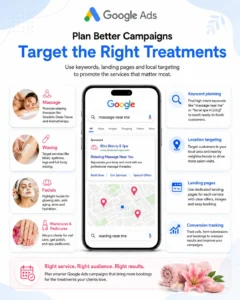
Research each core treatment independently. Useful keyword themes might include:
Beauty salon
Beauty salon near me
Nail salon
Gel nails
Manicure
Pedicure
Eyelash extensions
Lash lift
Eyebrow tinting
Waxing salon
Bikini waxing
Facial treatments
Deep tissue massage
Swedish massage
Pregnancy massage
Couples’ massage
Day spa
Spa day
Spa packages
Beauty gift vouchers
Location-modified searches can also be commercially valuable:
Massage in Wimbledon
Nail salon Bristol
Waxing salon near Leeds
Lash extensions Manchester city centre
Spa day in Cornwall
Do not rely exclusively on “near me” phrases. Google can use the searcher’s location and other contextual signals even when a town is not included in the query.
The broader Google Ads keyword research process should combine Keyword Planner with:
Existing customer enquiries
Website search data
Booking-system categories
Google Search Console queries
Competitor terminology
Google Ads search-term reports
Questions received by reception staff
Treatment names customers use instead of industry terminology
Customers do not always use the technically correct treatment name. The campaign must reflect the language used by the market without making inaccurate claims.
Separate Keywords by Intent
Good campaign structure is based on customer intent, not merely on creating a separate ad group for every slight keyword variation.
For example, these keywords may belong in one tightly themed massage group:
Deep tissue massage
Sports massage
Deep tissue massage near me
Local deep tissue massage
However, “spa day”, “couples’ massage” and “massage course” express different intentions. They should not automatically use the same advertisement or landing page.
A practical structure could include separate campaigns or ad groups for:
Brand searches
General beauty salon searches
Nails
Brows and lashes
Waxing
Massage
Facials and skincare
Spa days and packages
Gift vouchers
High-value specialist treatments
Campaign-level separation is particularly useful when services have different:
Locations
Budgets
opening hours
Profit margins
Practitioners
Conversion values
Geographical catchment areas
Seasonal patterns
A well-designed Single Theme Ad Group structure provides enough control to keep the keywords, advertisements and landing page aligned without fragmenting the account into hundreds of nearly empty ad groups.
Begin With Exact and Phrase Match
Exact and phrase match keywords usually provide a more controlled starting point for a local salon.
They make it easier to:
Concentrate on the most commercially relevant searches
Review how customers describe treatments
Identify profitable locations and services
Build a reliable negative keyword list
Protect a limited local advertising budget
Collect conversion data before expanding
Broad match can discover additional demand, but it gives Google considerably more freedom to interpret the meaning behind a keyword. It is more appropriate when the account has dependable conversion tracking, sufficient conversion volume and strong negative-keyword management.
Broad match should not be adopted simply because Google recommends greater automation. It must demonstrate that it can generate profitable bookings or customers.
Build a Strong Negative Keyword List
Beauty-related searches can overlap with jobs, education, products, health information and adult content. Without negative keywords, a salon can pay for traffic from people who have no intention of booking.
Potential negative-keyword themes include:
Jobs
Careers
Vacancies
Salary
Courses
Training
College
Apprenticeships
Qualifications
Wholesale
Supplies
Equipment
Machines
DIY
At home
Tutorial
How to
Meaning
Definition
Free
Images
Photos
Treatment-specific negatives are equally important.
A massage campaign may need to exclude searches relating to massage guns, chairs, courses or inappropriate services. A nail salon may want to exclude nail products, technician jobs and training courses. A spa campaign may need to exclude hot-tub products, swimming-pool equipment or unrelated hotel searches.
Negative keywords should be reviewed carefully because an apparently irrelevant word can sometimes form part of a valuable search. The negative keyword process should be based on actual search-term data and business context, not a generic list copied into every account.
Use Precise Local Targeting
Most salons should advertise within a carefully defined service area rather than targeting an entire county or region.
The appropriate radius depends on:
Population density
Local transport
Parking availability
Treatment value
Competitor density
Brand reputation
Appointment frequency
Whether customers are residents, commuters or visitors
A customer may travel only a few miles for a routine manicure but considerably further for a specialist practitioner, premium spa experience or treatment unavailable locally.
Google’s default location option can include people who have merely shown an interest in the targeted area. Local salons should test the more restrictive presence setting, which focuses on people in or regularly in the selected locations. Google explains the distinction in its advanced location options documentation.
Do not treat radius targeting as perfectly precise. Google uses several location signals, and accuracy is not guaranteed. Regularly review:
Matched locations
User locations
Search terms containing place names
Conversion rates by area
Booking values by postcode
Distance from the salon
Areas associated with cancellations or poor attendance
Location exclusions can then remove areas that generate clicks but rarely produce worthwhile customers.
Match the Campaign to Appointment Availability
Advertising a fully booked service wastes budget and creates a poor customer experience.
Ideally, the advertising strategy should reflect real appointment capacity. This could involve:
Increasing budgets for services with spare capacity
Reducing activity when a practitioner is unavailable
Promoting quieter weekdays
Advertising last-minute appointment availability
Pausing services with long waiting lists
Promoting treatments with newly trained practitioners
Adjusting campaigns around seasonal demand
The greatest technical opportunity is connecting the advertising system with the booking platform, CRM or operational data. This allows the business to move beyond static monthly budgets and make decisions using actual availability, attendance and revenue.
Automation should remain controlled. A single cancelled appointment does not necessarily justify an immediate campaign-wide budget change. Rules need safeguards, minimum data thresholds and human oversight.
Create Advertisements for Each Treatment
Generic advertisements such as “Professional Beauty Treatments – Book Today” provide very little reason to choose one salon over another.
Effective search adverts should reflect the specific service and communicate genuine differentiators such as:
Treatment type
Salon location
Practitioner experience
Relevant qualifications
Online booking availability
Evening or weekend appointments
Parking or public transport access
Product brands used
Consultation availability
Verified review ratings
Transparent pricing
Memberships or treatment packages
Gift vouchers
Suitable guarantees or aftercare
A massage advert could emphasise treatment type and appointment availability. A spa-day advert may focus on the experience, facilities, package contents and suitability as a gift.
Avoid vague claims such as “the best salon” unless they can be substantiated. Advertising should create confidence without exaggerating treatment outcomes.
Example Search Advert
A massage-focused advert might use assets such as:
Deep Tissue Massage in Bristol
Qualified Local Massage Therapists
View Prices & Book Online
Descriptions could explain the treatment, location, availability and next step:
“Book a deep tissue massage at our Bristol city-centre salon. View treatment times, prices and available appointments online.”
The advert is specific enough to qualify the click while remaining clear and credible.
Use Relevant Google Ads Assets
Assets expand the advert and give customers more ways to interact with the salon.
Useful options include:
Sitelinks for nails, lashes, massage, facials and spa packages
Callouts for online booking, late appointments or free parking
Structured snippets listing treatment categories
Call assets during staffed telephone hours
Location assets connected to the correct Google Business Profile
Image assets using professional, representative photography
Price assets where prices are consistent and current
Promotion assets for genuine limited offers
Assets should support the customer’s decision rather than repeat the same message in several places.
Connecting the correct Google Business Profile is especially important for local businesses because it can reinforce the salon’s location and make it easier for customers to obtain directions. Business names, addresses, opening hours and telephone numbers should remain consistent across the website, booking platform and business profile.
Send Each Search to the Right Landing Page
Sending every advert to the homepage forces visitors to search again for the treatment they already requested.
Create or improve dedicated pages for commercially important services, such as:
/massage//waxing//nails//lash-extensions//facials//spa-days/
Each page should answer the questions that matter for that treatment:
What does the treatment include?
Who is it suitable for?
How long does it take?
How much does it cost?
Who performs it?
What qualifications or experience do they have?
What should the customer expect?
Is preparation required?
Is there any aftercare?
Where is the salon?
When are appointments available?
How does the customer book?
The page should include a prominent booking action near the top, supported by:
Clear treatment photography
Genuine customer reviews
Practitioner profiles
Relevant qualifications
Pricing or price ranges
Frequently asked questions
Location information
Cancellation terms
Mobile-friendly booking
Click-to-call functionality
The advert, keyword and landing page must describe the same service. A search for “pregnancy massage” should not lead to a general page that makes the customer search through every type of massage.
Design the Booking Journey for Mobile Users
A large proportion of local beauty searches happen on mobile devices. Customers may be searching during a lunch break, while travelling or after seeing availability in their calendar.
The booking journey should therefore be:
Fast
Mobile-friendly
Easy to understand
Available without creating an unnecessary account
Clear about price and duration
Clear about available practitioners
Transparent about deposits
Simple to reschedule
Free from distracting pop-ups
Avoid placing the most important information behind several clicks. Customers should not have to call the salon merely to discover the treatment price or whether appointments are available.
If a deposit is required, explain it before the final booking step. Unexpected charges can reduce completion rates and create mistrust.
Track Confirmed Bookings, Not Button Clicks
A click on “Book Now” is not the same as an appointment.
A robust Google Ads conversion-tracking setup should distinguish between:
Booking-button clicks
Booking-system visits
Appointment starts
Confirmed bookings
Telephone enquiries
Contact-form submissions
Gift-voucher purchases
Deposits or full payments
Attended appointments
New customers
Repeat customers
Revenue
Confirmed bookings, qualified telephone calls and completed purchases are stronger primary conversion actions. Button clicks and page views may be useful for observation, but they should not normally control automated bidding.
The distinction between primary and secondary conversions is important. If Google is instructed to optimise for weak actions, it may generate more users who begin the booking process without completing it.
Third-party booking systems can complicate tracking, particularly when the customer leaves the salon’s website to complete the appointment. Cross-domain measurement, referral exclusions, Google Ads tags and booking-platform integrations should be checked carefully.
Connect Bookings With Attendance and Revenue
A confirmed booking is more valuable than a booking-page visit, but it still does not prove that the customer attended.
Beauty businesses often experience:
Cancellations
Rescheduled appointments
Duplicate bookings
Failed deposits
Non-attendance
Low-value bookings
Existing customers attributed as new acquisitions
Enquiries for unavailable treatments
The booking platform or CRM should ideally record the later commercial outcome. A useful customer journey could include:
New Booking
Deposit Paid
Appointment Confirmed
Appointment Attended
Treatment Purchased
Repeat Booking
Package or Membership Purchased
Revenue
Offline conversion tracking can return selected outcomes to Google Ads. This helps distinguish an inexpensive booking that never attends from a more valuable customer who completes the treatment and returns regularly.
First-party customer information and advertising identifiers should be collected and processed lawfully. Consent, privacy notices and data retention practices must reflect the business’s actual implementation.
Assign Values to Different Treatments
Not every booking should be reported as equally valuable.
A manicure, massage, spa package and annual membership can have substantially different financial value. Where the booking system supports it, send the actual transaction value to Google Ads.
For lead-based treatments, use estimated values informed by:
Booking-to-attendance rate
Average treatment revenue
Gross margin
Repeat-booking rate
Average customer lifespan
Package or membership uptake
This creates a better foundation for value-based optimisation than counting every enquiry equally.
Values should be commercially realistic. Inflated values may make campaign reporting look impressive without improving profit.
Use Automated Bidding at the Right Time
Automated bidding can be effective when it receives enough reliable conversion data. It cannot repair poor tracking, weak landing pages or an unprofitable treatment.
A new or low-volume salon campaign may need an initial period of controlled bidding and careful data collection. Maximise Conversions or target CPA can become more useful once the campaign produces consistent, high-quality conversions.
As a practical benchmark, approximately 15 meaningful conversions per campaign per month may be enough to begin evaluating conversion-based automation, while 30–50 or more usually provides a stronger learning signal. These are operating guidelines rather than guarantees.
If several small campaigns each produce very little data, consolidation may improve learning. However, unrelated treatments should not be combined merely to increase the conversion count. Massage, nail services and premium spa packages may have different economics and customer intent.
Introduce Performance Max Carefully
Performance Max can extend reach across Search, Maps, YouTube, Display, Gmail and other Google inventory. It may help a salon expand beyond conventional keyword targeting, particularly when the account has:
Accurate conversion tracking
Good-quality visual assets
Clear treatment landing pages
Meaningful booking values
Sufficient conversion volume
Well-defined location targeting
Reliable customer and audience data
However, Performance Max should not automatically replace a controlled Search campaign.
For local service lead generation, Performance Max can generate low-quality actions if the conversion setup rewards booking-button clicks, unqualified calls or weak form submissions. Search generally offers clearer control over treatment intent and search-term quality.
A sensible sequence is often:
Establish profitable Search campaigns.
Validate booking and revenue tracking.
Build strong creative assets.
Test Performance Max with a defined budget.
Compare attended appointments, customers and revenue rather than platform-reported leads alone.
Performance Max should earn its share of the budget through incremental commercial results.
Use Remarketing Without Becoming Intrusive
Some customers need time to compare reviews, prices, availability and practitioners before booking. Remarketing can help the salon remain visible after the initial visit.
Potential audiences include:
Visitors to a specific treatment page
Users who started but did not complete a booking
Previous customers due for a repeat treatment
Gift-voucher visitors
Customers interested in related treatments
Beauty and wellness advertising can sometimes overlap with sensitive health or body-related topics. Google restricts personalised advertising based on sensitive health interests, including certain invasive cosmetic procedures and injections. Advertisers offering these services should review Google’s personalised advertising health policy and the broader healthcare advertising requirements.
Advertisements should not imply knowledge of a private condition or make users feel that they are being individually judged. Avoid messaging such as “Embarrassed by your skin?” or “We know you need treatment.” Positive, service-led wording is safer and usually more persuasive.
Treat Brand Searches Separately
A dedicated brand campaign can protect searches for the salon’s name and provide useful control over messaging.
Brand traffic is usually cheaper and converts well, but it should not be confused with completely new customer acquisition. Someone searching for the salon by name may have:
Seen an Instagram post
Received a recommendation
Visited previously
Passed the premises
Used another marketing channel
Already decided to book
Report brand and non-brand performance separately. Otherwise, strong brand results can conceal weak generic campaigns.
Brand campaigns can still be valuable for:
Defending against competitors
Promoting current opening hours
Sending customers directly to online booking
Highlighting a new location
Advertising gift vouchers or memberships
Controlling the message shown above organic results
Plan for Seasonality
Beauty and spa demand can change around:
Christmas
Valentine’s Day
Mother’s Day
Weddings
School proms
Summer holidays
Festival periods
Graduation
Local tourism seasons
New Year wellness demand
Seasonality affects more than search volume. It can also change treatment mix, booking lead times, competition, cost per click and customer willingness to purchase packages.
Prepare campaigns, landing pages and creative assets before demand peaks. Ensure that:
Booking availability is accurate
Gift-voucher terms are clear
Promotional deadlines are genuine
Seasonal pages remain mobile-friendly
Budgets reflect expected demand
Reception teams can manage additional calls
Conversion tracking works across voucher and booking systems
A seasonal promotion is not successful merely because it generates cheap purchases. Consider redemption, unused capacity, discount cost and whether the promotion attracts repeat customers.
Calculate a Realistic Budget
There is no universal daily budget for a beauty salon.
A useful starting calculation is:
Expected monthly clicks = monthly budget ÷ estimated average cost per click
The likely booking volume can then be estimated:
Expected bookings = clicks × landing-page conversion rate
For example, if a salon expects an average click cost of £2.50 and allocates £750 per month, the campaign may generate approximately 300 clicks. At a 6% confirmed-booking rate, that would produce around 18 bookings.
The estimate should then be tested against:
Revenue per booking
Gross margin
Attendance rate
New-customer percentage
Repeat-booking value
Practitioner capacity
Keyword Planner forecasts can help with planning, but they are not guaranteed results. Actual performance depends on competition, relevance, bidding, landing pages, reviews, prices and local demand.
Very small budgets spread across too many treatments can make optimisation difficult. It is usually better to prioritise a few profitable services, establish what works and then expand.
Measure the Metrics That Affect Profit
Clicks and impressions provide context, but they do not determine whether the campaign is commercially successful.
Useful performance measures include:
Click-through rate
Average cost per click
Landing-page conversion rate
Confirmed bookings
Cost per booking
Telephone enquiries
Booking-to-attendance rate
Cost per attended appointment
New-customer acquisition cost
Revenue
Return on advertising spend
Gross profit
Repeat-booking rate
Customer lifetime value
Cancellation and non-attendance rate
Review performance by:
Treatment
Keyword
Search term
Location
Device
Day
Hour
Practitioner
New versus returning customer
A cheap booking is not always a good booking. The objective is to acquire profitable customers whose needs match the services the salon is equipped to provide.
Common Google Ads Mistakes for Beauty Salons
The most frequent problems are rarely caused by one setting. They usually result from a combination of weak targeting, measurement and customer experience.
Common mistakes include:
Advertising every treatment in one campaign
Using broad match without enough conversion data
Sending all traffic to the homepage
Targeting an unnecessarily large geographical area
Leaving “presence or interest” location targeting unreviewed
Optimising for booking-button clicks
Ignoring calls and offline bookings
Counting existing customers as new acquisitions
Using identical values for every service
Failing to exclude jobs, training and product searches
Advertising services with no available appointments
Using outdated prices in advertisements
Running automated campaigns without monitoring lead quality
Focusing on cost per lead instead of attended appointments and revenue
Ignoring the relationship between first bookings and customer lifetime value
A structured Google Ads audit can identify where budget is being lost and whether the underlying problem sits in targeting, tracking, bidding, creative, landing pages or operations.
A Practical Campaign Structure
A multi-service salon might begin with:
Brand Campaign
Target searches for the salon name, common misspellings and closely related branded terms.
General Local Salon Campaign
Target high-intent searches such as “beauty salon near me” and “beauty salon in [location]”.
Nails Campaign
Separate manicures, pedicures, gel nails and extensions where demand and landing pages justify it.
Brows and Lashes Campaign
Target relevant brow, tinting, lash-lift and extension searches using dedicated adverts and pages.
Waxing Campaign
Segment major waxing categories where customer intent, price and policies differ.
Massage Campaign
Separate therapeutic, relaxation, sports, pregnancy or couples’ massage when services and qualifications support them.
Facials and Skincare Campaign
Build around the treatments actually offered rather than targeting every possible skincare concern.
Spa Days and Packages Campaign
Promote experiences, couples’ packages, group bookings and gift vouchers separately from routine salon appointments.
Each campaign should have its own commercial objective, budget logic, landing pages and conversion measurement.
How to Improve Results Over Time
Google Ads optimisation should combine manual analysis with automation.
A practical routine includes:
Reviewing search terms and adding negatives
Comparing bookings with attended appointments
Checking geographical performance
Monitoring appointment capacity
Testing advert messages
Improving treatment landing pages
Comparing new and returning customers
Reviewing calls and booking quality
Checking tracking discrepancies
Updating treatment prices and availability
Reallocating budget towards profitable services
Testing new campaign types gradually
Supplying better CRM and revenue data to automated bidding
The purpose of optimisation is not to generate as many platform conversions as possible. It is to help the salon fill profitable appointment capacity with suitable customers.
Is Google Ads Worth It for Beauty Salons and Spas?
Google Ads can be an excellent acquisition channel for beauty salons and spas when people already search locally for the treatments offered.
Its greatest strength is intent. Search advertising can reach somebody at the moment they are actively comparing salons, checking availability or preparing to book.
Success depends on combining:
Profitable treatment selection
High-intent keywords
Precise local targeting
Strong negative keywords
Treatment-specific advertisements
Relevant landing pages
Simple mobile booking
Accurate appointment tracking
Attendance and revenue data
Controlled use of automated bidding
Continuous commercial optimisation
The salon that understands its customer lifetime value, appointment capacity and most profitable treatments has a significant advantage over competitors that optimise only for clicks or inexpensive enquiries.
Next Steps
Begin by identifying the treatments with the strongest combination of local demand, available capacity, profit margin and repeat-booking potential. Build focused Search campaigns around those services, send customers to dedicated landing pages and track confirmed appointments rather than superficial website actions.
Once reliable booking, attendance and revenue data are available, the campaign can expand more confidently into broader keywords, automated bidding, Performance Max and first-party audience strategies.
For professional support, explore One PPC’s Google Ads guides and management services or arrange a review of your existing campaign, booking journey and conversion tracking.