
A Facebook Ads sales funnel is the complete system that moves somebody from first discovering a business to becoming a lead, customer and, ideally, a repeat customer. Facebook and Instagram may generate the initial attention, but the commercial journey often continues through a website, Instant Form, Messenger or WhatsApp conversation, telephone call, email sequence, CRM pipeline and sales team.
This is why a Meta advertising funnel should not be treated as three disconnected campaigns labelled top, middle and bottom of funnel. The strongest funnels connect audience strategy, creative, conversion experience, follow-up, measurement and customer data around one commercial objective.
The traditional TOF, MOF and BOF framework remains useful, but it needs updating for modern Meta advertising. Meta now uses six consolidated campaign objectives—Awareness, Traffic, Engagement, Leads, App promotion and Sales—rather than the old objective menu divided into Awareness, Consideration and Conversion columns. More importantly, an objective does not belong permanently to one funnel stage.
A Sales campaign can introduce a product to a cold audience. A Leads campaign can acquire new prospects who have never heard of the business. An Engagement campaign can generate messages from high-intent prospects. The correct objective is normally the one that best represents the result you want Meta to find, not the position of the audience in a funnel diagram.
This guide explains how to build a Facebook and Instagram advertising funnel both on and off Meta, how to choose campaign objectives, how to connect the CRM and how to judge performance using qualified leads, customers and revenue rather than vanity metrics.

What Is a Facebook Ads Sales Funnel?
A Facebook Ads sales funnel is a planned sequence of marketing and sales experiences designed to move prospects towards a valuable business outcome.
It may include:
Prospecting adverts shown to new audiences on Facebook and Instagram
Video, image, carousel, collection or catalogue creative
Meta Instant Forms, Messenger, Instagram Direct or WhatsApp
Website landing pages, product pages and checkout
Remarketing to website visitors and people who engaged on Meta
Email, SMS and telephone follow-up
CRM qualification, opportunity management and sales activity
Conversions API events showing Meta which leads became customers
Customer retention, cross-selling and repeat-purchase campaigns
The advert is therefore an entry point, not the entire funnel. A campaign can generate excellent click-through and conversion rates while the overall system loses money because the landing page is weak, leads are contacted too slowly or Ads Manager is optimising for people who submit forms but rarely buy.
Our wider Facebook Ads management service reflects this full-system approach: campaign performance depends on the offer, creative, conversion path, tracking, CRM and sales process working together.
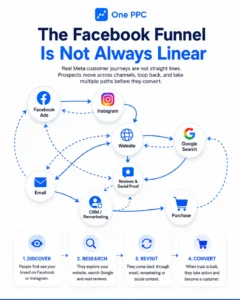
The Facebook Funnel Is Not Always Linear
The classic funnel assumes that people move neatly from awareness to consideration and then conversion. Real buying behaviour is less orderly.
A prospect may see a Reel, search for the brand on Google, read independent reviews, revisit through an organic Instagram post and later convert after a remarketing advert. Another person may see one direct-response advert, recognise an urgent need and purchase immediately. A returning customer may respond to a cross-sell advert without needing a new awareness phase.
The funnel should therefore be used as a planning model rather than a claim that every customer follows the same sequence. Its value is in helping the advertiser answer four questions:
What does this person probably know already?
What question or objection must the next advert resolve?
What action should they take next?
What data will show whether the action created commercial value?
The Main Stages of a Modern Meta Ads Funnel
The familiar three-stage model can be extended with retention because the customer relationship should not stop at the first sale.
| Funnel stage | Typical audience | Main job | Useful content and offers | Commercial measurement |
|---|---|---|---|---|
| Top of funnel | New or largely unfamiliar prospects | Create relevant attention and demand | Problem-led creative, demonstrations, educational video, strong offers and category introduction | Qualified reach, landing-page engagement, assisted conversions and new-customer growth |
| Middle of funnel | Engaged viewers, site visitors and researching prospects | Build confidence and reduce uncertainty | Case studies, comparisons, testimonials, FAQs, process explanations and lead magnets | High-intent visits, meaningful conversations, leads and progression rate |
| Bottom of funnel | High-intent visitors, cart users, form starters and sales-ready prospects | Generate the lead, booking or purchase | Clear proposition, proof, pricing context, consultation, quotation, availability or product reminder | Cost per qualified lead, customer acquisition cost, revenue and ROAS |
| Retention | Existing leads and customers | Convert later, increase lifetime value and generate repeat business | Nurture, replenishment, renewal, cross-sell, upsell and customer-specific offers | Repeat purchase, retention, lifetime value and incremental revenue |
These are strategic roles rather than compulsory campaign names. Depending on budget and data volume, several stages may be served within one campaign rather than split into many small campaigns and ad sets.
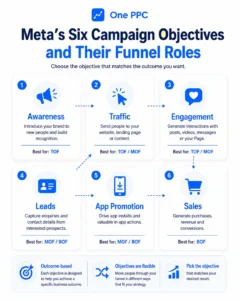
Meta’s Six Campaign Objectives and Their Funnel Roles
Meta’s current objective structure contains six choices. The objective tells the delivery system what type of result to pursue and affects the conversion locations, performance goals and optimisation options available later.
| Objective | What it is designed to help achieve | Possible funnel use |
| Awareness | Reach, ad recall and selected awareness outcomes | Broad introduction, local coverage, launches and campaigns where attention is the genuine goal |
| Traffic | Visits to a website, app or other destination | Content distribution, destination testing or journeys where a deeper event cannot yet be measured reliably |
| Engagement | Messages, video views, post engagement and other interactions | Video consumption, social proof, conversations and some on-platform nurture |
| Leads | Enquiries through forms, websites, calls or messaging, subject to available setup options | Cold acquisition, remarketing, consultations, quotations and qualified-lead generation |
| App promotion | App installs and valuable app activity | App acquisition and re-engagement |
| Sales | Purchases and other sales outcomes, including catalogue-based activity | Cold ecommerce acquisition, dynamic remarketing, customer acquisition and repeat sales |
Do not choose Traffic simply because the prospect is at the top of the funnel if the real objective is a lead or sale and that outcome can be measured accurately. Meta will generally try to find people likely to complete the event it has been asked to optimise towards. People likely to click are not necessarily people likely to enquire, qualify or purchase.
Our Meta Ads campaign objectives guide explains the current objective, conversion-location and performance-goal hierarchy in more detail.
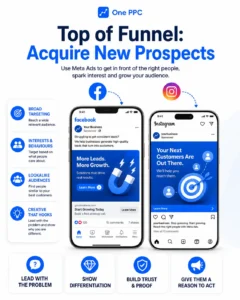
Top of Funnel: Acquire New Prospects
The top of the funnel reaches people who are not yet known customers or active prospects. Its job is not merely to obtain cheap reach. It must create the right kind of attention among people who could realistically buy.
Strong prospecting creative commonly does one or more of the following:
Makes a relevant problem recognisable
Demonstrates a product or outcome quickly
Explains why the offer is different
Qualifies who the service is and is not for
Uses credible proof rather than vague claims
Gives the viewer a reason to act now
Audience options may include broad targeting, interests, Lookalike Audiences and customer-based signals. Modern Meta targeting often works best with fewer unnecessary restrictions, especially when the market is sufficiently large and the conversion event is reliable. However, broad targeting is not automatically best for every local, niche or low-volume business. Geography, serviceability, economics and lead quality still matter.
Treat each audience method as a testable hypothesis rather than a doctrine. Our Facebook Ads targeting guide explains the balance between broad targeting, detailed targeting, Custom Audiences, Lookalikes and Advantage+ audience.
Awareness Is Optional, Not a Toll Gate
A dedicated Awareness campaign can make sense for a brand launch, major product introduction, local market coverage or a business with enough budget to measure incremental reach and later demand. It is not a mandatory payment required before Meta will generate leads or sales.
Smaller businesses often need to begin with direct response because they require measurable enquiries or sales. A Leads or Sales campaign can still reach a cold audience and perform the top-of-funnel task through its creative while optimising towards the bottom-line action.
The critical question is not, “Have we run an awareness campaign?” It is, “Does the prospect understand the problem, offer and reason to trust us well enough to act?”

Middle of Funnel: Build Confidence and Intent
The middle of the funnel contains people who have shown some evidence of interest but have not yet completed the primary conversion. Examples include:
Website visitors who viewed important pages
People who watched a meaningful proportion of a video
Facebook or Instagram engagers
Product viewers who did not add to basket
People who opened but did not submit an Instant Form
Prospects already in an email or CRM nurture sequence
This stage should add information rather than endlessly repeat the original advert. Useful creative includes case studies, product demonstrations, customer stories, objection handling, comparisons, buying guides, process explanations, guarantees and answers to frequently asked questions.
The recency and depth of the behaviour matter. Somebody who viewed a pricing page yesterday usually represents more intent than somebody who watched three seconds of a video several months ago. Build meaningful segments where volume permits, but avoid creating so many audiences that delivery and learning become fragmented.
Facebook remarketing can support this stage, but it cannot manufacture unlimited demand. Remarketing audiences are constrained by the number of people who entered the funnel. If frequency rises while conversions stagnate, the answer may be fresher creative, a stronger proposition or more qualified prospecting—not simply a larger remarketing budget.
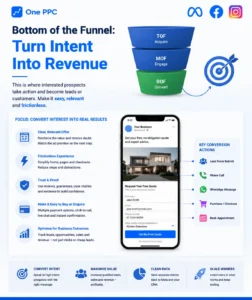
Bottom of Funnel: Turn Intent Into Revenue
The bottom of the funnel focuses on the action closest to commercial value: a purchase, qualified enquiry, booked appointment, quotation request, telephone conversation or other meaningful conversion.
The advert and conversion experience should now make the decision easier. That normally requires:
A precise offer and call to action
Clear pricing or appropriate price context
Strong trust signals and relevant proof
Answers to the main risk and suitability questions
A fast, mobile-friendly conversion path
Accurate stock, delivery, location or availability information
Minimal unnecessary friction without removing essential qualification
For lead generation, Meta can acquire enquiries through website forms, Instant Forms, calls and messaging, depending on the campaign configuration and account availability. The best conversion location is not always the one producing the lowest cost per lead. A website form may introduce more friction but provide stronger context and qualification. An Instant Form can convert efficiently on Meta but may require better questions, confirmation and follow-up to protect quality. See our updated Facebook Lead Ads guide for a full comparison.
For ecommerce, the Sales objective can optimise towards purchases and support catalogue-based advertising. Dynamic product advertising can show relevant products based on catalogue and behavioural signals, but it still depends on feed quality, event accuracy, commercial margins and creative. A product reminder cannot compensate for uncompetitive pricing, weak product pages or an unreliable checkout.
The Funnel Continues After the Lead
For service businesses, a form submission is usually the start of the sales process—not the final conversion.
A practical lead funnel might be:
| Stage | Definition |
| New lead | An enquiry has been received |
| Contacted | Two-way contact has been established |
| Qualified lead | The prospect meets documented commercial criteria |
| Appointment | A meaningful consultation, survey or sales call is booked or attended |
| Sales opportunity | There is a genuine potential transaction |
| Customer | The sale is completed |
| Revenue | The financial value is recorded |
The exact stages should match the business rather than a generic CRM template. What matters is that each stage has an objective definition and is used consistently.
If Meta receives only the initial Lead event, it cannot directly distinguish between a prospect who buys and one who is outside the service area, cannot be contacted or has no suitable budget. Connecting downstream CRM events can improve reporting and, in eligible campaign configurations, help Meta optimise towards higher-quality outcomes.
Our Facebook Ads CRM integration guide explains the difference between retrieving new leads into the CRM and sending later outcomes back to Meta. These are separate data flows, and having the first does not prove that the second is working.
On-Facebook Versus Off-Facebook Conversion Journeys
Meta can host much of the early customer journey, but keeping everything on-platform is not automatically superior.
| Journey | Main strengths | Main limitations | Often suitable for |
| Instant Form | Fast, mobile-friendly and can prefill contact information | Lower friction can attract accidental or weak enquiries; limited experience compared with a website | Quotations, consultations, local services and lead magnets |
| Messenger, Instagram Direct or WhatsApp | Conversational qualification and rapid answers | Requires prompt response, suitable staffing and structured handling | Higher-consideration services, appointments and questions before purchase |
| Website or landing page | More control over content, tracking, qualification, CRO and brand experience | Slower load or poor mobile UX can reduce conversion rate | Complex propositions, ecommerce and considered lead generation |
| Telephone call | Immediate human contact and strong intent in many service categories | Requires call coverage, call tracking and consistent qualification | Urgent, local and high-value services |
| Meta Shop or other on-platform commerce experience | Reduces transitions and can integrate catalogue discovery | Feature availability and checkout journey vary by market and setup | Eligible ecommerce catalogues and product discovery |
Test the complete commercial outcome. A £20 Instant Form lead is not cheaper than a £40 website lead if only 5% of Instant Form leads qualify and 25% of website leads qualify.
Measurement: Connect the Advert to the Customer
A full-funnel strategy requires a full-funnel measurement system. The core components can include:
Meta Pixel for browser-side website events
Conversions API for server-side website, CRM or offline events
Consistent event names, values, timestamps and identifiers
Event deduplication when the same website action is sent through both browser and server
UTMs and web analytics for independent channel and landing-page analysis
A CRM as the source of truth for lead status, rejection reason, opportunity and revenue
Ecommerce order data for sales, refunds, margin and repeat purchases
Meta recommends using the Pixel and Conversions API together where appropriate. That does not mean sending two independent copies of every conversion. When browser and server connections report the same event, matching event identifiers should allow Meta to deduplicate it. A later Qualified Lead or Purchase recorded in the CRM is a separate downstream event, not a duplicate of the original enquiry.
The Facebook Ads offline conversion tracking guide covers datasets, CRM events, qualified-lead optimisation and revenue feedback in more depth.
Measure Economics, Not Only Platform Activity
Use metrics that match the stage, but judge the overall system using commercial outcomes.
Top-of-funnel indicators can include reach, frequency, video retention, engaged sessions and new-user growth. Middle-of-funnel indicators can include high-intent page views, form starts, conversations and assisted conversions. Bottom-of-funnel indicators should include qualified leads, cost per acquisition, revenue, profit and return on ad spend.
Avoid treating every reported conversion as incremental. Meta attribution can include people who interacted with several channels or may have purchased anyway. Compare Ads Manager with CRM and ecommerce records, monitor blended acquisition cost and revenue, and use controlled geographic, audience or budget tests when the investment justifies stronger incrementality evidence.
A Practical Lead-Generation Funnel
Consider a local home-improvement company advertising a high-value service.
Prospecting
The business runs a Leads campaign to a serviceable local area. Creative shows the problem, the completed result, indicative project suitability and evidence from previous customers. It does not use a separate Traffic campaign merely to warm the audience.
Conversion
The advertiser tests a website quotation page against an Instant Form. Both ask enough questions to establish location, service required and likely timescale without turning the form into an interrogation.
Follow-Up
New enquiries enter the CRM immediately. Confirmation is sent automatically, but sales calls remain personal. Leads are assigned, response times are monitored and a structured follow-up sequence continues when the first contact attempt fails.
CRM Feedback
The team records Contacted, Qualified Lead, Appointment, Opportunity and Customer stages, together with standard rejection reasons. Suitable events are returned to Meta through an appropriate integration, while management reports compare cost per lead, cost per qualified lead, customer acquisition cost and revenue.
Remarketing
Recent pricing-page visitors, relevant video viewers and non-converting form openers see case studies, process explanations and answers to common objections. Existing customers and unsuitable leads are excluded where appropriate.
This is a funnel because the advertising, conversion path, follow-up and sales data are connected—not because three campaigns have been named TOF, MOF and BOF.
A Practical Ecommerce Funnel
An ecommerce advertiser may use a Sales campaign to introduce products and acquire purchases from new customers. Prospecting creative demonstrates the product, problem, use case and differentiation. Catalogue ads and broader product creative can work together rather than being treated as substitutes.
Product viewers and basket abandoners may receive relevant reminders, proof, delivery information or legitimate offers. Purchasers can enter replenishment, accessory, cross-sell or new-range campaigns based on the economics and buying cycle.
The measurement layer should send ViewContent, AddToCart, InitiateCheckout and Purchase events accurately, with value and currency where required. Purchase is normally the most commercially meaningful optimisation event, but the account must have reliable tracking and enough usable data. Moving permanently to AddToCart simply to create more reported conversions can optimise the system towards people who add products but do not buy.
Revenue is not profit. Product margin, discounts, shipping, returns, payment costs and new-versus-returning customer mix should influence bidding and budget decisions.
How Smaller and Larger Advertisers Should Structure the Funnel
Budget changes what can be measured reliably.
Smaller businesses often benefit from beginning near the bottom of the funnel: promote the strongest proven offer, optimise for a lead or sale, install reliable measurement and build follow-up. This creates commercial feedback sooner. Warm-audience remarketing can be added where the audience is large enough, while prospecting creative performs both education and response generation.
Larger advertisers may have enough budget, traffic and creative capacity to separate prospecting, consideration, remarketing and retention more deliberately. They can also invest in brand-lift studies, incrementality testing, creative sequencing and broader demand creation.
Neither approach justifies unnecessary fragmentation. Ten small ad sets do not create a sophisticated funnel if each receives too little budget or too few outcomes to learn. Structure should be as simple as possible while preserving genuine differences in objective, geography, economics, conversion event or creative strategy.
Creative Should Do the Funnel Work
Audience targeting alone cannot carry a Meta funnel. Creative frequently determines who pays attention, how the offer is understood and whether unsuitable prospects self-select out.
Build a portfolio rather than one advert resized several times:
Problem-aware creative makes the need recognisable
Product-aware creative demonstrates the solution
Proof creative uses credible reviews, results or case studies
Objection creative deals with price, risk, time, complexity or trust
Comparison creative clarifies alternatives without misleading claims
Offer creative gives a specific reason to act
Retention creative introduces the next relevant purchase or service
Different creative can serve different levels of awareness inside the same campaign. This is often more practical than forcing every message into a separate campaign.
Follow-Up Automation Without Losing the Human Element
Fast lead handling can materially affect conversion. Instant Form and website leads should normally enter the CRM automatically, trigger confirmation and reach the responsible person without manual spreadsheet downloads.
Useful automation may include:
Immediate email or SMS confirmation
Internal lead notifications and assignment
Missed-call text-back
Appointment reminders
Follow-up tasks when a lead is not reached
Nurture based on service or product interest
Audience inclusion or exclusion based on CRM status
Conversion events when documented funnel milestones occur
Automation should support the buying experience rather than bombard every lead with identical messages. Consent, communication preferences and applicable privacy rules still apply. High-value enquiries often need fast human contact supported by automation, not replaced by it.
Common Facebook Funnel Mistakes
Treating Awareness, Traffic and Sales as Mandatory Sequential Objectives
The old objective columns encouraged advertisers to assume that every buyer must be moved through three campaign types. Current Meta objectives are outcome-based. Choose the result the campaign can measure and genuinely needs.
Optimising for the Easiest Event
Cheap clicks, video views, form submissions or add-to-basket events can make reports look active. They are weak substitutes when the real outcome is a qualified lead or profitable sale.
Building Too Many Tiny Audiences
Excessive segmentation divides budget, duplicates creative and can restrict delivery. Separate audiences when the difference changes strategy, not merely because Ads Manager allows it.
Using the Same Advert at Every Stage
Some repetition is valuable, but middle- and bottom-funnel prospects often need new evidence, clarification or urgency—not the same introduction shown indefinitely.
Measuring Cost per Lead Without Lead Quality
The lowest-cost lead source can be the most expensive after qualification and sales. Our guide to improving Facebook Ads lead quality explains how creative, forms, CRM stages and downstream feedback work together.
Assuming Conversions API Automatically Fixes Performance
Conversions API is a data connection, not a strategy. Poor event definitions, duplicates, missing identifiers, inconsistent CRM stages or inaccurate values can supply more data without supplying better information.
Ignoring the Sales Process
Advertising cannot compensate indefinitely for slow response, unanswered calls, weak qualification, inconsistent quotation follow-up or a proposition that is not competitive.
Judging Everything Inside Ads Manager
Platform reporting is useful but not a complete source of business truth. Reconcile it with the CRM, order system, finance data and overall business performance.
How to Build Your Facebook Ads Funnel Step by Step
Define the commercial outcome. Decide whether success means a qualified lead, appointment, new customer, purchase, revenue or profit.
Map the real buying journey. Document the main touchpoints on Meta, the website, telephone, email, CRM and sales process.
Set funnel-stage definitions. Make Lead, Qualified Lead, Opportunity and Customer objective and measurable.
Choose the conversion location. Compare Instant Forms, website, messaging and calls based on quality as well as volume.
Select the correct objective and performance goal. Optimise towards the deepest reliable event that has enough usable volume.
Build the measurement foundation. Test Pixel, Conversions API, event deduplication, UTMs, CRM fields, values and revenue reporting.
Start with the strongest proposition. Smaller advertisers should usually prove direct response before spreading budget across multiple awareness layers.
Create messages for different awareness levels. Use problem, solution, proof, objection and offer creative.
Connect lead retrieval and follow-up. Get enquiries into the CRM immediately and establish ownership, response standards and nurture.
Return meaningful outcomes. Where eligible and useful, send qualified leads, customers and revenue back to Meta.
Evaluate the complete economics. Compare cost per qualified lead, acquisition cost, revenue, margin and lifetime value.
Expand deliberately. Add prospecting scale, remarketing, retention and upper-funnel investment when data, audience size and budget justify them.
Frequently Asked Questions
Do I Need Separate TOF, MOF and BOF Campaigns?
No. Separate campaigns can be useful when objectives, conversion events, budgets or audiences genuinely require different control. Smaller accounts may perform better with a simpler structure and creative that addresses several awareness levels. Funnel strategy matters more than campaign naming.
Should Small Businesses Start at the Bottom of the Funnel?
Often, yes. A smaller business usually needs measurable leads or sales before allocating substantial budget to pure awareness. Start with the strongest direct-response offer and reliable tracking, then expand upwards and outwards as results, audience size and budget develop.
Is the Traffic Objective Good for Warming Up Audiences?
It can distribute content or test a destination, but do not assume cheap traffic will later become profitable demand. If the campaign can accurately optimise for the required lead or sale, the deeper objective is often the stronger starting point.
Should I Use Instant Forms or a Website Landing Page?
Test both when the economics justify it. Instant Forms reduce friction and can increase lead volume. Websites provide more control over explanation, qualification, conversion-rate optimisation and analytics. Compare qualified-lead and customer acquisition cost rather than cost per form alone.
Does Remarketing Always Produce the Best ROAS?
Remarketing often reports strong returns because it targets people who already know the business, but some may have converted without another advert. Audience size is also limited. Use remarketing selectively and evaluate its incremental value alongside prospecting and blended results.
What Is the Best Event for Meta to Optimise Towards?
Use the deepest meaningful event that is accurately measured, consistently defined, sufficiently frequent and returned quickly enough to support useful learning. For ecommerce this is commonly Purchase. For lead generation it may initially be Lead, then Qualified Lead or another reliable CRM milestone where the setup and volume support it.
Can Facebook Ads Build an Entire Funnel Without a Website?
Yes, parts of the journey can use Instant Forms, messaging, calls and other Meta experiences. However, the lead still needs a CRM or dependable management process, follow-up and commercial measurement. A website remains valuable when the proposition requires more explanation, trust, qualification or ecommerce functionality.
Final Thoughts
A modern Facebook Ads funnel is not a row of three campaigns and it is not a rigid sequence imposed by Meta. It is an operating system that connects demand generation, creative, conversion paths, follow-up, CRM stages and revenue measurement.
For smaller businesses, the most sensible starting point is often the strongest bottom-funnel offer delivered to new prospects with a Leads or Sales campaign. Once tracking and commercial performance are established, the funnel can expand through additional creative, remarketing, nurture, retention and measured awareness investment.
The objective is not to make every stage of Ads Manager look busy. It is to produce more qualified prospects and profitable customers while understanding how advertising contributes to the result.
If you need help planning, measuring or improving this system, review the One PPC Facebook Ads approach or explore our latest Facebook Ads guides.