
For most recruitment agencies, the purpose of Google Ads should be to win hiring companies—not to attract more job seekers.
That distinction sounds obvious, but it is one of the hardest parts of recruitment advertising. Employers and candidates use overlapping language, while candidate searches are usually much more common. A keyword such as “sales recruitment agency” can indicate a company looking for help hiring salespeople. A keyword such as “sales jobs” almost certainly indicates a candidate looking for work.
A single retained search, permanent placement agreement or temporary staffing contract can be worth considerably more than an individual candidate application. Yet a poorly controlled campaign can spend most of its budget on candidates because they are easier to reach and more likely to complete a form.
That creates an account which appears busy without necessarily producing revenue.
A stronger strategy connects three elements:
Targeting: Reach searches that indicate the right type of recruitment requirement.
Landing pages: Match the searcher’s sector, location, hiring model and level of urgency.
AI bidding and commercial data: Teach Google which enquiries become qualified vacancies, placements and profitable clients.
This is why keyword selection, search-term control and conversion setup are central to recruitment PPC. The campaign should target searches made by hiring companies, avoid job seekers wherever possible and optimise towards employer enquiries. This is the standard One PPC approach to Google Ads success, applied specifically to recruitment agencies.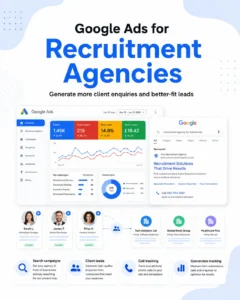
Why Google Ads Can Work Well for Recruitment Agencies
Google Search captures declared intent. An HR manager searching for “engineering recruitment agency Manchester”, “temporary warehouse staff agency” or “executive search firm UK” is actively expressing a requirement.
That is different from targeting someone because their profile suggests they work in HR. Search can place an agency in front of a potential client when a vacancy exists, an internal hiring process has stalled or additional recruitment capacity is needed.
Google Ads can be particularly effective when:
the agency specialises in a defined sector, role type or geography;
placement fees or contract values justify the cost of competitive searches;
the website demonstrates genuine sector expertise;
enquiries are answered quickly and qualified consistently;
the CRM records which leads become vacancies, placements and revenue;
the campaign has enough budget to collect meaningful evidence.
It is less likely to work when an agency targets vague recruitment terms, sends every visitor to a generic homepage and optimises towards every form submission regardless of quality.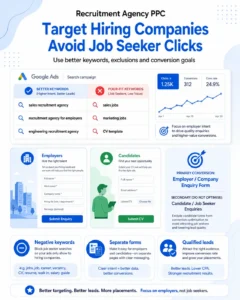
The Central Objective: Target Hiring Companies, Not Job Seekers
Recruitment websites naturally serve employers and candidates, but an employer-acquisition campaign should be designed exclusively around companies with a hiring requirement.
Employer acquisition
Employer campaigns are designed to generate new hiring clients. Useful actions may include:
requesting a recruitment proposal;
registering a vacancy;
booking a consultation;
calling the agency about an active hiring requirement;
requesting temporary or contract staff;
discussing retained search or recruitment process outsourcing.
These campaigns should use employer-focused keywords, adverts and landing pages. The message should address hiring speed, candidate quality, sector knowledge, geographic coverage, fee model, compliance and delivery process. The visitor should immediately understand that the page is for employers who need to recruit.
Candidate acquisition is a separate activity
Candidate campaigns are designed to generate applications, registrations or interest in a specific vacancy or category of work. They may be valuable when:
a live role is difficult to fill;
the agency has an urgent temporary staffing requirement;
one placement can support an acceptable candidate acquisition cost;
organic job boards and existing databases cannot supply enough suitable people;
the advertiser needs candidates with a rare skill or qualification.
Candidate campaigns should only be used when candidate acquisition is a deliberate objective. They should be separated by vacancy, profession, location or closely related role family. Their budgets and conversion goals must not compete with employer acquisition.
Do not combine both audiences in one campaign or conversion goal
The word “recruitment” is ambiguous. Someone searching for a recruitment agency may want to hire staff, find work, register a CV, advertise a vacancy or apply for a job at the agency itself.
If employer and candidate activity share the same campaign or primary conversion goal, Google may allocate more budget to whichever action is easier or cheaper. That will often be a candidate registration rather than a high-value employer enquiry.
The website should have separate forms and journeys for the two audiences:
Employer form: “Register a Vacancy”, “Request Recruitment Support” or “Discuss Your Hiring Requirement”.
Candidate form: “Apply for a Job”, “Register as a Candidate” or “Upload Your CV”.
For employer-focused Google Ads, only the employer form should normally be a primary conversion. The candidate form should be secondary for observation or excluded from Google Ads conversion goals altogether. This prevents a candidate registration from being counted as though it were a prospective recruitment client.
Use separate campaigns, separate goals and separate landing-page journeys. If the commercial priority is winning new clients, give employer acquisition its own protected budget and do not allow candidate actions to guide its bidding.
Start With the Agency’s Commercial Model
Campaign structure should reflect how the recruitment agency makes money. A specialist retained-search firm should not copy the account of a high-volume temporary staffing provider.
Clarify:
permanent, temporary, contract, retained or contingency recruitment;
sectors and job families served;
employer size and type;
geographic coverage;
average placement fee or contract value;
gross profit or contribution per placement;
lead-to-vacancy and vacancy-to-placement rates;
capacity to fulfil additional vacancies;
roles the agency can fill better than competitors.
This information determines which searches are affordable. A keyword with a relatively high cost per click may still be attractive if it reliably produces retained assignments. A cheaper keyword may be poor value if it creates large volumes of unsuitable candidate traffic.
The correct target is not simply the lowest cost per lead. It is profitable client acquisition.
Build Campaigns Around Services, Sectors and Locations
A useful Search account normally separates themes that require different budgets, messages, landing pages or sales treatment.
Possible employer campaign groups include:
permanent recruitment;
temporary staffing;
contract recruitment;
executive search;
retained recruitment;
recruitment process outsourcing;
sector-specific recruitment;
location-specific recruitment;
competitor or alternative-agency searches;
brand searches.
Within those campaigns, ad groups should represent close commercial themes. For example, an engineering recruitment campaign might separate manufacturing, civil engineering, mechanical engineering and electrical engineering if each has a relevant landing page and a meaningful volume of demand.
Avoid fragmenting a modest budget into dozens of nearly identical campaigns. Segmentation is useful when it changes a decision; unnecessary fragmentation starves each campaign of data.
Separate permanent, temporary and contract recruitment
These services solve different problems. Employers seeking temporary warehouse staff may prioritise immediate availability, payroll administration and compliance. A company hiring a finance director may care more about market mapping, confidentiality and retained search methodology.
Separate campaigns allow each service to have:
its own budget;
appropriate keywords and negatives;
relevant advert copy;
a dedicated landing page;
different lead values;
different CRM qualification criteria.
Segment by sector where the agency has genuine expertise
Sector-specific searches frequently show stronger intent than generic “recruitment agency” searches. Examples include:
technology recruitment agency;
healthcare recruitment company;
construction recruitment specialists;
finance recruitment agency;
legal recruitment consultants;
hospitality staffing agency;
engineering recruitment firm;
warehouse staffing agency.
Only claim specialisation that the agency can demonstrate. Landing pages should include relevant role types, candidate networks, market knowledge, compliance requirements, delivery process and evidence.
Use location structure carefully
Recruitment can be local, national or international depending on the service. Temporary staffing is often constrained by commuting distance, while executive search may cover the whole country.
Target the area the agency can genuinely serve, then use Google’s presence-based location option where appropriate to reduce clicks from people merely interested in the location. Review the geographic report because a location setting is an eligibility control, not proof that every searcher is commercially relevant.
Do not create thin city pages by changing only a place name. A location landing page should explain the markets, roles, employer needs and service capability in that area.
Recruitment Keyword Research Requires More Than Search Volume
Keyword selection is one of the most important parts of Google Ads for a recruitment agency. The campaign succeeds by entering auctions that are likely to involve hiring companies and avoiding the much larger volume of searches made by job seekers.
The difference can be one or two words:
| Search theme | Likely intent | Employer campaign decision |
|---|---|---|
| sales recruitment agency | Company seeking a specialist recruiter | Strong keyword candidate |
| hire salespeople | Company with an active hiring requirement | Strong keyword candidate |
| sales staffing agency | Company seeking temporary or permanent staff | Strong keyword candidate |
| executive sales recruiters | Company seeking senior sales talent | Potentially strong, subject to service fit |
| sales jobs | Candidate looking for work | Exclude or avoid |
| sales vacancies | Candidate looking for an open role | Exclude or avoid |
| sales recruitment consultant jobs | Recruiter looking for employment | Exclude or avoid |
| sales salary | Research or candidate intent | Usually exclude |
“Sales recruitment agency” is not automatically profitable, but its language suggests that the searcher wants a recruitment service. “Sales jobs” expresses the opposite side of the market. High search volume does not make the second phrase a good keyword for employer acquisition.
The best recruitment keywords combine employer intent, service fit and economic value. Our wider Google Ads keyword research guide explains how to evaluate those factors.
For employer acquisition, useful patterns may include:
recruitment agency for employers;
hire a recruitment agency;
recruitment company for [sector];
[role] recruitment specialists;
temporary staffing agency;
executive search firm;
retained recruitment company;
contract recruitment agency;
hire [role] in [location];
recruit [role or profession];
agency to fill [role type].
Words such as “agency”, “company”, “consultancy”, “staffing”, “recruiters”, “headhunter”, “executive search”, “temporary staff”, “hire” and “recruit” can help signal employer intent. They still require context: “recruitment agency jobs” contains the word “agency” but is clearly a candidate search.
The exact language varies by market. Some employers search for “staffing agency”, others use “recruitment consultancy”, “headhunter”, “executive search” or a specific service such as “RPO provider”. Keyword Planner can provide estimates, but the agency’s own sales calls, CRM records, site search and Search Console data often reveal more commercially accurate terminology.
Begin with control before expanding reach
Exact and Phrase Match are sensible starting points for many recruitment campaigns because they make it easier to understand demand and control ambiguity. They still match variants and related meanings, so they do not remove the need to review actual search terms.
A keyword is the term selected by the advertiser. A search term is what the person actually entered into Google. Even a well-chosen Phrase or Exact Match keyword can trigger related searches that reveal candidate intent. The Search Terms Report therefore matters just as much as the original keyword list.
Broad Match can discover additional demand, but recruitment is especially vulnerable to semantic overlap between employers and job seekers. Test it only when conversion tracking is trustworthy, negative coverage is strong, the budget can absorb exploration and Google receives meaningful downstream lead-quality data.
Our guide to Broad Match for lead generation explains the trade-off between scale and control.
Negative Keywords Are Essential in Recruitment Advertising
Negative keywords protect employer campaigns from candidate, training and information traffic. They should be based on the campaign’s objective rather than copied blindly from a generic list.
Potential candidate-related negatives for an employer-only campaign include:
jobs;
vacancies;
careers;
salary;
CV;
resume;
apprenticeship;
internship;
graduate scheme;
application;
interview questions;
recruitment consultant jobs;
work for us;
how to become a recruiter.
Other possible exclusions include irrelevant sectors, locations, qualifications, courses, templates, definitions, software searches and competitor names that the agency has chosen not to target.
Check every negative in context. “Job” may be irrelevant to a retained-search campaign but useful in a keyword such as “advertise a job through a recruitment agency”. Overly broad exclusions can remove valuable employer searches.
The Google Ads Search Terms Report should be reviewed routinely. It shows how Google’s matching interpreted the keyword and provides direct evidence for new negatives, new exact keywords and landing-page improvements. Our negative keyword guide provides a broader framework.
Write Adverts for Employers, Not Everyone
An employer-focused advert should make it obvious that the service is for organisations hiring people. This helps attract the right click and discourage candidates before the agency pays for an unproductive visit.
Useful messages may include:
Hire Proven [Sector] Talent
Need to Fill a [Role] Vacancy?
Permanent and Contract Recruitment
Speak to a Specialist Recruiter
Submit Your Vacancy
UK-Wide Candidate Network
Shortlist Delivered in [credible timeframe]
Retained Search for Senior Hires
Advert copy should communicate a real reason to choose the agency. That might be a specialist consultant team, a vetted talent network, a replacement guarantee, transparent fees, relevant accreditations or evidence of filling similar roles.
Avoid unsupported superlatives, invented scarcity and claims such as guaranteed placements unless the commercial terms genuinely support them. Specific proof is more credible than generic language such as “leading recruitment experts”.
Use assets to provide additional routes and information:
sitelinks for sectors, temporary staffing, executive search and employer resources;
callouts for relevant differentiators;
structured snippets for sectors or services;
call assets when calls are handled promptly;
location assets when physical offices matter;
lead forms only when their quality can be measured and followed up effectively.
Build Landing Pages Around the Hiring Requirement
Sending every advert to the homepage makes the visitor interpret the agency’s entire proposition for themselves. A dedicated page can continue the exact conversation started by the keyword and advert.
The paid landing page should be built for hiring companies. Do not place one ambiguous “Register” form in front of both audiences. An employer registering a vacancy and a candidate registering a CV are different conversions, require different fields and represent very different commercial values.
An effective recruitment landing page should explain:
who the service is for;
sectors, roles and locations covered;
permanent, contract or temporary capability;
how the recruitment process works;
how candidates are sourced and assessed;
expected communication and delivery times;
relevant compliance or vetting;
case studies, testimonials or placement evidence;
fees or commercial model where appropriate;
the next action for an employer.
The primary call to action could be “Register a Vacancy”, “Discuss Your Hiring Requirement” or “Request a Recruitment Proposal”. A secondary telephone option can help urgent employers.
Candidate navigation should remain available, but it should not dominate an employer acquisition page. If a candidate lands there accidentally, a clear “Looking for a job?” route should send them to a separate candidate page and candidate form without recording an employer conversion.
Qualify without making the form exhausting
Useful employer form fields may include:
name and business email;
company;
telephone number;
role or roles being recruited;
permanent, temporary or contract requirement;
location;
expected hiring timeframe;
optional vacancy details.
Collect enough information to route and prioritise the enquiry, but avoid turning the first interaction into a full job specification. Progressive qualification can continue in the CRM or during the initial call.
The candidate form should live separately and collect information relevant to job applications, such as CV, role interests and location. Its submissions may be useful to the recruitment business, but they should not be allowed to inflate the reported performance of campaigns intended to acquire hiring companies.
Measure the Recruitment Funnel, Not Just Form Submissions
Basic Google Ads conversion tracking can record submitted forms, calls and booked consultations. That is necessary, but it does not reveal whether the enquiry came from an employer, whether a real vacancy existed or whether the agency earned revenue.
A recruitment sales funnel might include:
Employer Enquiry;
Qualified Employer Lead;
Vacancy Registered;
Terms Agreed;
Candidate Shortlist Submitted;
Interview Arranged;
Placement Made;
Fee or Gross Profit Recorded.
Candidate campaigns need a different funnel:
Application or Registration;
Candidate Contacted;
Candidate Qualified;
Submitted to Employer;
Interviewed;
Placed.
Do not assign the same meaning or value to every stage. A CV upload, a genuine employer vacancy and a completed placement are not commercially equivalent.
Connect Google Ads to the recruitment CRM
The CRM or applicant tracking system should preserve the lead source, campaign information, landing page, click identifiers and consented first-party data captured at the first interaction. Sales or recruitment consultants then update the record as the opportunity progresses.
Selected outcomes can be returned to Google Ads through a supported native connection, Google Ads Data Manager, an API, scheduled upload or a no-code tool. Google’s current recommended approach for new lead-generation implementations is Enhanced Conversions for Leads, which can use hashed first-party data alongside advertising identifiers to improve matching of later outcomes.
Our Google Ads CRM integration guide explains the implementation options in more detail.
This feedback loop lets the agency compare:
cost per employer enquiry;
cost per Qualified Lead;
cost per registered vacancy;
cost per agreed client;
cost per placement;
revenue or gross profit by campaign;
return on advertising spend;
time from enquiry to placement.
The biggest improvement often comes from changing what Google is told to pursue. If bidding receives only raw forms, it will seek people likely to submit forms. If it receives reliable qualified-vacancy and placement data, it has a better signal of commercial value.
Set Conversion Goals and Values Deliberately
Primary conversion actions are generally eligible to influence bidding. Secondary actions are normally retained for observation. The account should therefore distinguish outcomes worth optimising towards from useful diagnostic interactions.
For an employer-acquisition campaign, the company or employer form should be the primary website conversion. A candidate form should normally be secondary or excluded from that campaign’s goals. If candidate registrations are left as primary conversions, Google may appear to reduce the cost per conversion while moving the budget away from prospective clients.
For an employer campaign, a sensible starting arrangement may be:
Primary initially: valid employer enquiry or a sufficiently qualified booked consultation;
Primary when volume and reliability permit: Qualified Employer Lead or Vacancy Registered;
Secondary or excluded from employer goals: candidate registrations, page engagement, email clicks, short calls and other micro-conversions;
Imported for reporting and value: terms agreed, placement and revenue or gross profit.
The final structure depends on conversion volume and sales-cycle length. An account generating only a handful of registered vacancies may need to use an earlier qualified stage for bidding while retaining deeper outcomes for reporting and value analysis.
Avoid putting employer leads and candidate applications into one account-default goal. Use campaign-specific goals where needed, and test the conversion setup by completing each form to confirm that the employer action and candidate action are recorded separately.
Choose a Bidding Strategy That Matches the Evidence
Automated bidding can optimise auction-time bids, but it cannot repair a poor commercial definition of success.
For a new or low-volume campaign, Maximise Clicks with a carefully controlled bid limit or a conversion-focused strategy may both be considered depending on the quality of the tracking, budget and existing account evidence. Manual CPC can also remain useful where close control matters, particularly for brand activity or very small specialist campaigns.
Once reliable conversion volume exists, Maximise Conversions or Target CPA can be tested. If different recruitment outcomes have credible economic values, Maximise Conversion Value or Target ROAS may eventually become more appropriate.
As a practical planning benchmark rather than a Google rule, One PPC generally wants a Target CPA campaign to produce around 15 meaningful conversions per month at minimum, with 30–50 providing a healthier learning environment. High-value recruitment may justify lower volume, but the decisions must then rely more heavily on longer evaluation periods and qualitative CRM evidence.
Do not combine weak conversions simply to manufacture volume. Ten genuine employer opportunities are more informative than 100 mixed candidate registrations, button clicks and low-quality forms.
Use Google’s Automation in the Right Order
Google Ads offers increasing automation through Broad Match, AI Max for Search and Performance Max. These systems can find incremental demand, but expanded reach should follow reliable measurement rather than compensate for its absence.
Search campaigns first
For most recruitment agencies, tightly structured Search campaigns are the best starting point because they provide the clearest connection between a search, an advert, a landing page and a recruitment requirement.
Establish which sectors, services, locations and search terms create qualified opportunities. Improve the landing pages and connect the CRM before handing Google substantially more freedom.
AI Max for Search
AI Max can expand beyond the existing keyword set, customise advert text and use landing-page content to find additional queries and destinations. It may be useful when the account has strong service pages, enough budget and dependable outcome data.
It should be introduced cautiously in employer lead generation. If the only goal is an unqualified form, wider matching may produce more inexpensive but irrelevant enquiries. Review search terms, selected landing pages, assets and conversion quality after activation.
Performance Max
Performance Max can advertise across Google’s inventory from one goal-based campaign. It may support remarketing, employer brand activity or incremental lead generation, but it offers less direct control than a tightly built Search campaign.
For recruitment agencies, it should normally complement proven Search activity rather than replace it at launch. Use suitable creative, first-party signals, brand controls, URL exclusions and campaign-specific conversion goals. Our guide to Performance Max for lead-generation businesses covers the main risks and controls.
If You Advertise Jobs, Isolate Candidate Campaigns Completely
The main strategy in this guide is employer acquisition. Paid candidate acquisition can still work for selected vacancies, but it should operate as a separate system. Generic job-seeker traffic is easy to buy and difficult to monetise, and it must never be allowed to distort the results of campaigns designed to win recruitment clients.
Where practical:
advertise live, economically viable vacancies;
group only closely related roles;
target locations candidates can realistically travel to or work from;
state salary or rate information when available;
explain essential qualifications or right-to-work requirements;
send traffic to the exact vacancy or relevant role category;
measure completed, valid applications rather than vacancy-page views;
feed candidate quality and placements back into reporting.
Pause or update adverts promptly when roles close. A visitor should not pay the agency the hidden cost of a click only to find an expired vacancy.
Google Ads should not be confused with Google for Jobs. Google for Jobs is an organic job-search experience which can surface eligible vacancy pages and feeds; paying for a Search advert does not buy a higher organic job listing. Recruitment agencies should manage paid candidate acquisition and job-posting SEO as related but distinct activities.
Employment Advertising Policies and Data Protection
Recruitment advertising requires particular care because employment is a sensitive area.
Google applies restrictions to personalised advertising and employment targeting, with some of the strictest demographic and postcode limitations applying in specific countries. Requirements can vary by location and campaign type, so agencies should review Google’s current personalised advertising policy before launch rather than assuming that a targeting option is permitted simply because it appears in the interface.
Advertisers must also comply with applicable equality, employment, privacy and data-protection law. In practice:
avoid discriminatory targeting or advert wording;
collect only information needed for the stated purpose;
provide clear privacy information;
obtain and record appropriate consent where required;
control access to candidate and employer data;
define retention and deletion processes;
ensure CRM uploads and audience use have an appropriate lawful basis.
Google Ads approval does not prove that an advert or recruitment process complies with the law. Agencies operating across several countries should obtain appropriate legal guidance.
Budget From Commercial Outcomes Backwards
A recruitment budget should be based on the economics of the funnel rather than an arbitrary daily amount.
Suppose an agency estimates:
one in four qualified employer leads registers a vacancy;
one in three registered vacancies becomes a successful placement;
the average placement generates £6,000 in gross profit;
the agency is prepared to spend 15% of gross profit on acquiring that placement.
The target cost per placement would be £900. Based on the estimated funnel, one placement requires approximately three vacancies and twelve qualified leads, creating an initial target of £75 per qualified lead.
These figures are illustrative, not benchmarks. Each agency should use its own CRM evidence and include sales capacity, refunds, rebates, fulfilment costs and the time lag between lead and placement.
Work backwards through:
acceptable acquisition cost per client or placement;
vacancy-to-placement rate;
Qualified Lead-to-vacancy rate;
raw lead-to-Qualified Lead rate;
landing-page conversion rate;
expected cost per click and search volume.
This reveals whether the market can support the required evidence and whether the proposed spend is commercially realistic.
Optimise for Revenue and Capacity, Not Vanity Metrics
Recruitment campaigns should be reviewed across Google Ads, the website and the CRM.
Useful optimisation questions include:
Which searches generate employers rather than candidates?
Which sectors create registered vacancies?
Which services produce placements with acceptable margin?
Which locations create qualified demand the agency can fulfil?
Which landing pages convert and qualify effectively?
Which adverts set the correct expectation?
How quickly are new enquiries contacted?
Which consultants convert opportunities most effectively?
Which campaigns generate revenue after rebates and fulfilment costs?
Is limited candidate supply constraining the ability to accept new vacancies?
Search impression share, click-through rate and form conversion rate can help diagnose performance, but none is a final commercial objective. A campaign can have an excellent click-through rate and still attract the wrong side of the market.
Common Google Ads Mistakes Recruitment Agencies Make
Optimising all activity towards applications
Candidate volume overwhelms employer demand, so Google learns to find more applicants rather than more clients. Keep the employer form primary and make the candidate form secondary or remove it from the employer campaign’s goals.
Using the homepage for every search
The page asks employers to work out whether the agency covers their sector, service, location and seniority level.
Targeting “recruitment agency” without qualification
The keyword can match employers, candidates, training searches and people looking for recruitment jobs. It needs controlled match types, negatives and a clear advert.
Choosing high-volume job keywords
Keywords such as “sales jobs”, “marketing vacancies” and “recruitment consultant jobs” may generate traffic, but that traffic is predominantly from candidates. For client acquisition, prioritise commercially specific phrases such as “sales recruitment agency”, “marketing recruitment company” and “hire recruitment consultants”.
Treating every form as a lead
Spam, candidates, suppliers and irrelevant enquiries inflate performance. Conversion validation and CRM qualification are required.
Turning on Broad Match or Performance Max too early
Google receives more freedom before the agency has defined the right outcome or built sufficient negative and CRM feedback controls.
Mixing specialisms in one advert and page
A generic claim to recruit “across all sectors” is rarely as persuasive as evidence directly relevant to the employer’s requirement.
Ignoring telephone outcomes
Calls may be among the strongest employer leads, but a click on a telephone number is not proof that a meaningful conversation occurred. Track answered calls, duration and qualified outcomes while avoiding duplicate conversions.
Evaluating performance too quickly
Recruitment sales cycles can extend from enquiry to vacancy, interview, placement and fee. Recent leads need time to mature before their true value can be assessed.
A Practical Launch Plan
Define the priority
Make employer acquisition the objective of the main campaign. Specify the sectors, services, locations and roles for which the agency wants more hiring clients. If candidate advertising is also required, place it in separate campaigns with a separate budget and separate goals.
Establish the economics
Calculate acceptable acquisition costs using actual placement fees, margins and historic funnel rates.
Prepare measurement
Create separate employer and candidate forms. Track the employer form as the primary website conversion for client-acquisition campaigns. Keep the candidate form secondary or outside those campaign goals. Configure the CRM or ATS to record source data and recruitment stages consistently.
Build focused landing pages
Create pages that answer the needs of each priority employer or candidate segment and provide a clear next step.
Launch controlled Search campaigns
Start with commercially specific Exact and Phrase Match themes, relevant advert copy, appropriate locations and a deliberate negative keyword structure.
Review real search terms and lead quality
Use both Google Ads and recruitment-team feedback. Add negatives, promote successful queries and fix landing-page gaps.
Import downstream outcomes
Return Qualified Employer Leads, registered vacancies, placements and values where the data is reliable enough to use.
Scale in stages
Increase budgets on proven segments, expand location or sector coverage, test broader matching and introduce other campaign types only when the evidence supports them.
Frequently Asked Questions
Is Google Ads effective for recruitment agencies?
Yes, particularly for agencies with a clear specialism, commercially valuable placements, relevant landing pages and reliable follow-up. Performance depends on distinguishing employer demand from candidate traffic and measuring outcomes beyond initial forms.
Should a recruitment agency advertise to employers or candidates?
That depends on the business constraint. If the agency has candidates but needs more vacancies, employer acquisition should receive the protected budget. If it has valuable live vacancies but insufficient applicants, candidate advertising may be appropriate. The campaigns and goals should remain separate.
Which keywords are best for winning recruitment clients?
The strongest keywords usually combine a recruitment service with a sector, role, location or employer intention. “Sales recruitment agency”, “engineering recruitment agency”, “temporary staffing company” and “hire a finance director” can all indicate an employer requirement. “Sales jobs”, “engineering vacancies” and similar job-search terms usually indicate candidate intent and should be avoided or excluded from employer campaigns. Actual search terms and CRM outcomes should decide which keywords are retained.
How can recruitment agencies stop candidate clicks on employer campaigns?
Use employer-specific keyword phrases, employer-focused advert wording, separate landing pages, Exact and Phrase Match during the controlled phase, candidate-related negative keywords and frequent Search Terms Report reviews. Use separate forms and ensure candidate submissions are not primary conversions. No single control will remove every candidate click, so these safeguards need to work together.
Should recruitment agencies use Performance Max?
It can be useful after Search campaigns, conversion measurement and CRM feedback are established. It is a poor substitute for defining the audience and commercial outcome. Start with campaign-specific goals, suitable assets and strong exclusions, then judge it using qualified opportunities and placements rather than raw forms.
What should count as a Google Ads conversion?
Track initial enquiries and calls, but distinguish them from Qualified Employer Leads, registered vacancies, placements and revenue. The actions used for bidding should be meaningful, reliable and frequent enough to guide the strategy.
How long does Google Ads take to work for a recruitment agency?
Clicks and enquiries can begin quickly, but commercial evaluation takes longer because employer leads must be qualified and vacancies must progress towards placements. The initial optimisation period should cover enough spend and mature CRM outcomes to distinguish genuine patterns from short-term variation.
Turn Google Ads Into a Recruitment Revenue System
Google Ads can place a recruitment agency in front of a company at the moment it needs to hire. The commercial advantage comes from protecting that employer focus: selecting keywords that indicate a recruitment requirement, excluding job-seeker searches, using employer-specific landing pages and forms, and measuring the outcome through to placement and revenue.
The strongest recruitment campaigns do not simply generate more forms. They distinguish a prospective client from a candidate, treat only the employer form as the primary website conversion, and use precise targeting, disciplined negative keywords, fast follow-up and CRM feedback to generate more of the vacancies and placements the agency actually wants.
If you would like an independent review, request a free Google Ads audit or learn more about One PPC Google Ads management. We can review your targeting, search terms, tracking, landing pages, bidding and CRM feedback, then identify the changes most likely to improve qualified employer leads and recruitment revenue.