
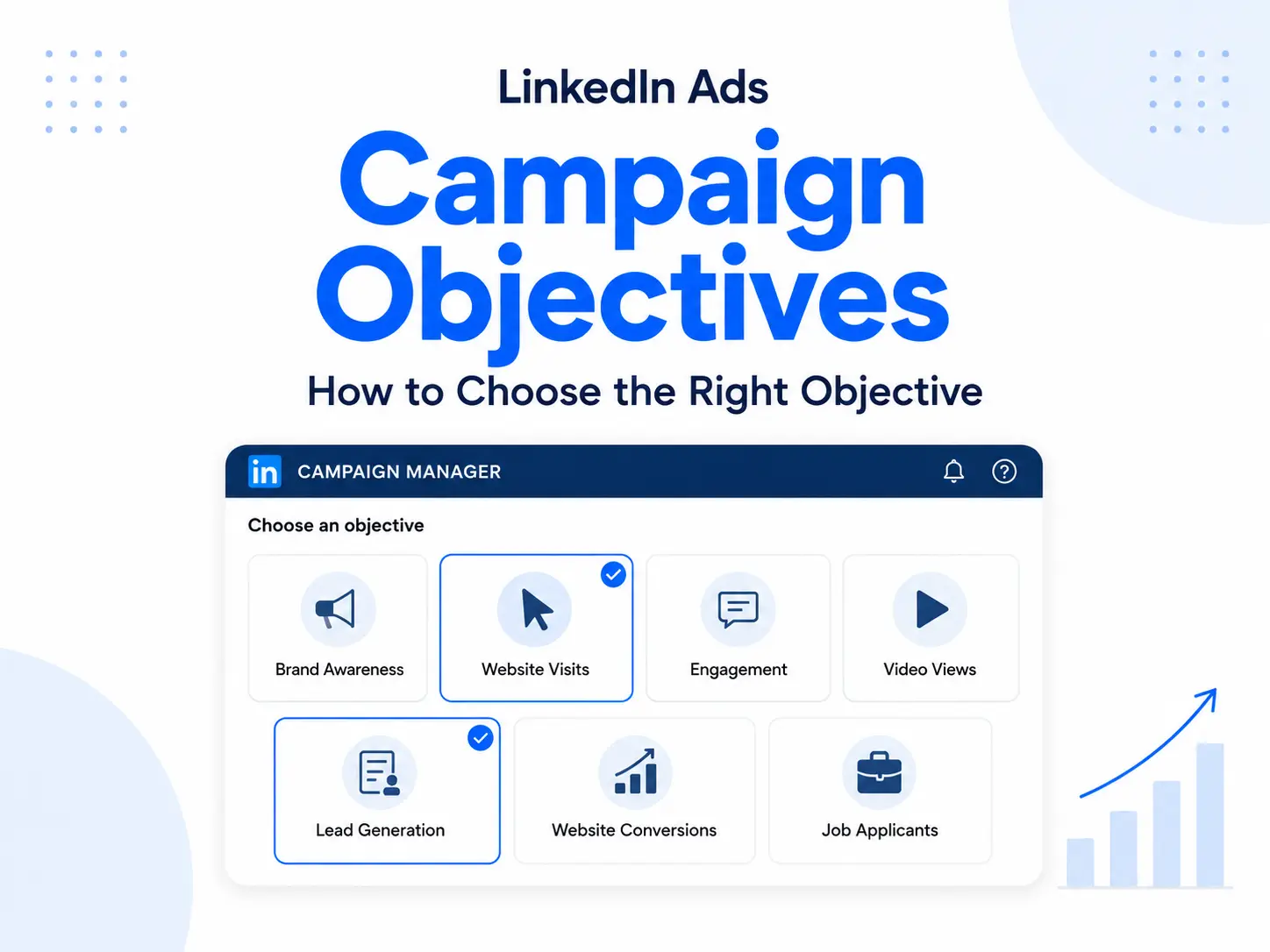
Choosing a LinkedIn Ads campaign objective can look like a routine setup decision. In reality, it tells LinkedIn what result to pursue, influences which people within your audience are most likely to receive the adverts and determines which ad formats, optimisation goals and bidding options are available.
That makes the objective more than a label for reporting. Select website visits, and LinkedIn will prioritise people who are more likely to click through. Select video views, and it will look for people more likely to watch. Select lead generation, and delivery can focus on people more likely to submit a native Lead Gen Form. These users may all fit the same professional targeting, but their predicted behaviour is not necessarily the same.
The right objective therefore starts with the business outcome, not the metric that appears easiest or cheapest to generate. A B2B company does not ultimately need impressions, clicks or even form submissions. It needs suitable prospects to become qualified leads, sales opportunities and profitable customers.
This guide explains the current LinkedIn campaign objectives, when to use each one, when not to use it and how to connect platform optimisation with CRM outcomes and revenue.
What Is a LinkedIn Ads Campaign Objective?
A LinkedIn Ads objective defines the primary result an ad set is intended to produce. LinkedIn groups its marketing objectives into three broad funnel stages:
-
Brand awareness
-
Consideration
-
Conversions
Within those stages, advertisers can choose from Brand Awareness, Website Visits, Engagement, Video Views, Lead Generation and Website Conversions. LinkedIn also provides Job Applicants and Talent Leads objectives for recruitment use cases.
LinkedIn’s current objective guidance confirms that an objective affects the marketing goal and recommended optimisation goal. It also affects which formats and bid strategies are available. Our wider LinkedIn Ads campaign setup guide explains where this decision fits within the full account-building process.
An objective should answer a precise question:
What is the most valuable action LinkedIn can realistically optimise towards at the current stage of this campaign?
The word “realistically” matters. A sales objective may be commercially desirable, but an advertising platform cannot learn directly from closed revenue if that outcome is not tracked, shared back or generated frequently enough. In that situation, the advertiser needs to select the closest meaningful action with sufficient data while continuing to assess deeper outcomes in the CRM.
LinkedIn Campaign Objectives at a Glance
The following comparison covers the main marketing objectives available in Campaign Manager.
| Funnel stage | Objective | Default or recommended focus | Best suited to | Main risk |
|---|---|---|---|---|
| Awareness | Brand Awareness | Reach | Increasing exposure within a defined market | Mistaking cheap reach for commercial impact |
| Consideration | Website Visits | Landing-page clicks | Sending relevant users to a website or landing page | Optimising for traffic rather than outcomes |
| Consideration | Engagement | Engagement clicks | Increasing interaction, follows and social proof | Attracting low-value reactions and clicks |
| Consideration | Video Views | Video views | Education, demonstrations and retargeting-pool development | Measuring views without message retention or progression |
| Conversions | Lead Generation | Leads or qualified leads | Capturing prospects through LinkedIn Lead Gen Forms | Low-friction but low-intent submissions |
| Conversions | Website Conversions | Website conversions | Enquiries, trials, bookings, purchases and other site actions | Weak learning caused by poor tracking or insufficient volume |
| Conversions | Job Applicants | Landing-page clicks | Promoting relevant vacancies | Optimising traffic without assessing applicant quality |
| Conversions | Talent Leads | Talent leads | Candidate interest capture for eligible Recruiter customers | Specialist availability and recruitment-only use |
This table is a decision aid, not a universal ranking. A Website Visits campaign is not inferior to a Website Conversions campaign if its genuine purpose is to distribute research to a cold buying committee. Equally, a conversion objective is not automatically effective simply because it sits nearer the bottom of the funnel.
Brand Awareness Objective
Brand Awareness is designed to expose a message to more people within the selected audience. LinkedIn normally optimises this objective towards reach or impressions, depending on the campaign configuration.
It is most useful when the immediate goal is to increase recognition before asking for a substantial action. Typical use cases include:
-
Entering a new market or sector
-
Launching a company, product or service
-
Repositioning a brand
-
Reaching a target-account list before sales outreach
-
Introducing a complex category or unfamiliar problem
-
Promoting research or a distinctive point of view
-
Building familiarity across a B2B buying committee
LinkedIn is often well suited to targeted awareness because the audience can be defined using professional and company attributes. A campaign could, for example, focus on finance leaders in selected industries or senior decision-makers within named accounts rather than buying broad consumer reach.
However, professional targeting does not prove that the advertising changed anyone’s perception. Reach only shows that the platform delivered adverts to member accounts. It does not establish attention, recall, consideration or future revenue.
Measure Brand Awareness with a combination of:
-
Unique reach and frequency
-
Cost per 1,000 members reached
-
Video completion or content interaction where relevant
-
Branded search and direct-traffic trends
-
Engagement from target accounts
-
Website visits from the intended professional segments
-
Retargeting-audience growth
-
Brand studies where budget and audience size justify them
-
Later pipeline influence, interpreted with appropriate caution
Do not use awareness as a vague destination for budget that cannot be commercially explained. Define the exact market, message and next signal before launch.
Website Visits Objective
Website Visits is designed to send people to a website, landing page or other URL. LinkedIn’s default optimisation goal is landing-page clicks, and delivery is biased towards members likely to click through.
This objective can make sense when visiting the destination is itself the immediate goal, such as:
-
Reading original research or a detailed guide
-
Viewing a product, service or industry page
-
Exploring a comparison or buyers’ guide
-
Visiting a case study
-
Reviewing an event or webinar page
-
Building a website-retargeting audience
-
Testing whether a message creates sufficient interest before conversion volume exists
Website Visits can also provide a useful controlled starting point when a new account has no reliable conversion history. It should not, however, become the permanent default simply because it generates more data quickly.
The platform is being asked to find likely clickers, not necessarily likely buyers. A high click-through rate can coexist with poor engagement, weak conversion rates and no qualified pipeline. Some audiences are naturally curious or responsive to content without being commercially suitable.
Use the LinkedIn Insight Tag and conversion tracking even when Website Visits is the selected objective. Review:
-
Landing-page sessions rather than all platform clicks
-
Engaged visits and meaningful page depth
-
Conversion rate by audience and advert
-
Cost per website conversion
-
Assisted journeys
-
Qualified leads and opportunities in the CRM
If meaningful conversions become frequent enough and the campaign’s real purpose is direct response, test or migrate to Website Conversions rather than continuing to optimise primarily for traffic.
Engagement Objective
Engagement campaigns are intended to increase interactions such as reactions, comments, shares, follows and clicks to a landing page or LinkedIn Page. The default optimisation goal is engagement clicks.
The objective can be useful for:
-
Distributing high-quality thought leadership
-
Building social proof around a strong company post
-
Promoting eligible employee or expert content through Thought Leader Ads
-
Increasing relevant Page followers
-
Supporting event or newsletter visibility
-
Building audiences for later engagement retargeting
-
Starting a credible discussion within a tightly defined professional community
The strongest engagement campaigns usually begin with content that deserves interaction. Paying to promote a generic corporate announcement rarely turns it into useful thought leadership.
Engagement can also be deceptive. LinkedIn may generate the behaviour requested without producing buying intent. Reactions from peers, jobseekers, competitors or people outside the real buying committee can make a campaign look active while delivering little commercial value.
Before using this objective, define what a valuable interaction looks like. A substantive comment from a target-account decision-maker is different from a lightweight reaction. A relevant new follower is more valuable than a click caused by curiosity. A document interaction may support education, but it does not automatically indicate an active purchase requirement.
Where commercial outcomes matter, connect engagement to a broader journey. Create relevant retargeting segments, exclude audiences that no longer fit the message and use follow-up campaigns to offer a logical next step. Our LinkedIn Matched Audiences guide explains how first-party and engagement signals can support that structure.
Video Views Objective
Video Views optimises delivery towards members likely to view video content. Video is the only advertising format available under this objective, although the precise bidding options can depend on the configuration.
This objective works best when the video itself performs a valuable communication job, for example:
-
Explaining a complex business problem
-
Demonstrating software, equipment or a process
-
Introducing a new category or service
-
Presenting customer evidence
-
Communicating a founder or expert viewpoint
-
Promoting an event or product launch
-
Creating retargeting segments based on viewing depth
The mistake is to treat a video view as proof that someone understood or remembered the message. A cheap view can still be commercially worthless. The opening must identify the subject quickly, the creative should work without sound and the content should reward continued attention.
Review viewing depth, completion rate, audience quality and subsequent behaviour—not just the headline cost per view. People who watch a substantial proportion of a relevant demonstration may form a stronger retargeting audience than people who received an impression or watched only the opening seconds.
Video Views is not always required merely because the advert is a video. If the actual goal is website conversion or lead capture, a video advert may be available under the corresponding conversion objective. Choose the objective based on the required action, then select the format.
Lead Generation Objective
Lead Generation uses native LinkedIn Lead Gen Forms to capture prospect information without requiring the member to complete a form on an external landing page. Eligible profile fields can be pre-filled, reducing friction, particularly on mobile devices.
The objective is a strong candidate for:
-
Demonstration or consultation requests
-
Audit and assessment offers
-
Webinar and event registrations
-
Reports, guides and research downloads
-
Product trials
-
Quote or information requests
-
Carefully targeted account-based campaigns
Native forms can produce a smoother experience and more submissions than a weak external landing page. That does not make every submission a qualified lead. Low friction can increase volume while reducing intent, especially when targeting is broad, the offer is generic or the form asks almost nothing that confirms suitability.
Leads Versus Qualified-Lead Optimisation
LinkedIn can optimise Lead Generation campaigns towards native leads. For eligible campaigns with appropriate qualified-lead data supplied through Conversions API, a supported partner or another available method, LinkedIn also offers qualified-lead optimisation.
This is an important development because two people who submit the same form can have very different commercial value. One may match the target market, book a meeting and become an opportunity. The other may use outdated profile details, misunderstand the offer or fall outside the service area.
Qualified-lead optimisation is directionally better aligned with business value, but it is not magic. Its performance depends on:
-
A clear and consistently applied qualified-lead definition
-
Accurate CRM stage management
-
Reliable and timely event sharing
-
Enough outcome data to support learning
-
Appropriate consent, privacy and data governance
-
Campaign and format eligibility
Do not automatically accept a platform-defined recommendation as evidence that a campaign will improve. Validate results using cost per qualified lead, opportunity rate, cost per opportunity, customer acquisition cost and revenue.
Website Conversions Objective
Website Conversions is intended to drive valuable actions on an advertiser’s website. Conversion tracking must be enabled to use the objective, and website conversions are normally the default optimisation goal.
Suitable conversion actions include:
-
Contact or enquiry form submissions
-
Demonstration and consultation bookings
-
Quote requests
-
Trial or account registrations
-
Applications
-
Purchases or subscriptions
-
High-intent content requests
This is often the most appropriate direct-response objective when the website experience needs to educate, qualify or route prospects before they enquire. It offers more control than a native form over page design, supporting evidence, form logic, analytics and conversion-rate optimisation.
However, Website Conversions is only as good as the signal attached to it. Common problems include:
-
Tracking a page view or button click as if it were a completed enquiry
-
Counting duplicate actions
-
Combining high- and low-value conversions indiscriminately
-
Optimising towards a very rare event with insufficient data
-
Failing to account for consent and browser limitations
-
Treating every form submission as equally valuable
-
Ignoring telephone, offline and CRM outcomes
Install and verify the Insight Tag, define conversion actions carefully and use consistent URL tracking parameters. Where appropriate, complement browser-based tracking with supported server-side or CRM event sharing. LinkedIn’s own conversion tracking documentation explains the available measurement foundations, but implementation should still be tested independently.
The website should also match the advert. Message continuity, mobile performance, credible proof, a clear call to action and proportionate form friction all influence conversion rate. Automated delivery cannot repair a poor offer or landing page.
Job Applicants and Talent Leads Objectives
Job Applicants is designed to promote relevant opportunities and encourage people to visit or apply for vacancies. Talent Leads is a more specialised objective for capturing candidate interest and is only available to companies with an active LinkedIn Recruiter contract.
These objectives belong to recruitment strategy rather than normal B2B demand generation. Their presence in the conversion category does not mean they should be used for selling products or services.
Recruitment teams should also avoid judging performance only by clicks, applications or cost per applicant. Useful downstream measures include:
-
Suitable applicant rate
-
Cost per qualified applicant
-
Interview rate
-
Offer rate
-
Cost per hire
-
Time to hire
-
Retention and role performance where responsibly measurable
The same principle applies as in lead generation: platform volume is an intermediate result, not the final business outcome.
Lead Generation or Website Conversions?
For many B2B advertisers, the most important objective decision is whether to capture leads within LinkedIn or send prospects to a website.
| Consideration | Lead Generation | Website Conversions |
| Form location | Inside LinkedIn | On the advertiser’s website |
| Friction | Usually lower | Depends on page and form design |
| Design control | Limited | Extensive |
| Pre-filled professional data | Available for eligible fields | Usually entered or enriched separately |
| Education before submission | More restricted | Greater scope for proof and detail |
| Complex qualification | Limited | More flexible |
| Website analytics | Reduced before submission | More complete on-site journey |
| Main quality risk | Easy, low-intent submissions | Page friction suppressing genuine demand |
Use Lead Generation when convenience and native mobile capture are important, the offer can be understood within the advert and form, and the CRM can respond quickly. Use Website Conversions when prospects need more detail, proof, comparison or qualification before taking action.
Do not decide using cost per lead alone. Run a controlled comparison where practical and assess:
-
Valid contact rate
-
Marketing-qualified and sales-qualified lead rate
-
Meeting-booked and meeting-attended rate
-
Opportunity rate
-
Average pipeline value
-
Customer acquisition cost
-
Revenue and profitability
A £100 lead that becomes an opportunity can be far more valuable than a £30 lead that sales cannot contact or qualify.
How to Choose the Right LinkedIn Ads Objective
Use the following process before building the ad set.
1. Define the Business Outcome
Start with the commercial result: awareness within named accounts, engaged prospects, qualified leads, opportunities, purchases or hires. Avoid beginning with an available Campaign Manager metric.
2. Identify the Immediate User Action
Determine what the audience should realistically do after seeing the advert. A cold prospect may need to watch, read or visit before requesting a demonstration. A retargeted high-intent visitor may be ready to enquire.
3. Select the Closest Meaningful Optimisation Signal
Choose the objective that most closely represents that action. Do not optimise for engagement when the campaign is expected to generate enquiries, or for traffic when sufficient conversion data is already available and the commercial goal is direct response.
4. Check Tracking and Data Volume
Confirm that the selected result can be measured accurately and produced often enough to inform decisions. If deep outcomes are scarce, optimise towards a higher-volume but still meaningful action while using the deeper outcome for CRM reporting and manual evaluation.
5. Confirm Format Compatibility
Objective selection changes the formats available. Review the current combinations in Campaign Manager and use our LinkedIn Ads formats guide to choose a format suited to the message. Do not reverse the strategy by selecting an objective simply to unlock a favourite format.
6. Define Success Before Launch
Set primary, diagnostic and commercial KPIs. For example, a Lead Generation campaign might use leads as the platform result, cost per qualified lead as the principal quality measure and cost per opportunity as the commercial KPI.
Build Objectives Around the Full B2B Funnel
Not every business needs to run all funnel stages simultaneously. Smaller budgets are often diluted by too many objectives, audiences and adverts. Concentrating spend on the most valuable reachable stage can produce clearer learning.
Where the audience is sufficiently large and the sales cycle justifies a full-funnel approach, objectives can work together:
-
Brand Awareness introduces the problem, point of view or proposition.
-
Video Views or Engagement develops attention and creates retargeting signals.
-
Website Visits supports deeper education and comparison.
-
Lead Generation or Website Conversions captures active demand.
-
CRM and offline events reveal which leads become opportunities and customers.
Audience design is central to this progression. Broad cold audiences, named accounts, website visitors, content engagers, known leads and existing customers should not automatically receive the same proposition. See our LinkedIn Ads targeting guide for a detailed approach to professional, account and first-party audiences.
Connect Campaign Objectives to CRM Outcomes
The advertising objective should be connected to the business’s lifecycle stages. Otherwise, LinkedIn may optimise towards the top of a funnel that the advertiser never evaluates properly.
A practical B2B measurement structure could include:
-
Lead created
-
Valid lead
-
Marketing-qualified lead
-
Sales-qualified lead
-
Meeting booked
-
Meeting attended
-
Sales opportunity created
-
Proposal issued
-
Customer won
-
Revenue recorded
The exact stages should reflect the real sales process, with clear entry criteria. Avoid using tags or vague status labels as a substitute for reliable lifecycle fields and opportunity stages.
A LinkedIn Ads CRM integration can support lead delivery, source preservation, audience activation and closed-loop reporting. Where technically and legally appropriate, LinkedIn offline conversion tracking can help associate later outcomes with advertising activity.
CRM data must still be treated critically. Missing updates, inconsistent qualification and duplicate records can send misleading signals back to the platform. Automation improves speed and consistency, but it does not repair an unclear process definition.
Common LinkedIn Objective Mistakes
Choosing Website Visits for Every Campaign
Traffic is easy to understand and often generates data faster than conversions. It can therefore become a habitual choice. If the real requirement is qualified enquiries, this can train delivery towards likely clickers rather than likely converters.
Selecting Engagement to Obtain Cheap Results
Low-cost reactions can make reports look positive without supporting pipeline. Engagement should have a defined strategic role, such as thought-leadership distribution, follower development or retargeting-pool creation.
Using Brand Awareness Without a Measurement Plan
Awareness is not an excuse to abandon accountability. Define the target market, frequency range, message, attention indicators and later commercial signals.
Treating All Leads as Equal
Lead volume and lead quality are different metrics. Native forms can reduce friction, while website forms can provide more qualification context. Compare both using downstream CRM outcomes.
Optimising Towards the Deepest Event Too Soon
The closest event to revenue is not always the best initial optimisation event if it occurs too infrequently or arrives after a long delay. Use the deepest reliable signal that can support learning and retain later outcomes for evaluation.
Allowing the Desired Format to Dictate the Objective
The format should communicate the message; the objective should reflect the action. If a format is unavailable, reconsider the creative route instead of choosing a strategically incorrect objective merely to unlock it.
Accepting Platform Recommendations Without Independent Validation
LinkedIn has an incentive to improve advertiser results, but it is also an advertising platform. Recommendations about expansion, automated delivery, budgets or optimisation should be treated as hypotheses and assessed against lead quality, opportunity creation and profitability.
Measuring Performance by Objective
Each objective needs an appropriate measurement hierarchy.
| Objective | Primary platform indicators | Stronger business indicators |
| Brand Awareness | Reach, frequency, cost per 1,000 reached | Target-account engagement, brand demand, influenced pipeline |
| Website Visits | Landing-page clicks, click-through rate, cost per click | Engaged sessions, conversions, qualified leads and opportunities |
| Engagement | Engagements, engagement rate, follows | Relevant audience interaction, retargeting progression, pipeline influence |
| Video Views | Views, completion rate, cost per view | High-intent viewing segments, site visits, leads and opportunities |
| Lead Generation | Leads, form completion rate, cost per lead | Valid leads, qualified leads, opportunities, customers and revenue |
| Website Conversions | Conversions, conversion rate, cost per conversion | Qualified pipeline, customer acquisition cost, revenue and profit |
Platform metrics remain valuable for diagnosing delivery, creative and audience response. They become dangerous only when they are presented as final commercial outcomes.
Frequently Asked Questions About LinkedIn Campaign Objectives
Can You Change a LinkedIn Campaign Objective After Launch?
Treat the objective as a foundational setup choice. If the strategy changes, creating a new ad set with the correct objective is generally cleaner than attempting to repurpose an existing structure. This also preserves reporting clarity and avoids mixing results produced under different delivery goals.
Which LinkedIn Objective Is Best for B2B Lead Generation?
Lead Generation and Website Conversions are usually the principal direct-response choices. Lead Generation is suited to native LinkedIn forms; Website Conversions is suited to actions on your website. The better option is the one that produces qualified pipeline efficiently, not necessarily the lowest initial cost per lead.
Should a New Campaign Start with Website Visits Before Conversions?
Not automatically. If conversion tracking is reliable and the account can produce enough meaningful actions, Website Conversions may be appropriate from launch. Website Visits can be useful when the genuine goal is content consumption or when conversion evidence is extremely limited, but it should not be treated as a mandatory preliminary stage.
Is Brand Awareness a Waste of Budget?
No, but poorly defined awareness can be. It can be valuable for narrow B2B markets, new propositions and account-based programmes where buyers need familiarity before acting. It requires a defined audience, message, frequency approach and measurement plan.
Can LinkedIn Optimise for Qualified Leads?
LinkedIn offers qualified-lead optimisation for eligible Lead Generation campaigns when suitable qualified-lead data is available. Results depend on accurate definitions, reliable data transfer, sufficient outcome volume and campaign eligibility. Always verify performance using CRM evidence.
Does the Objective Affect Available Ad Formats?
Yes. LinkedIn only surfaces formats, bid strategies and optimisation goals compatible with the selected objective and configuration. Availability can change, so check Campaign Manager before finalising the creative plan.
Final Thoughts
The best LinkedIn campaign objective is not the one that produces the cheapest visible metric. It is the objective that gives the platform the clearest useful instruction while keeping optimisation connected to the business outcome.
Begin with the commercial goal, identify the next realistic action and choose the closest reliable signal. Use Brand Awareness for targeted exposure, Website Visits for purposeful traffic, Engagement for meaningful interaction, Video Views for attention and education, Lead Generation for native form capture, and Website Conversions for valuable actions on your site.
Most importantly, do not stop measurement at the platform conversion. Connect campaigns to CRM stages, qualified leads, sales opportunities, customers and revenue. That is how campaign objectives become part of a commercial growth system rather than a collection of advertising metrics.
If you need help selecting objectives, structuring audiences, implementing tracking or improving lead quality, One PPC provides LinkedIn Ads management focused on measurable B2B performance.